






 8QYK
8QYK
Zorya anti-bacteriophage defense system ZorAB, ZorA delta_359-592, ZorA tail middle deletion.
8QYK の概要
| エントリーDOI | 10.2210/pdb8qyk/pdb |
| EMDBエントリー | 18756 |
| 分子名称 | Anti-phage defense ZorAB system ZorA, Membrane protein, CARDIOLIPIN, ... (6 entities in total) |
| 機能のキーワード | nuclease, antiviral protein |
| 由来する生物種 | Escherichia coli 詳細 |
| タンパク質・核酸の鎖数 | 7 |
| 化学式量合計 | 341746.51 |
| 構造登録者 | |
| 主引用文献 | Hu, H.,Popp, P.F.,Hughes, T.C.D.,Roa-Eguiara, A.,Rutbeek, N.R.,Martin, F.J.O.,Hendriks, I.A.,Payne, L.J.,Yan, Y.,Humolli, D.,Klein-Sousa, V.,Songailiene, I.,Wang, Y.,Nielsen, M.L.,Berry, R.M.,Harms, A.,Erhardt, M.,Jackson, S.A.,Taylor, N.M.I. Structure and mechanism of the Zorya anti-phage defence system. Nature, 639:1093-1101, 2025 Cited by PubMed Abstract: Zorya is a recently identified and widely distributed bacterial immune system that protects bacteria from viral (phage) infections. Three Zorya subtypes have been identified, each containing predicted membrane-embedded ZorA-ZorB (ZorAB) complexes paired with soluble subunits that differ among Zorya subtypes, notably ZorC and ZorD in type I Zorya systems. Here we investigate the molecular basis of Zorya defence using cryo-electron microscopy, mutagenesis, fluorescence microscopy, proteomics and functional studies. We present cryo-electron microscopy structures of ZorAB and show that it shares stoichiometry and features of other 5:2 inner membrane ion-driven rotary motors. The ZorAB complex contains a dimeric ZorB peptidoglycan-binding domain and a pentameric α-helical coiled-coil tail made of ZorA that projects approximately 70 nm into the cytoplasm. We also characterize the structure and function of the soluble Zorya components ZorC and ZorD, finding that they have DNA-binding and nuclease activity, respectively. Comprehensive functional and mutational analyses demonstrate that all Zorya components work in concert to protect bacterial cells against invading phages. We provide evidence that ZorAB operates as a proton-driven motor that becomes activated after sensing of phage invasion. Subsequently, ZorAB transfers the phage invasion signal through the ZorA cytoplasmic tail to recruit and activate the soluble ZorC and ZorD effectors, which facilitate the degradation of the phage DNA. In summary, our study elucidates the foundational mechanisms of Zorya function as an anti-phage defence system. PubMed: 39662505DOI: 10.1038/s41586-024-08493-8 主引用文献が同じPDBエントリー |
| 実験手法 | ELECTRON MICROSCOPY (2.07 Å) |
構造検証レポート
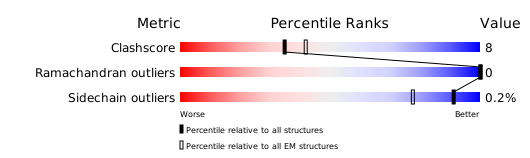
検証レポート(詳細版) をダウンロード
をダウンロード


