






 8QO7
8QO7
OPR3 variant R283E in complex with NADPH4
Summary for 8QO7
| Entry DOI | 10.2210/pdb8qo7/pdb |
| Related | 8QMX 8QN1 8QN3 8QN9 8QNA 8QNE 8QNK 8QNM 8QNP 8QNW 8QNX 8QNY 8QO6 |
| Descriptor | 12-oxophytodienoate reductase 3, FLAVIN MONONUCLEOTIDE, [[(2R,3S,4R,5R)-5-(5-aminocarbonyl-3,4-dihydro-2H-pyridin-1-yl)-3,4-bis(oxidanyl)oxolan-2-yl]methoxy-oxidanyl-phosphoryl] [(2R,3R,4R,5R)-5-(6-aminopurin-9-yl)-3-oxidanyl-4-phosphonooxy-oxolan-2-yl]methyl hydrogen phosphate, ... (5 entities in total) |
| Functional Keywords | old yellow enzyme, ene-reductase, flavoenzyme, nadph, flavoprotein |
| Biological source | Solanum lycopersicum (tomato) |
| Total number of polymer chains | 1 |
| Total formula weight | 46420.40 |
| Authors | Bijelic, A.,Macheroux, P.,Kerschbaumer, B. (deposition date: 2023-09-28, release date: 2025-04-09, Last modification date: 2026-03-25) |
| Primary citation | Kerschbaumer, B.,Friesser, E.M.,Wallner, S.,Oberdorfer, G.,Friess, M.,Breinbauer, R.,Macheroux, P.,Bijelic, A. Structural and evolutionary dissection of NADPH-binding motifs in NADPH-preferring ene-reductases. Protein Sci., 35:e70521-e70521, 2026 Cited by PubMed Abstract: Ene-reductases (ERs) catalyze nicotinamide-dependent, stereoselective reductions of activated CC bonds. While their catalytic chemistry and applications are well-explored, cosubstrate (NAD(P)H) binding remains poorly understood. Most ERs strongly prefer NADPH despite lacking canonical dinucleotide-binding folds and instead employ flexible loop motifs. We recently elucidated the NADPH-binding mode of the NADPH-preferring ER Solanum lycopersicum OPR3 (SlOPR3), identifying four key residues (R283/R343/Y364/R366) that form two motifs: a 2'-phosphate (2'-P)-binding site (R343/Y364/R366) and a loop 6 (L6)-mediated adenine clamp (R283/R343). Guided by this model, we analyzed the conservation of these motifs across 51 NADPH-preferring ERs from different Old Yellow Enzyme (OYE) classes by multi-sequence alignment and homology modeling. Analyses revealed a class-dependent distribution: class-II ERs predominantly conserve the OPR3-like motifs, whereas other classes employ alternative mechanisms, including dimerization-induced modes. Functional dissection of SlOPR3 through mutagenesis, kinetics, and crystallography established a functional hierarchy of the motif elements, indicating that R343 and R366 are indispensable for NADPH binding in OPR3-like ERs, while the adenine clamp acts as a conformation-sensitive affinity tuner. Ancestral sequence reconstruction revealed the stepwise and convergent assembly of motif elements, culminating in the complete motif set in plant, fungal, and cyanobacterial lineages. Our findings delineate (i) a strict functional hierarchy of NADPH-binding residues in OPR3-like ERs, (ii) alternative binding solutions in other OYE classes, and (iii) a convergent evolutionary trajectory, advancing the fundamental understanding of NADPH binding in NADPH-preferring ERs and offering a modular framework to predict NADPH preference in ERs. PubMed: 41848427DOI: 10.1002/pro.70521 PDB entries with the same primary citation |
| Experimental method | X-RAY DIFFRACTION (1.4 Å) |
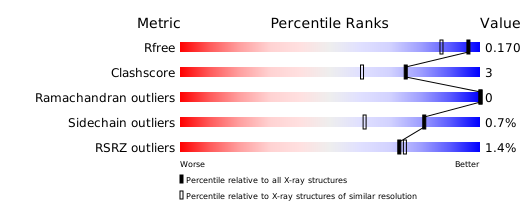
Structure validation
Download full validation report


