






 8QNA
8QNA
OPR3 variant - R366A
8QNA の概要
| エントリーDOI | 10.2210/pdb8qna/pdb |
| 関連するPDBエントリー | 8QMX 8QN1 8QN3 8QN9 |
| 分子名称 | 12-oxophytodienoate reductase 3, FLAVIN MONONUCLEOTIDE, NADP NICOTINAMIDE-ADENINE-DINUCLEOTIDE PHOSPHATE, ... (5 entities in total) |
| 機能のキーワード | old yellow enzyme, ene-reductase, flavoenzyme, oxidoreductase, flavoprotein |
| 由来する生物種 | Solanum lycopersicum (tomato) |
| タンパク質・核酸の鎖数 | 1 |
| 化学式量合計 | 45610.90 |
| 構造登録者 | |
| 主引用文献 | Kerschbaumer, B.,Friesser, E.M.,Wallner, S.,Oberdorfer, G.,Friess, M.,Breinbauer, R.,Macheroux, P.,Bijelic, A. Structural and evolutionary dissection of NADPH-binding motifs in NADPH-preferring ene-reductases. Protein Sci., 35:e70521-e70521, 2026 Cited by PubMed Abstract: Ene-reductases (ERs) catalyze nicotinamide-dependent, stereoselective reductions of activated CC bonds. While their catalytic chemistry and applications are well-explored, cosubstrate (NAD(P)H) binding remains poorly understood. Most ERs strongly prefer NADPH despite lacking canonical dinucleotide-binding folds and instead employ flexible loop motifs. We recently elucidated the NADPH-binding mode of the NADPH-preferring ER Solanum lycopersicum OPR3 (SlOPR3), identifying four key residues (R283/R343/Y364/R366) that form two motifs: a 2'-phosphate (2'-P)-binding site (R343/Y364/R366) and a loop 6 (L6)-mediated adenine clamp (R283/R343). Guided by this model, we analyzed the conservation of these motifs across 51 NADPH-preferring ERs from different Old Yellow Enzyme (OYE) classes by multi-sequence alignment and homology modeling. Analyses revealed a class-dependent distribution: class-II ERs predominantly conserve the OPR3-like motifs, whereas other classes employ alternative mechanisms, including dimerization-induced modes. Functional dissection of SlOPR3 through mutagenesis, kinetics, and crystallography established a functional hierarchy of the motif elements, indicating that R343 and R366 are indispensable for NADPH binding in OPR3-like ERs, while the adenine clamp acts as a conformation-sensitive affinity tuner. Ancestral sequence reconstruction revealed the stepwise and convergent assembly of motif elements, culminating in the complete motif set in plant, fungal, and cyanobacterial lineages. Our findings delineate (i) a strict functional hierarchy of NADPH-binding residues in OPR3-like ERs, (ii) alternative binding solutions in other OYE classes, and (iii) a convergent evolutionary trajectory, advancing the fundamental understanding of NADPH binding in NADPH-preferring ERs and offering a modular framework to predict NADPH preference in ERs. PubMed: 41848427DOI: 10.1002/pro.70521 主引用文献が同じPDBエントリー |
| 実験手法 | X-RAY DIFFRACTION (1.5 Å) |
構造検証レポート
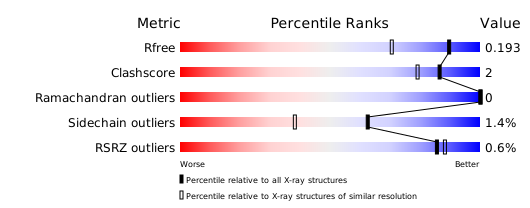
検証レポート(詳細版) をダウンロード
をダウンロード


