






 8JEF
8JEF
Cryo-EM Structure of the 3HO-HCAR3-Gi complex
8JEF の概要
| エントリーDOI | 10.2210/pdb8jef/pdb |
| EMDBエントリー | 36186 |
| 分子名称 | Hydroxycarboxylic acid receptor 3, Guanine nucleotide-binding protein G(i) subunit alpha-1, Guanine nucleotide-binding protein G(I)/G(S)/G(T) subunit beta-1, ... (6 entities in total) |
| 機能のキーワード | complex, membrane protein |
| 由来する生物種 | Homo sapiens (human) 詳細 |
| タンパク質・核酸の鎖数 | 5 |
| 化学式量合計 | 154471.20 |
| 構造登録者 | |
| 主引用文献 | Ye, F.,Pan, X.,Zhang, Z.,Xiang, X.,Li, X.,Zhang, B.,Ning, P.,Liu, A.,Wang, Q.,Gong, K.,Li, J.,Zhu, L.,Qian, C.,Chen, G.,Du, Y. Structural basis for ligand recognition of the human hydroxycarboxylic acid receptor HCAR3. Cell Rep, 43:114895-114895, 2024 Cited by PubMed Abstract: Hydroxycarboxylic acid receptor 3 (HCAR3), a class A G-protein-coupled receptor, is an important cellular energy metabolism sensor with a key role in the regulation of lipolysis in humans. HCAR3 is deeply involved in many physiological processes and serves as a valuable target for the treatment of metabolic diseases, tumors, and immune diseases. Here, we report four cryoelectron microscopy (cryo-EM) structures of human HCAR3-Gi1 complexes with or without agonists: the endogenous ligand 3-hydroxyoctanoic acid, the drug niacin, the highly subtype-specific agonist compound 5c (4-(n-propyl)amino-3-nitrobenzoic acid), and the apo form. Together with mutagenesis and functional analyses, we revealed the recognition mechanisms of HCAR3 for different agonists. In addition, the key residues that determine the ligand selectivity between HCAR2 and HCAR3 were also illuminated. Overall, these findings provide a structural basis for the ligand recognition, activation, and selectivity and G-protein coupling mechanisms of HCAR3, which contribute to the design of HCAR3-targeting drugs with high efficacy and selectivity. PubMed: 39427321DOI: 10.1016/j.celrep.2024.114895 主引用文献が同じPDBエントリー |
| 実験手法 | ELECTRON MICROSCOPY (2.96 Å) |
構造検証レポート
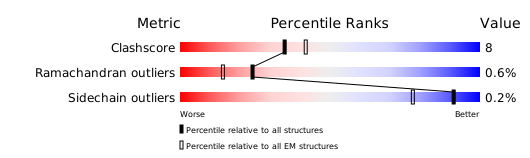
検証レポート(詳細版) をダウンロード
をダウンロード


