






8FTX
FlgN-FliJ fusion complex
8FTX の概要
| エントリーDOI | 10.2210/pdb8ftx/pdb |
| NMR情報 | BMRB: 31070 |
| 分子名称 | Flagella biosynthesis chaperone FlgN, Flagellar FliJ protein fusion (1 entity in total) |
| 機能のキーワード | chaperone-client complex, chaperone |
| 由来する生物種 | Salmonella enterica subsp. enterica serovar Typhimurium 詳細 |
| タンパク質・核酸の鎖数 | 1 |
| 化学式量合計 | 24116.90 |
| 構造登録者 | |
| 主引用文献 | Rossi, P.,Xing, Q.,Bini, E.,Portaliou, A.G.,Clay, M.C.,Warren, E.M.,Khanra, N.K.,Economou, A.,Kalodimos, C.G. Chaperone Recycling in Late-Stage Flagellar Assembly. J.Mol.Biol., 435:167954-167954, 2023 Cited by PubMed Abstract: The flagellum is a sophisticated nanomachine responsible for motility in Gram-negative bacteria. Flagellar assembly is a strictly choreographed process, in which the motor and export gate are formed first, followed by the extracellular propeller structure. Extracellular flagellar components are escorted to the export gate by dedicated molecular chaperones for secretion and self-assembly at the apex of the emerging structure. The detailed mechanisms of chaperone-substrate trafficking at the export gate remain poorly understood. Here, we structurally characterized the interaction of Salmonella enterica late-stage flagellar chaperones FliT and FlgN with the export controller protein FliJ. Previous studies showed that FliJ is absolutely required for flagellar assembly since its interaction with chaperone-client complexes controls substrate delivery to the export gate. Our biophysical and cell-based data show that FliT and FlgN bind FliJ cooperatively, with high affinity and on specific sites. Chaperone binding completely disrupts the FliJ coiled-coil structure and alters its interactions with the export gate. We propose that FliJ aids the release of substrates from the chaperone and forms the basis of chaperone recycling during late-stage flagellar assembly. PubMed: 37330284DOI: 10.1016/j.jmb.2023.167954 主引用文献が同じPDBエントリー |
| 実験手法 | SOLUTION NMR |
構造検証レポート
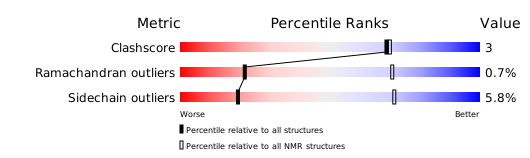
検証レポート(詳細版) をダウンロード
をダウンロード


