






 7VU7
7VU7
The Solution structure of the C-terminal domain from flagelliform spidroin
7VU7 の概要
| エントリーDOI | 10.2210/pdb7vu7/pdb |
| 分子名称 | Flagelliform fibroin (1 entity in total) |
| 機能のキーワード | flagelliform spidroin, ctd, structural protein |
| 由来する生物種 | Araneus ventricosus (Orbweaver spider, Epeira ventricosa) |
| タンパク質・核酸の鎖数 | 2 |
| 化学式量合計 | 22028.43 |
| 構造登録者 | |
| 主引用文献 | Li, X.,Fan, J.S.,Shi, M.,Lai, C.C.,Li, J.,Meng, Q.,Yang, D. C-Terminal Domains of Spider Silk Proteins Having Divergent Structures but Conserved Functional Roles. Biomacromolecules, 23:1643-1651, 2022 Cited by PubMed Abstract: Spider silk is self-assembled from silk proteins or spidroins. C-terminal domains (CTDs) of various types of spidroins are relatively conserved in amino acid sequences and are suggested to adopt similar structures and perform similar functional roles in spidroin storage and silk formation. Here, we solved the structure of the CTD from a capture-spiral silk protein (CTD) and characterized its stability and fibril formation in the presence and absence of a reducing agent at different pH values. CTD adopts a dimeric structure with 8 helices, but the CTDs of other types of spidroins exist in a domain-swapped dimeric structure with 10 helices. Despite the structural differences, CTD is pH-responsive in stability and fibril formation, similar to the CTDs from minor and major ampullate spidroins. Thus, the functional role of CTDs in silk fiber formation seems conserved. Comparing wild-type CTD and its mutants, we found that the pH-responsive behavior results from the protonation of H76, which is conserved from different spider species. In addition, the fibril formation rate of CTD correlates with its instability, suggesting that structural changes are involved in fibril formation. PubMed: 35312302DOI: 10.1021/acs.biomac.1c01513 主引用文献が同じPDBエントリー |
| 実験手法 | SOLUTION NMR |
構造検証レポート
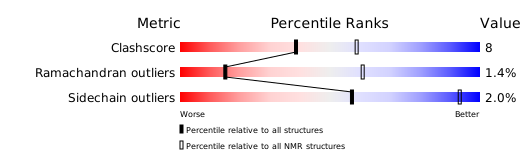
検証レポート(詳細版) をダウンロード
をダウンロード


