






7OR6
The crystal structure of the domain-swapped dimer of onconase
This is a non-PDB format compatible entry.
Summary for 7OR6
| Entry DOI | 10.2210/pdb7or6/pdb |
| Descriptor | Protein P-30 (2 entities in total) |
| Functional Keywords | ribonuclease; onconase; onconase dimer; 3d domain swapping; antitumor activity, hydrolase |
| Biological source | Lithobates pipiens (Northern leopard frog, Rana pipiens) |
| Total number of polymer chains | 2 |
| Total formula weight | 23947.55 |
| Authors | Merlino, A.,Loreto, D. (deposition date: 2021-06-04, release date: 2021-10-06, Last modification date: 2024-11-13) |
| Primary citation | Gotte, G.,Campagnari, R.,Loreto, D.,Bettin, I.,Calzetti, F.,Menegazzi, M.,Merlino, A. The crystal structure of the domain-swapped dimer of onconase highlights some catalytic and antitumor activity features of the enzyme. Int.J.Biol.Macromol., 191:560-571, 2021 Cited by PubMed Abstract: Onconase (ONC) is a monomeric amphibian "pancreatic-type" RNase endowed with remarkable anticancer activity. ONC spontaneously forms traces of a dimer (ONC-D) in solution, while larger amounts can be formed when ONC is lyophilized from mildly acidic solutions. Here, we report the crystal structure of ONC-D and analyze its catalytic and antitumor activities in comparison to ONC. ONC-D forms via the three-dimensional swapping of the N-terminal α-helix between two monomers, but it displays a significantly different quaternary structure from that previously modeled [Fagagnini A et al., 2017, Biochem J 474, 3767-81], and based on the crystal structure of the RNase A N-terminal swapped dimer. ONC-D presents a variable quaternary assembly deriving from a variable open interface, while it retains a catalytic activity that is similar to that of ONC. Notably, ONC-D displays antitumor activity against two human melanoma cell lines, although it exerts a slightly lower cytostatic effect than the monomer. The inhibition of melanoma cell proliferation by ONC or ONC-D is associated with the reduction of the expression of the anti-apoptotic B cell lymphoma 2 (Bcl2), as well as of the total expression and phosphorylation of the Signal Transducer and Activator of Transcription (STAT)-3. Phosphorylation is inhibited in both STAT3 Tyr705 and Ser727 key-residues, as well as in its upstream tyrosine-kinase Src. Consequently, both ONC species should exert their anti-cancer action by inhibiting the pro-tumor pleiotropic STAT3 effects deriving either by its phospho-tyrosine activation or by its non-canonical signaling pathways. Both ONC species, indeed, increase the portion of A375 cells undergoing apoptotic cell death. This study expands the variety of RNase domain-swapped dimeric structures, underlining the unpredictability of the open interface arrangement upon domain swapping. Structural data also offer valuable insights to analyze the differences in the measured ONC or ONC-D biological activities. PubMed: 34563576DOI: 10.1016/j.ijbiomac.2021.09.095 PDB entries with the same primary citation |
| Experimental method | X-RAY DIFFRACTION (2.12 Å) |
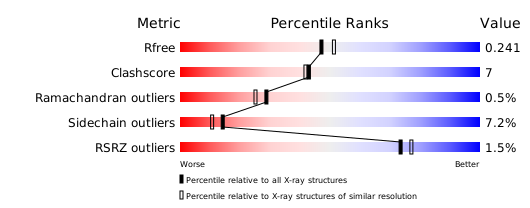
Structure validation
Download full validation report


