






 6PH2
6PH2
Complete LOV domain from the LOV-HK sensory protein from Brucella abortus (mutant C69S, construct 15-155)
6PH2 の概要
| エントリーDOI | 10.2210/pdb6ph2/pdb |
| 関連するPDBエントリー | 3T50 |
| 分子名称 | Blue-light-activated histidine kinase, FLAVIN MONONUCLEOTIDE (3 entities in total) |
| 機能のキーワード | pas superfamily, blue-light photoreceptor, fmn binding, transferase |
| 由来する生物種 | Brucella melitensis biotype 1 (strain 16M / ATCC 23456 / NCTC 10094) |
| タンパク質・核酸の鎖数 | 4 |
| 化学式量合計 | 68833.72 |
| 構造登録者 | Rinaldi, J.,Otero, L.H.,Fernandez, I.,Goldbaum, F.A.,Shin, H.,Yang, X.,Klinke, S. (登録日: 2019-06-25, 公開日: 2020-12-30, 最終更新日: 2023-10-11) |
| 主引用文献 | Rinaldi, J.,Fernandez, I.,Shin, H.,Sycz, G.,Gunawardana, S.,Kumarapperuma, I.,Paz, J.M.,Otero, L.H.,Cerutti, M.L.,Zorreguieta, A.,Ren, Z.,Klinke, S.,Yang, X.,Goldbaum, F.A. Dimer Asymmetry and Light Activation Mechanism in Brucella Blue-Light Sensor Histidine Kinase. Mbio, 12:-, 2021 Cited by PubMed Abstract: The ability to sense and respond to environmental cues is essential for adaptation and survival in living organisms. In bacteria, this process is accomplished by multidomain sensor histidine kinases that undergo autophosphorylation in response to specific stimuli, thereby triggering downstream signaling cascades. However, the molecular mechanism of allosteric activation is not fully understood in these important sensor proteins. Here, we report the full-length crystal structure of a blue light photoreceptor LOV histidine kinase (LOV-HK) involved in light-dependent virulence modulation in the pathogenic bacterium Joint analyses of dark and light structures determined in different signaling states have shown that LOV-HK transitions from a symmetric dark structure to a highly asymmetric light state. The initial local and subtle structural signal originated in the chromophore-binding LOV domain alters the dimer asymmetry via a coiled-coil rotary switch and helical bending in the helical spine. These amplified structural changes result in enhanced conformational flexibility and large-scale rearrangements that facilitate the phosphoryl transfer reaction in the HK domain. Bacteria employ two-component systems (TCSs) to sense and respond to changes in their surroundings. At the core of the TCS signaling pathway is the multidomain sensor histidine kinase, where the enzymatic activity of its output domain is allosterically controlled by the input signal perceived by the sensor domain. Here, we examine the structures and dynamics of a naturally occurring light-sensitive histidine kinase from the pathogen in both its full-length and its truncated constructs. Direct comparisons between the structures captured in different signaling states have revealed concerted protein motions in an asymmetric dimer framework in response to light. Findings of this work provide mechanistic insights into modular sensory proteins that share a similar modular architecture. PubMed: 33879593DOI: 10.1128/mBio.00264-21 主引用文献が同じPDBエントリー |
| 実験手法 | X-RAY DIFFRACTION (2.34 Å) |
構造検証レポート
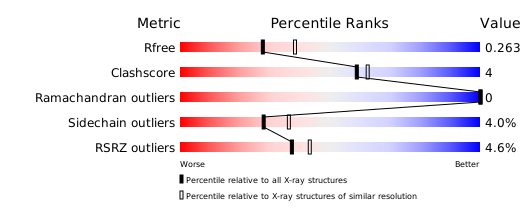
検証レポート(詳細版) をダウンロード
をダウンロード


