






6LBL
Crystal structure of IMP-1 metallo-beta-lactamase in complex with NO9 inhibitor
6LBL の概要
| エントリーDOI | 10.2210/pdb6lbl/pdb |
| 分子名称 | Metallo-beta-lactamase type 2, ZINC ION, SODIUM ION, ... (5 entities in total) |
| 機能のキーワード | metallo-beta-lactamase, hydrolase |
| 由来する生物種 | Serratia marcescens |
| タンパク質・核酸の鎖数 | 1 |
| 化学式量合計 | 25519.70 |
| 構造登録者 | |
| 主引用文献 | Wachino, J.I.,Jin, W.,Kimura, K.,Kurosaki, H.,Sato, A.,Arakawa, Y. Sulfamoyl Heteroarylcarboxylic Acids as Promising Metallo-beta-Lactamase Inhibitors for Controlling Bacterial Carbapenem Resistance. Mbio, 11:-, 2020 Cited by PubMed Abstract: Production of metallo-β-lactamases (MBLs), which hydrolyze carbapenems, is a cause of carbapenem resistance in Development of effective inhibitors for MBLs is one approach to restore carbapenem efficacy in carbapenem-resistant (CRE). We report here that sulfamoyl heteroarylcarboxylic acids (SHCs) can competitively inhibit the globally spreading and clinically relevant MBLs (i.e., IMP-, NDM-, and VIM-type MBLs) at nanomolar to micromolar orders of magnitude. Addition of SHCs restored meropenem efficacy against 17/19 IMP-type and 7/14 NDM-type MBL-producing to satisfactory clinical levels. SHCs were also effective against IMP-type MBL-producing spp. and engineered strains overproducing individual minor MBLs (i.e., TMB-2, SPM-1, DIM-1, SIM-1, and KHM-1). However, SHCs were less effective against MBL-producing Combination therapy with meropenem and SHCs successfully cured mice infected with IMP-1-producing and dually NDM-1/VIM-1-producing clinical isolates. X-ray crystallographic analyses revealed the inhibition mode of SHCs against MBLs; the sulfamoyl group of SHCs coordinated to two zinc ions, and the carboxylate group coordinated to one zinc ion and bound to positively charged amino acids Lys224/Arg228 conserved in MBLs. Preclinical testing revealed that the SHCs showed low toxicity in cell lines and mice and high stability in human liver microsomes. Our results indicate that SHCs are promising lead compounds for inhibitors of MBLs to combat MBL-producing CRE. Carbapenem antibiotics are the last resort for control of severe infectious diseases, bloodstream infections, and pneumonia caused by Gram-negative bacteria, including However, carbapenem-resistant (CRE) strains have spread globally and are a critical concern in clinical settings because CRE infections are recognized as a leading cause of increased mortality among hospitalized patients. Most CRE produce certain kinds of serine carbapenemases (e.g., KPC- and GES-type β-lactamases) or metallo-β-lactamases (MBLs), which can hydrolyze carbapenems. Although effective MBL inhibitors are expected to restore carbapenem efficacy against MBL-producing CRE, no MBL inhibitor is currently clinically available. Here, we synthesized 2,5-diethyl-1-methyl-4-sulfamoylpyrrole-3-carboxylic acid (SPC), which is a potent inhibitor of MBLs. SPC is a remarkable lead compound for clinically useful MBL inhibitors and can potentially provide a considerable benefit to patients receiving treatment for lethal infectious diseases caused by MBL-producing CRE. PubMed: 32184250DOI: 10.1128/mBio.03144-19 主引用文献が同じPDBエントリー |
| 実験手法 | X-RAY DIFFRACTION (1.68 Å) |
構造検証レポート
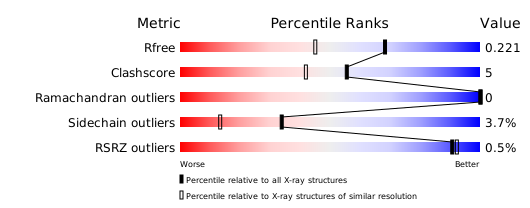
検証レポート(詳細版) をダウンロード
をダウンロード


