






6FT5
Structure of A3_A3, an artificial bi-domain protein based on two identical alphaRep A3 domains
6FT5 の概要
| エントリーDOI | 10.2210/pdb6ft5/pdb |
| 分子名称 | alphaRep A3_A3, GLYCEROL, SULFATE ION, ... (4 entities in total) |
| 機能のキーワード | alpharep, artificial protein, chimera, bidomain, biosynthetic protein |
| 由来する生物種 | synthetic construct |
| タンパク質・核酸の鎖数 | 1 |
| 化学式量合計 | 45365.76 |
| 構造登録者 | Li de la Sierra-Gallay, I.,Leger, C.,Di Meo, T. (登録日: 2018-02-20, 公開日: 2018-08-08, 最終更新日: 2024-01-17) |
| 主引用文献 | Leger, C.,Di Meo, T.,Aumont-Nicaise, M.,Velours, C.,Durand, D.,Li de la Sierra-Gallay, I.,van Tilbeurgh, H.,Hildebrandt, N.,Desmadril, M.,Urvoas, A.,Valerio-Lepiniec, M.,Minard, P. Ligand-induced conformational switch in an artificial bidomain protein scaffold. Sci Rep, 9:1178-1178, 2019 Cited by PubMed Abstract: Artificial proteins binding any predefined "target" protein can now be efficiently generated using combinatorial libraries based on robust protein scaffolds. αRep is such a family of artificial proteins, based on an α-solenoid protein repeat scaffold. The low aggregation propensity of the specific "binders" generated from this library opens new protein engineering opportunities such as the creation of biosensors within multidomain constructions. Here, we have explored the properties of two new types of artificial bidomain proteins based on αRep structures. Their structural and functional properties are characterized in detail using biophysical methods. The results clearly show that both bidomain proteins adopt a closed bivalve shell-like conformation, in the ligand free form. However, the presence of ligands induces a conformational transition, and the proteins adopt an open form in which each domain can bind its cognate protein partner. The open/closed equilibria alter the affinities of each domain and induce new cooperative effects. The binding-induced relative domain motion was monitored by FRET. Crystal structures of the chimeric proteins indicate that the conformation of each constituting domain is conserved but that their mutual interactions explain the emergent properties of these artificial bidomain proteins. The ligand-induced structural transition observed in these bidomain proteins should be transferable to other αRep proteins with different specificity and could provide the basis of a new generic biosensor design. PubMed: 30718544DOI: 10.1038/s41598-018-37256-5 主引用文献が同じPDBエントリー |
| 実験手法 | X-RAY DIFFRACTION (1.94 Å) |
構造検証レポート
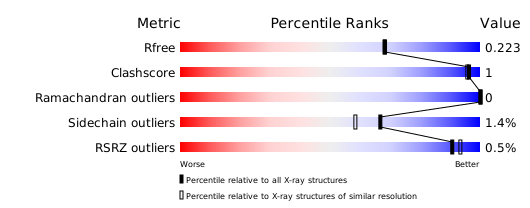
検証レポート(詳細版) をダウンロード
をダウンロード


