






 4IFF
4IFF
Structural organization of FtsB, a transmembrane protein of the bacterial divisome
4IFF の概要
| エントリーDOI | 10.2210/pdb4iff/pdb |
| 分子名称 | Fusion of phage phi29 Gp7 protein and Cell division protein FtsB, GLYCEROL (3 entities in total) |
| 機能のキーワード | bacterial division, ftsl, cell cycle |
| 由来する生物種 | Bacillus phage phi29 詳細 |
| 細胞内の位置 | Cell inner membrane ; Single-pass type II membrane protein : P0A6S5 |
| タンパク質・核酸の鎖数 | 4 |
| 化学式量合計 | 38741.97 |
| 構造登録者 | LaPointe, L.M.,Taylor, K.C.,Subramaniam, S.,Khadria, A.,Rayment, I.,Senes, A. (登録日: 2012-12-14, 公開日: 2013-04-10, 最終更新日: 2024-02-28) |
| 主引用文献 | Lapointe, L.M.,Taylor, K.C.,Subramaniam, S.,Khadria, A.,Rayment, I.,Senes, A. Structural Organization of FtsB, a Transmembrane Protein of the Bacterial Divisome. Biochemistry, 52:2574-2585, 2013 Cited by PubMed Abstract: We report the first structural analysis of an integral membrane protein of the bacterial divisome. FtsB is a single-pass membrane protein with a periplasmic coiled coil. Its heterologous association with its partner FtsL represents an essential event for the recruitment of the late components to the division site. Using a combination of mutagenesis, computational modeling, and X-ray crystallography, we determined that FtsB self-associates, and we investigated its structural organization. We found that the transmembrane domain of FtsB homo-oligomerizes through an evolutionarily conserved interaction interface where a polar residue (Gln 16) plays a critical role through the formation of an interhelical hydrogen bond. The crystal structure of the periplasmic domain, solved as a fusion with Gp7, shows that 30 juxta-membrane amino acids of FtsB form a canonical coiled coil. The presence of conserved Gly residue in the linker region suggests that flexibility between the transmembrane and coiled coil domains is functionally important. We hypothesize that the transmembrane helices of FtsB form a stable dimeric core for its association with FtsL into a higher-order oligomer and that FtsL is required to stabilize the periplasmic domain of FtsB, leading to the formation of a complex that is competent for binding to FtsQ, and to their consequent recruitment to the divisome. The study provides an experimentally validated structural model and identifies point mutations that disrupt association, thereby establishing important groundwork for the functional characterization of FtsB in vivo. PubMed: 23520975DOI: 10.1021/bi400222r 主引用文献が同じPDBエントリー |
| 実験手法 | X-RAY DIFFRACTION (2.3 Å) |
構造検証レポート
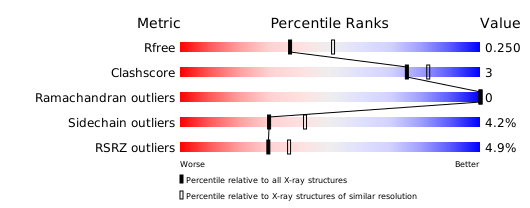
検証レポート(詳細版) をダウンロード
をダウンロード


