






 3UDS
3UDS
Inositol 1,3,4,5,6-pentakisphosphate 2-kinase from A. thaliana in complex with ADP.
3UDS の概要
| エントリーDOI | 10.2210/pdb3uds/pdb |
| 関連するPDBエントリー | 3UDT |
| 分子名称 | Inositol-pentakisphosphate 2-kinase, ADENOSINE-5'-DIPHOSPHATE, MAGNESIUM ION (3 entities in total) |
| 機能のキーワード | transferase, inositol, ipk, ins5p 2-k, atipk1, ip5 2-k, polyphosphate kinase |
| 由来する生物種 | Arabidopsis thaliana (mouse-ear cress,thale-cress) |
| タンパク質・核酸の鎖数 | 2 |
| 化学式量合計 | 111566.29 |
| 構造登録者 | Gosein, V.,Leung, T.-F.,Krajden, O.,Miller, G.J. (登録日: 2011-10-28, 公開日: 2012-03-14, 最終更新日: 2024-02-28) |
| 主引用文献 | Gosein, V.,Leung, T.F.,Krajden, O.,Miller, G.J. Inositol phosphate-induced stabilization of inositol 1,3,4,5,6-pentakisphosphate 2-kinase and its role in substrate specificity. Protein Sci., 21:737-742, 2012 Cited by PubMed Abstract: Inositol phosphate kinases (IPKs) sequentially phosphorylate inositol phosphates (IPs) on their inositol rings to yield an array of signaling molecules. IPKs must possess the ability to recognize their physiological substrates from among a pool of over 30 cellular IPs that differ in numbers and positions of phosphates. Crystal structures from IPK subfamilies have revealed structural determinants for IP discrimination, which vary considerably between IPKs. However, recent structures of inositol 1,3,4,5,6-pentakisphosphate 2-kinase (IPK1) did not reveal how IPK1 selectively recognizes its physiological substrate, IP5, while excluding others. Here, we report that limited proteolysis has revealed the presence of multiple conformational states in the IPK1 catalytic cycle, with notable protection from protease only in the presence of IP. Further, a 3.1-Å crystal structure of IPK1 bound to ADP in the absence of IP revealed decreased order in residues 110-140 within the N-lobe of the kinase compared with structures in which IP is bound. Using this solution and crystallographic data, we propose a model for recognition of IP substrate by IPK1 wherein phosphate groups at the 4-, 5-, and 6-positions are recognized initially by the C-lobe with subsequent interaction of the 1-position phosphate by Arg130 that stabilizes this residue and the N-lobe. This model explains how IPK1 can be highly specific for a single IP substrate by linking its interactions with substrate phosphate groups to the stabilization of the N- and C-lobes and kinase activation. PubMed: 22362712DOI: 10.1002/pro.2049 主引用文献が同じPDBエントリー |
| 実験手法 | X-RAY DIFFRACTION (3.1 Å) |
構造検証レポート
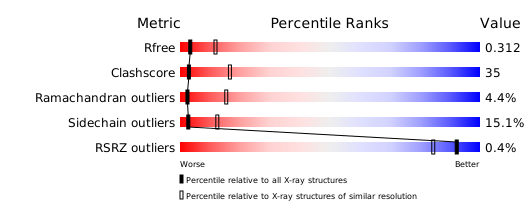
検証レポート(詳細版) をダウンロード
をダウンロード


