






 3TFM
3TFM
Myosin X PH1N-PH2-PH1C tandem
3TFM の概要
| エントリーDOI | 10.2210/pdb3tfm/pdb |
| 分子名称 | Myosin X, PHOSPHATE ION (3 entities in total) |
| 機能のキーワード | split ph domain, motor protein |
| 由来する生物種 | Rattus norvegicus (rat) |
| タンパク質・核酸の鎖数 | 1 |
| 化学式量合計 | 26585.54 |
| 構造登録者 | |
| 主引用文献 | Lu, Q.,Yu, J.,Yan, J.,Wei, Z.,Zhang, M. Structural basis of the myosin X PH1N-PH2-PH1C tandem as a specific and acute cellular PI(3,4,5)P3 sensor MOLECULAR BIOLOGY OF THE CELL, 22:4268-4278, 2011 Cited by PubMed Abstract: Myosin X (MyoX) is an unconventional myosin that is known to induce the formation and elongation of filopodia in many cell types. MyoX-induced filopodial induction requires the three PH domains in its tail region, although with unknown underlying molecular mechanisms. MyoX's first PH domain is split into halves by its second PH domain. We show here that the PH1(N)-PH2-PH1(C) tandem allows MyoX to bind to phosphatidylinositol (3,4,5)-triphosphate [PI(3,4,5)P(3)] with high specificity and cooperativity. We further show that PH2 is responsible for the specificity of the PI(3,4,5)P(3) interaction, whereas PH1 functions to enhance the lipid membrane-binding avidity of the tandem. The structure of the MyoX PH1(N)-PH2-PH1(C) tandem reveals that the split PH1, PH2, and the highly conserved interdomain linker sequences together form a rigid supramodule with two lipid-binding pockets positioned side by side for binding to phosphoinositide membrane bilayers with cooperativity. Finally, we demonstrate that disruption of PH2-mediated binding to PI(3,4,5)P(3) abolishes MyoX's function in inducing filopodial formation and elongation. PubMed: 21965296DOI: 10.1091/mbc.E11-04-0354 主引用文献が同じPDBエントリー |
| 実験手法 | X-RAY DIFFRACTION (2.53 Å) |
構造検証レポート
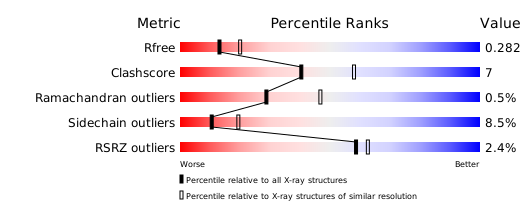
検証レポート(詳細版) をダウンロード
をダウンロード


