






3PXT
Crystal Structure of Ferrous CO Adduct of MauG in Complex with Pre-Methylamine Dehydrogenase
Summary for 3PXT
| Entry DOI | 10.2210/pdb3pxt/pdb |
| Related | 3L4M 3L4O 3ORV 3PXS 3PXT 3PXW |
| Descriptor | Methylamine utilization protein MauG, Methylamine dehydrogenase light chain, Methylamine dehydrogenase heavy chain, ... (10 entities in total) |
| Functional Keywords | oxidoreductase, electron transfer, periplasmic space, oxidoreductase-electron transport complex, oxidoreductase/electron transport |
| Biological source | Paracoccus denitrificans More |
| Cellular location | Periplasm: Q51658 P22619 |
| Total number of polymer chains | 6 |
| Total formula weight | 200365.62 |
| Authors | Yukl, E.T.,Goblirsch, B.R.,Wilmot, C.M. (deposition date: 2010-12-10, release date: 2011-03-23, Last modification date: 2024-10-30) |
| Primary citation | Yukl, E.T.,Goblirsch, B.R.,Davidson, V.L.,Wilmot, C.M. Crystal Structures of CO and NO Adducts of MauG in Complex with Pre-Methylamine Dehydrogenase: Implications for the Mechanism of Dioxygen Activation. Biochemistry, 50:2931-2938, 2011 Cited by PubMed Abstract: MauG is a diheme enzyme responsible for the post-translational formation of the catalytic tryptophan tryptophylquinone (TTQ) cofactor in methylamine dehydrogenase (MADH). MauG can utilize hydrogen peroxide, or molecular oxygen and reducing equivalents, to complete this reaction via a catalytic bis-Fe(IV) intermediate. Crystal structures of diferrous, Fe(II)-CO, and Fe(II)-NO forms of MauG in complex with its preMADH substrate have been determined and compared to one another as well as to the structure of the resting diferric MauG-preMADH complex. CO and NO each bind exclusively to the 5-coordinate high-spin heme with no change in ligation of the 6-coordinate low-spin heme. These structures reveal likely roles for amino acid residues in the distal pocket of the high-spin heme in oxygen binding and activation. Glu113 is implicated in the protonation of heme-bound diatomic oxygen intermediates in promoting cleavage of the O-O bond. Pro107 is shown to change conformation on the binding of each ligand and may play a steric role in oxygen activation by positioning the distal oxygen near Glu113. Gln103 is in a position to provide a hydrogen bond to the Fe(IV)═O moiety that may account for the unusual stability of this species in MauG. PubMed: 21355604DOI: 10.1021/bi200023n PDB entries with the same primary citation |
| Experimental method | X-RAY DIFFRACTION (2.16 Å) |
Structure validation
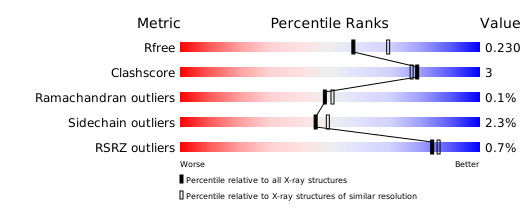
Download full validation report


