






 36BD
36BD36BD の概要
| エントリーDOI | 10.2210/pdb36bd/pdb |
| 関連するPDBエントリー | 35ZR 35ZV 35ZW 36AX |
| EMDBエントリー | 77302 77304 77307 77308 77338 77350 |
| 分子名称 | 26S proteasome regulatory subunit 7 homolog, 26S proteasome regulatory subunit RPN2, 26S proteasome subunit RPT4, ... (13 entities in total) |
| 機能のキーワード | proteasome, chaperone, base, 26s, aaa, motor, assembly, motor protein |
| 由来する生物種 | Saccharomyces cerevisiae (brewer's yeast) 詳細 |
| タンパク質・核酸の鎖数 | 12 |
| 化学式量合計 | 654643.68 |
| 構造登録者 | |
| 主引用文献 | Hsieh, H.H.,Martin, A. Chaperones shape the conformational landscape of 26S-proteasome-base assembly for allosteric ATPase motor activation. Biorxiv, 2026 Cited by PubMed Abstract: Protein homeostasis depends on the 26S proteasome, the most complex ATP-dependent protease in eukaryotic cells. The proteasome base subcomplex is responsible for mechanical substrate unfolding and translocation into an internal degradation chamber. It contains three non-ATPase subunits, Rpn1, Rpn2, and Rpn13, and a heterohexameric AAA+ motor with six distinct ATPases, Rpt1 - Rpt6. Correct base assembly requires four dedicated chaperones that initially form the Hsm3 module (Hsm3-Rpt1-Rpt2-Rpn1), the Rpn14/Nas6 module (Rpn14-Rpt6-Nas6-Rpt3-Rpn2-Rpn13), and the Nas2 module (Nas2-Rpt5-Rpt4). However, the mechanisms underlying module assembly and formation of the mature base remain unknown. Here, we reconstitute the base subcomplex of the 26S proteasome from recombinant modules. Using biochemical assays, mass photometry, single-molecule fluorescence measurements, and single-particle cryo-EM, we reveal how the chaperones direct the conformational transitions through several intermediates toward the ATP-hydrolysis-active base. The Nas2 and Rpn14/Nas6 modules associate first, and binding of the Hsm3 module creates a state in which the chaperones stabilize an open ATPase ring that lacks hydrolysis activity. Sequential chaperone release then leads to a gradual ATPase-ring closure, whereby Hsm3's unstructured C-terminal tail mimics a substrate polypeptide in the central channel and induces a processing motor state with a spiral-staircase arrangement of Rpt subunits and a closed ATPase site at Rpt4. Inaugural ATP hydrolysis in Rpt4 is subsequently required to eject Hsm3 and transition to the Nas6-bound base that is ATPase active and competent for 26S-proteasome incorporation. Our studies thus provide exciting insights into how chaperones assure correct assembly, guide the complex through an intricate conformational landscape, and thereby prevent premature ATP-hydrolysis activation or incorporation of faulty assemblies into holoenzymes. PubMed: 42282764DOI: 10.64898/2026.06.01.729410 主引用文献が同じPDBエントリー |
| 実験手法 | ELECTRON MICROSCOPY (3.93 Å) |
構造検証レポート
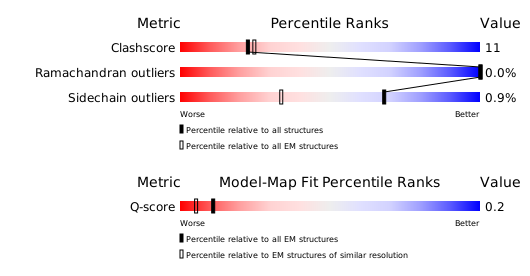
検証レポート(詳細版) をダウンロード
をダウンロード


