






 1IMO
1IMO
NMR STRUCTURE OF HUMAN DNA LIGASE IIIALPHA BRCT DOMAIN
1IMO の概要
| エントリーDOI | 10.2210/pdb1imo/pdb |
| NMR情報 | BMRB: 5041 |
| 分子名称 | DNA LIGASE III (1 entity in total) |
| 機能のキーワード | parallel beta sheet, ligase |
| 由来する生物種 | Homo sapiens (human) |
| 細胞内の位置 | Nucleus: P49916 |
| タンパク質・核酸の鎖数 | 1 |
| 化学式量合計 | 9985.42 |
| 構造登録者 | Krishnan, V.V.,Thornton, K.H.,Thelen, M.P.,Cosman, M. (登録日: 2001-05-11, 公開日: 2001-05-25, 最終更新日: 2024-05-22) |
| 主引用文献 | Krishnan, V.V.,Thornton, K.H.,Thelen, M.P.,Cosman, M. Solution structure and backbone dynamics of the human DNA ligase IIIalpha BRCT domain Biochemistry, 40:13158-13166, 2001 Cited by PubMed Abstract: BRCT (BRCA1 carboxyl terminus) domains are found in a number of DNA repair enzymes and cell cycle regulators and are believed to mediate important protein-protein interactions. The DNA ligase IIIalpha BRCT domain partners with the distal BRCT domain of the DNA repair protein XRCC1 (X1BRCTb) in the DNA base excision repair (BER) pathway. To elucidate the mechanisms by which these two domains can interact, we have determined the solution structure of human ligase IIIalpha BRCT (L3[86], residues 837-922). The structure of L3[86] consists of a beta2beta1beta3beta4 parallel sheet with a two-alpha-helix bundle packed against one face of the sheet. This fold is conserved in several proteins having a wide range of activities, including X1BRCTb [Zhang, X. D., et al. (1998) EMBO J. 17, 6404-6411]. L3[86] exists as a dimer in solution, but an insufficient number of NOE restraints precluded the determination of the homodimer structure. However, 13C isotope-filtered and hydrogen-deuterium exchange experiments indicate that the N-terminus, alpha1, the alpha1-beta2 loop, and the three residues following alpha2 are involved in forming the dimer interface, as similarly observed in the structure of X1BRCTb. NOE and dynamic data indicate that several residues (837-844) in the N-terminal region appear to interconvert between helix and random coil conformations. Further studies of other BRCT domains and of their complexes are needed to address how these proteins interact with one another, and to shed light on how mutations can lead to disruption of function and ultimately disease. PubMed: 11683624DOI: 10.1021/bi010979g 主引用文献が同じPDBエントリー |
| 実験手法 | SOLUTION NMR |
構造検証レポート
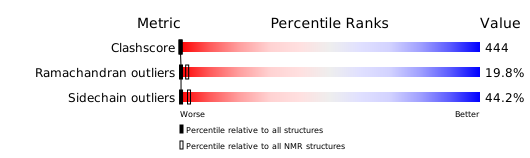
検証レポート(詳細版) をダウンロード
をダウンロード


