






 13PP
13PP
PanDDA analysis group deposition -- Crystal structure of PLpro-C111S in complex with PS-5144
13PP の概要
| エントリーDOI | 10.2210/pdb13pp/pdb |
| Group deposition | Crystallographic fragment screening of SARS-CoV-2 PLpro-C111S mutant (G_1002354) |
| 分子名称 | Papain-like protease nsp3, ZINC ION, N-methyl-1-[3-(pyridin-3-yl)phenyl]methanamine (3 entities in total) |
| 機能のキーワード | plpro, sars-cov-2, hydrolase |
| 由来する生物種 | Severe acute respiratory syndrome coronavirus 2 |
| タンパク質・核酸の鎖数 | 1 |
| 化学式量合計 | 40066.74 |
| 構造登録者 | |
| 主引用文献 | Wang, W.W.,Huang, L.Q.,Xu, Q.,Zhu, Z.M.,Li, M.,Zhou, H.,Han, T.L.,Zheng, S.H.,Li, J.,Wang, Q.S.,Yu, F. Crystallographic fragment screening discovers novel micromolar active inhibitors and druggable hotspots of SARS-CoV-2 PL pro. Int.J.Biol.Macromol., 347:150689-150689, 2026 Cited by PubMed Abstract: The COVID-19 pandemic has highlighted the need to develop broad-spectrum antiviral therapeutics targeting rapidly evolving coronaviruses. This research focuses on SARS-CoV-2 PL, a conserved viral protease that plays dual roles in viral polyprotein processing and host immune suppression. Using an integrated fragment-based drug discovery (FBDD) approach that combines high-throughput X-ray crystallography and biochemical assays, we systematically screened a diverse library of 800 fragment compounds. Structural characterization identified 129 validated binders occupying 12 distinct binding sites on PL. Remarkably, two fragments demonstrated potent micromolar inhibitory activity. Fr12895 inhibited SARS-CoV-2 PL protease activity (IC = 8.013 μM), as measured using the fluorogenic substrate RLRGG-AMC, while Fr12338 showed inhibition against PL deISGylase activity (IC = 4.5 μM), as determined with the substrate Ac-ISG15prox-Rh110MP. This provides a case for directly obtaining micromolar-active compounds through crystallographic fragment screening of a small number of random compounds. Detailed structural analysis revealed these fragments engage key functional regions including the blocking loop 2 (BL2) and ubiquitin/ISG15 binding interface through extensive hydrogen-bond networks and hydrophobic interactions. Our study reveals novel micromolar active inhibitors and druggable sites of SARS-CoV-2 PL by crystallographic fragment screening, provides crucial scaffold and a structural roadmap for developing broad-spectrum antivirals against coronaviruses. PubMed: 41638277DOI: 10.1016/j.ijbiomac.2026.150689 主引用文献が同じPDBエントリー |
| 実験手法 | X-RAY DIFFRACTION (2.98 Å) |
構造検証レポート
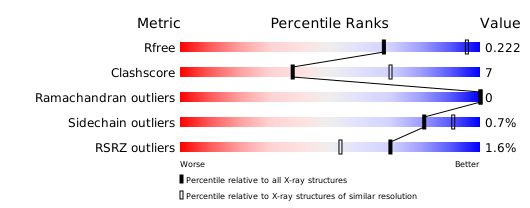
検証レポート(詳細版) をダウンロード
をダウンロード


