






 10MC
10MC
Open2 Eco-ePEC: Cryo-EM structure of Eco RNAP his-elemental paused elongation complex with an open active site (open TL, SI3 and RH-FL)
10MC の概要
| エントリーDOI | 10.2210/pdb10mc/pdb |
| EMDBエントリー | 75281 |
| 分子名称 | template DNA, ZINC ION, DNA-directed RNA polymerase subunit omega, ... (11 entities in total) |
| 機能のキーワード | transcription, nucleotide addition cycle, dna/rna, rna polymerase, transcription-dna-rna complex, transcription/dna/rna |
| 由来する生物種 | Escherichia coli 詳細 |
| タンパク質・核酸の鎖数 | 8 |
| 化学式量合計 | 415976.78 |
| 構造登録者 | |
| 主引用文献 | Dhingra, Y.,Landick, R.,Campbell, E.A.,Darst, S.A. RNA polymerase inhibitors reveal active-site motions essential for the nucleotide addition cycle. Proc.Natl.Acad.Sci.USA, 123:e2609228123-e2609228123, 2026 Cited by PubMed Abstract: The nucleotide addition cycle (NAC) of multisubunit DNA-dependent RNA polymerases (RNAPs) involves coordinated conformational changes in conserved active-site structural elements, including the trigger loop (TL). The TL is open (unfolded) in most RNAP structures but can close (fold) in substrate-bound (post- or pretranslocated) states of the RNAP, promoting catalysis. TL closure has been associated with closure of another conserved structural element, the Rim-Helices/F-loop (RH-FL), but the role of the RH-FL in the NAC is unclear. Antibiotic leads CBR9379 and AAP-SO inhibit the and RNAPs, respectively, by binding in a pocket formed by the bridge helix and RH-FL. The precise mechanism of action for these inhibitors is yet to be defined. We present cryoelectron microscopy structures showing that both compounds inhibit the RNAP NAC by preventing RH-FL closure, thereby allosterically destabilizing the closed TL. This work reveals a conserved mechanistic principle of RNAP catalysis across all domains of life and provides insight for antibiotic design. PubMed: 42378287DOI: 10.1073/pnas.2609228123 主引用文献が同じPDBエントリー |
| 実験手法 | ELECTRON MICROSCOPY (2.8 Å) |
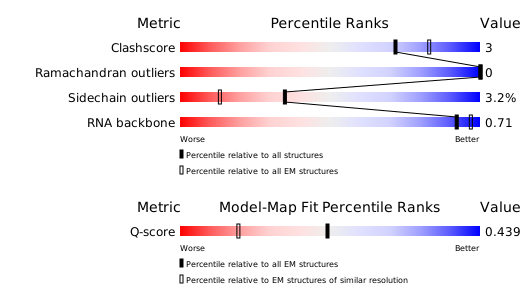
構造検証レポート
検証レポート(詳細版) をダウンロード
をダウンロード


