Journal: FEBS J / Year: 2020 Title: Farnesylation of human guanylate-binding protein 1 as safety mechanism preventing structural rearrangements and uninduced dimerization. Authors: Charlotte Lorenz / Semra Ince / Tao Zhang / Anneliese Cousin / Renu Batra-Safferling / Luitgard Nagel-Steger / Christian Herrmann / Andreas M Stadler / Abstract: Human guanylate-binding protein 1 (hGBP1) belongs to the family of dynamin-like proteins and is activated by addition of nucleotides, leading to protein oligomerization and stimulated GTPase activity. ...Human guanylate-binding protein 1 (hGBP1) belongs to the family of dynamin-like proteins and is activated by addition of nucleotides, leading to protein oligomerization and stimulated GTPase activity. In vivo, hGBP1 is post-translationally modified by attachment of a farnesyl group yielding farn-hGBP1. In this study, hydrodynamic differences in farn-hGBP1 and unmodified hGBP1 were investigated using dynamic light scattering (DLS), analytical ultracentrifugation (AUC) and analytical size-exclusion chromatography (SEC). In addition, we performed small-angle X-ray scattering (SAXS) experiments coupled with a SEC setup (SEC-SAXS) to investigate structural properties of nonmodified hGBP1 and farn-hGBP1 in solution. SEC-SAXS measurements revealed that farnesylation keeps hGBP1 in its inactive monomeric and crystal-like conformation in nucleotide-free solution, whereas unmodified hGBP1 forms a monomer-dimer equilibrium both in the inactive ground state in nucleotide-free solution as well as in the activated state that is trapped by addition of the nonhydrolysable GTP analogue GppNHp. Nonmodified hGBP1 is structurally perturbed as compared to farn-hGBP. In particular, GppNHp binding leads to large structural rearrangements and higher conformational flexibility of the monomer and the dimer. Structural changes observed in the nonmodified protein are prerequisites for further oligomer assemblies of farn-hGBP1 that occur in the presence of nucleotides. DATABASE: All SEC-SAXS data, corresponding fits to the data and structural models are deposited in the Small Angle Scattering Biological Data Bank [SASBDB (Nucleic Acids Res, 43, 2015, D357)] with project IDs: SASDEE8, SASDEF8, SASDEG8, SASDEH8, SASDEJ8, SASDEK8, SASDEL8 and SASDEM8.
Contact author
Charlotte Lorenz (Forschungszentrum Jülich, Germany)
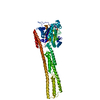
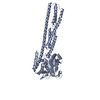
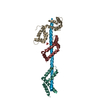
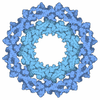
Title: Human Guanylate Binding Protein 1 (hGBP1), monomer from SEC-SAXS Measurement date: Apr 30, 2017 / Storage temperature: 20 °C / Cell temperature: 20 °C / Exposure time: 1 sec. / Number of frames: 3600 / Unit: 1/nm /
Min
Max
Q
0.0327
4.9445
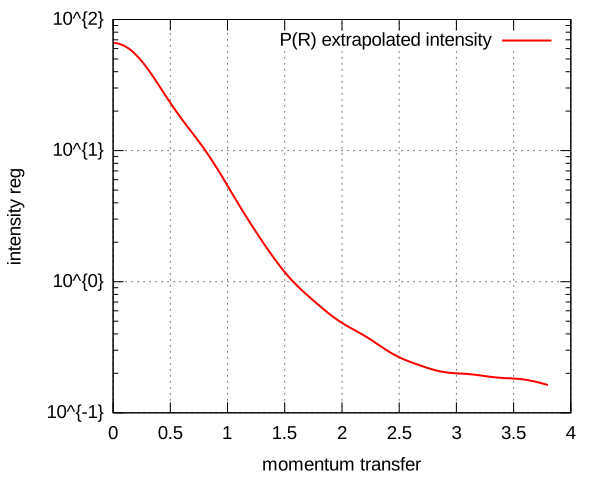
Distance distribution function P(R)
Sofotware P(R): GNOM 5.0 / Number of points: 770 /
Min
Max
Q
0.174074
3.799
P(R) point
1
770
R
0
13.44
Result
Type of curve: single_conc /
Experimental
Porod
MW
65.3 kDa
66.08 kDa
Volume
-
105.72 nm3
P(R)
Guinier
Guinier error
Forward scattering, I0
66.23
65.89
0.057
Radius of gyration, Rg
4.02 nm
3.89 nm
0.06
Min
Max
D
-
13.44
Guinier point
31
52
+
About Yorodumi
-
News
-
Feb 9, 2022. New format data for meta-information of EMDB entries
New format data for meta-information of EMDB entries
Version 3 of the EMDB header file is now the official format.
The previous official version 1.9 will be removed from the archive.
In the structure databanks used in Yorodumi, some data are registered as the other names, "COVID-19 virus" and "2019-nCoV". Here are the details of the virus and the list of structure data.
Jan 31, 2019. EMDB accession codes are about to change! (news from PDBe EMDB page)
EMDB accession codes are about to change! (news from PDBe EMDB page)
The allocation of 4 digits for EMDB accession codes will soon come to an end. Whilst these codes will remain in use, new EMDB accession codes will include an additional digit and will expand incrementally as the available range of codes is exhausted. The current 4-digit format prefixed with “EMD-” (i.e. EMD-XXXX) will advance to a 5-digit format (i.e. EMD-XXXXX), and so on. It is currently estimated that the 4-digit codes will be depleted around Spring 2019, at which point the 5-digit format will come into force.
The EM Navigator/Yorodumi systems omit the EMD- prefix.
Related info.:Q: What is EMD? / ID/Accession-code notation in Yorodumi/EM Navigator
Yorodumi is a browser for structure data from EMDB, PDB, SASBDB, etc.
This page is also the successor to EM Navigator detail page, and also detail information page/front-end page for Omokage search.
The word "yorodu" (or yorozu) is an old Japanese word meaning "ten thousand". "mi" (miru) is to see.
Related info.:EMDB / PDB / SASBDB / Comparison of 3 databanks / Yorodumi Search / Aug 31, 2016. New EM Navigator & Yorodumi / Yorodumi Papers / Jmol/JSmol / Function and homology information / Changes in new EM Navigator and Yorodumi
 Movie
Movie Controller

 Open data
 Basic information
 Sample
 Function and homology information
 Homo sapiens (human)
 Citation
 Contact author
 Structure visualization
 Downloads & links
 SASDEF8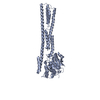
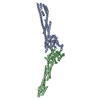
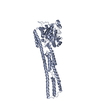

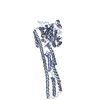


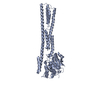
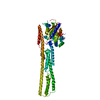
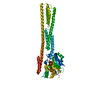
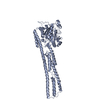
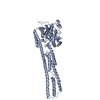
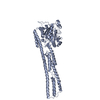
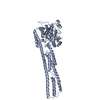
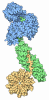
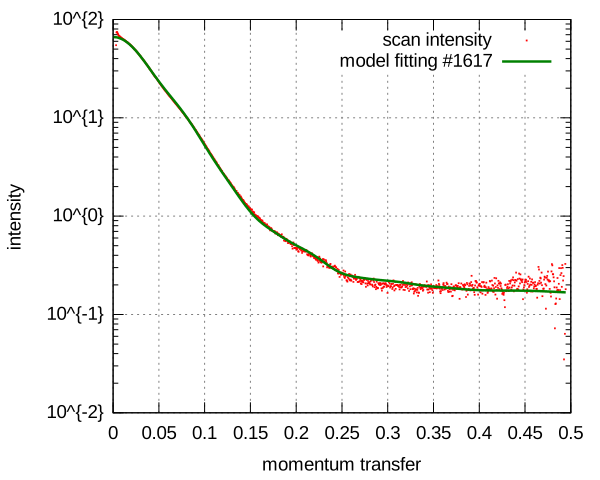
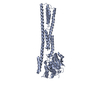
 Search similar-shape structures of this assembly by Omokage search (details)

 / Type of source: X-ray synchrotron / Wavelength: 0.09919 Å / Dist. spec. to detc.: 2.867 mm