 Movie
Movie Controller


+ Open data

- Basic information
| Entry | Database: PDB / ID: 9yqk | |||||||||
|---|---|---|---|---|---|---|---|---|---|---|
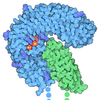
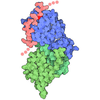
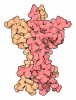
| Title | C-terminal LRRK2 bound to C12 DARPin | |||||||||
 Components Components |
| |||||||||
 Keywords Keywords | PROTEIN BINDING / Kinase / Complex / DARPins | |||||||||
| Function / homology |  Function and homology information Function and homology informationregulation of neuron maturation / regulation of kidney size / caveola neck / Wnt signalosome assembly / beta-catenin destruction complex binding / regulation of branching morphogenesis of a nerve / negative regulation of motile cilium assembly / tangential migration from the subventricular zone to the olfactory bulb / regulation of cell projection organization / regulation of dopamine receptor signaling pathway ...regulation of neuron maturation / regulation of kidney size / caveola neck / Wnt signalosome assembly / beta-catenin destruction complex binding / regulation of branching morphogenesis of a nerve / negative regulation of motile cilium assembly / tangential migration from the subventricular zone to the olfactory bulb / regulation of cell projection organization / regulation of dopamine receptor signaling pathway / regulation of ER to Golgi vesicle-mediated transport / GTP-dependent protein kinase activity / regulation of SNARE complex assembly / regulation of neuroblast proliferation / protein localization to endoplasmic reticulum exit site / negative regulation of late endosome to lysosome transport / regulation of mitochondrial depolarization / peroxidase inhibitor activity / amphisome / regulation of synaptic vesicle transport / regulation of CAMKK-AMPK signaling cascade / positive regulation of dopamine receptor signaling pathway / striatum development / negative regulation of autophagosome assembly / co-receptor binding / positive regulation of microglial cell activation / olfactory bulb development / regulation of retrograde transport, endosome to Golgi / negative regulation of GTPase activity / cellular response to curcumin / positive regulation of synaptic vesicle endocytosis / regulation of locomotion / JUN kinase kinase kinase activity / cytoplasmic side of mitochondrial outer membrane / endoplasmic reticulum organization / regulation of cAMP/PKA signal transduction / negative regulation of excitatory postsynaptic potential / multivesicular body, internal vesicle / neuron projection arborization / positive regulation of mitochondrial outer membrane permeabilization involved in apoptotic signaling pathway / regulation of dendritic spine morphogenesis / mitochondrion localization / cellular response to dopamine / negative regulation of protein processing / Wnt signalosome / positive regulation of protein autoubiquitination / GTP metabolic process / syntaxin-1 binding / regulation of reactive oxygen species metabolic process / exploration behavior / lysosome organization / regulation of canonical Wnt signaling pathway / positive regulation of programmed cell death / PTK6 promotes HIF1A stabilization / Golgi-associated vesicle / clathrin binding / regulation of synaptic vesicle exocytosis / negative regulation of protein localization to mitochondrion / locomotory exploration behavior / regulation of mitochondrial fission / Golgi organization / Lewy body / intracellular distribution of mitochondria / microvillus / canonical Wnt signaling pathway / protein kinase A binding / neuromuscular junction development / autolysosome / protein localization to mitochondrion / endoplasmic reticulum exit site / Rho protein signal transduction / determination of adult lifespan / MAP kinase kinase kinase activity / JNK cascade / regulation of synaptic vesicle endocytosis / negative regulation of macroautophagy / negative regulation of endoplasmic reticulum stress-induced intrinsic apoptotic signaling pathway / regulation of synaptic transmission, glutamatergic / presynaptic cytosol / cellular response to manganese ion / phagocytic vesicle / GTPase activator activity / positive regulation of autophagy / neuron projection morphogenesis / dendrite cytoplasm / excitatory postsynaptic potential / positive regulation of protein ubiquitination / cellular response to starvation / calcium-mediated signaling / mitochondrion organization / SNARE binding / negative regulation of neuron projection development / regulation of protein stability / trans-Golgi network / cellular response to reactive oxygen species / endocytosis / regulation of membrane potential / tubulin binding / regulation of autophagy / kinase activity Similarity search - Function | |||||||||
| Biological species |  Homo sapiens (human) Homo sapiens (human)synthetic construct (others) | |||||||||
| Method | ELECTRON MICROSCOPY / single particle reconstruction / cryo EM / Resolution: 3.6 Å | |||||||||
 Authors Authors | Sanz-Murillo, M. / Leschziner, A. | |||||||||
| Funding support |  United States, 1items United States, 1items
| |||||||||
 Citation Citation | Journal: Cell / Year: 2026 Title: The structural basis for LRRK2's activation and autoinhibition. Authors: Amalia Villagran Suarez / Kathryn S Hatch / Tatyana Bodrug / Wei Gai / Katherine J Surridge / Elizabeth Moussikhina / Kendrick H V Nguyen / Marta Sanz-Murillo / Robert Callahan / Erica Xiong ...Authors: Amalia Villagran Suarez / Kathryn S Hatch / Tatyana Bodrug / Wei Gai / Katherine J Surridge / Elizabeth Moussikhina / Kendrick H V Nguyen / Marta Sanz-Murillo / Robert Callahan / Erica Xiong / Delisa Ramos / Lawrence Zhu / Verena Dederer / Sebastian Mathea / Janet Iwasa / Stefan Knapp / Kevan M Shokat / Samara L Reck-Peterson / Andres E Leschziner /  Abstract: Mutations in leucine-rich repeat kinase 2 (LRRK2) are the second most common cause of autosomal-dominant Parkinson's disease (PD), and increased LRRK2 kinase activity is also observed in idiopathic ...Mutations in leucine-rich repeat kinase 2 (LRRK2) are the second most common cause of autosomal-dominant Parkinson's disease (PD), and increased LRRK2 kinase activity is also observed in idiopathic PD, making LRRK2 a major actionable therapeutic target. LRRK2 is a 286-kDa multidomain enzyme containing a Ras-like GTPase (ROC) and a kinase domain. Using cryo-electron microscopy (cryo-EM), biochemical reconstitution, and cell-based assays, we show that the ROC GTPase governs switching between autoinhibited and active states: GTP binding promotes activation, whereas GDP binding enforces autoinhibition. Two common PD-linked mutations, G2019S and R1441C/G/H, activate LRRK2 through distinct structural mechanisms, revealing genotype-specific routes to dysregulation. These findings provide a unified framework for understanding LRRK2 regulation with broad therapeutic implications. Stabilizing the guanosine diphosphate (GDP)-bound state may inhibit LRRK2 by maintaining autoinhibition, whereas promoting the GTP-bound state could be advantageous in specific cellular contexts, such as the lung, where increased LRRK2 kinase activity may play protective or regulatory roles. | |||||||||
| History |
|
- Structure visualization
| Structure viewer | Molecule: MolmilJmol/JSmol |
|---|
- Downloads & links
-Download
| PDBx/mmCIF format | 9yqk.cif.gz | 240.8 KB | Display | PDBx/mmCIF format |
|---|---|---|---|---|
| PDB format | pdb9yqk.ent.gz | 171.7 KB | Display | PDB format |
| PDBx/mmJSON format | 9yqk.json.gz | Tree view | PDBx/mmJSON format | |
| Others |  Other downloads Other downloads |
-Validation report
| Arichive directory | https://data.pdbj.org/pub/pdb/validation_reports/yq/9yqkftp://data.pdbj.org/pub/pdb/validation_reports/yq/9yqk | HTTPS FTP |
|---|
-Related structure data
| Related structure data |  73338MC  9om2C  9oxhC  9oxiC  9oyaC  9y67C  9y68C  9y7aC  9y7iC  9yblC  9ybpC  9yc8C  9ycdC  9ygtC  73280 73281 73282 M: map data used to model this data C: citing same article ( |
|---|---|
| Similar structure data |


-Links
 PDBj
PDBj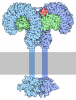

- Assembly
| Deposited unit | 
|
|---|---|
| 1 |
|
-Components
| #1: Protein | Mass: 286462.781 Da / Num. of mol.: 1 Source method: isolated from a genetically manipulated source Source: (gene. exp.) Homo sapiens (human) / Gene: LRRK2 / Production host:   Spodoptera frugiperda (fall armyworm) / References: UniProt: Q5S007 Spodoptera frugiperda (fall armyworm) / References: UniProt: Q5S007 |
|---|---|
| #2: Protein | Mass: 14348.062 Da / Num. of mol.: 1 Source method: isolated from a genetically manipulated source Source: (gene. exp.) synthetic construct (others) / Production host:   Escherichia coli (E. coli) Escherichia coli (E. coli) |
| Has protein modification | N |
-Experimental details
-Experiment
| Experiment | Method: ELECTRON MICROSCOPY |
|---|---|
| EM experiment | Aggregation state: PARTICLE / 3D reconstruction method: single particle reconstruction |
- Sample preparation
| Component | Name: C-terminal LRRK2 bound to C12 DARPin / Type: COMPLEX / Entity ID: all / Source: RECOMBINANT | |||||||||||||||||||||||||||||||||||
|---|---|---|---|---|---|---|---|---|---|---|---|---|---|---|---|---|---|---|---|---|---|---|---|---|---|---|---|---|---|---|---|---|---|---|---|---|
| Molecular weight | Value: 0.156 MDa / Experimental value: YES | |||||||||||||||||||||||||||||||||||
| Source (natural) | Organism: Homo sapiens (human) | |||||||||||||||||||||||||||||||||||
| Source (recombinant) | Organism: Spodoptera frugiperda (fall armyworm) | |||||||||||||||||||||||||||||||||||
| Buffer solution | pH: 7.4 | |||||||||||||||||||||||||||||||||||
| Buffer component |
| |||||||||||||||||||||||||||||||||||
| Specimen | Conc.: 0.68 mg/ml / Embedding applied: NO / Shadowing applied: NO / Staining applied: NO / Vitrification applied: YES | |||||||||||||||||||||||||||||||||||
| Specimen support | Grid material: GOLD / Grid mesh size: 300 divisions/in. / Grid type: UltrAuFoil R1.2/1.3 | |||||||||||||||||||||||||||||||||||
| Vitrification | Instrument: FEI VITROBOT MARK IV / Cryogen name: ETHANE / Humidity: 100 % / Chamber temperature: 277.15 K |
- Electron microscopy imaging
| Experimental equipment | 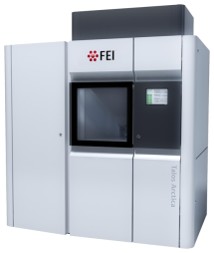 Model: Talos Arctica / Image courtesy: FEI Company |
|---|---|
| Microscopy | Model: FEI TALOS ARCTICA |
| Electron gun | Electron source:  FIELD EMISSION GUN / Accelerating voltage: 200 kV / Illumination mode: FLOOD BEAM FIELD EMISSION GUN / Accelerating voltage: 200 kV / Illumination mode: FLOOD BEAM |
| Electron lens | Mode: BRIGHT FIELD / Nominal defocus max: 36000 nm / Nominal defocus min: 1000 nm / Calibrated defocus min: 2500 nm / Cs: 2.7 mm / Alignment procedure: BASIC |
| Specimen holder | Cryogen: NITROGEN / Specimen holder model: FEI TITAN KRIOS AUTOGRID HOLDER |
| Image recording | Electron dose: 50 e/Å2 / Detector mode: COUNTING / Film or detector model: GATAN K2 SUMMIT (4k x 4k) / Num. of grids imaged: 1 |
- Processing
| EM software |
| ||||||||||||||||||||||||||||
|---|---|---|---|---|---|---|---|---|---|---|---|---|---|---|---|---|---|---|---|---|---|---|---|---|---|---|---|---|---|
| CTF correction | Type: PHASE FLIPPING AND AMPLITUDE CORRECTION | ||||||||||||||||||||||||||||
| Symmetry | Point symmetry: C1 (asymmetric) | ||||||||||||||||||||||||||||
| 3D reconstruction | Resolution: 3.6 Å / Resolution method: FSC 0.143 CUT-OFF / Num. of particles: 392016 / Algorithm: FOURIER SPACE / Num. of class averages: 1 / Symmetry type: POINT | ||||||||||||||||||||||||||||
| Atomic model building | Protocol: AB INITIO MODEL / Space: REAL | ||||||||||||||||||||||||||||
| Atomic model building | PDB-ID: 6VP7 Accession code: 6VP7 / Source name: PDB / Type: experimental model | ||||||||||||||||||||||||||||
| Refinement | Highest resolution: 3.6 Å Stereochemistry target values: REAL-SPACE (WEIGHTED MAP SUM AT ATOM CENTERS) | ||||||||||||||||||||||||||||
| Refine LS restraints |
|

