[English] 日本語
Yorodumi Papers
- Database of articles cited by EMDB/PDB/SASBDB data -

+
Search query

Keywords
Structure methods
Author
Journal
IF

-
Structure paper

TitleThe structural basis for LRRK2's activation and autoinhibition.
Journal, issue, pagesCell, Year 2026
Publish dateAug 10, 2026
AuthorsAmalia Villagran Suarez / Kathryn S Hatch / Tatyana Bodrug / Wei Gai / Katherine J Surridge / Elizabeth Moussikhina / Kendrick H V Nguyen / Marta Sanz-Murillo / Robert Callahan / Erica Xiong / Delisa Ramos / Lawrence Zhu / Verena Dederer / Sebastian Mathea / Janet Iwasa / Stefan Knapp / Kevan M Shokat / Samara L Reck-Peterson / Andres E Leschziner /
PubMed AbstractMutations in leucine-rich repeat kinase 2 (LRRK2) are the second most common cause of autosomal-dominant Parkinson's disease (PD), and increased LRRK2 kinase activity is also observed in idiopathic ...Mutations in leucine-rich repeat kinase 2 (LRRK2) are the second most common cause of autosomal-dominant Parkinson's disease (PD), and increased LRRK2 kinase activity is also observed in idiopathic PD, making LRRK2 a major actionable therapeutic target. LRRK2 is a 286-kDa multidomain enzyme containing a Ras-like GTPase (ROC) and a kinase domain. Using cryo-electron microscopy (cryo-EM), biochemical reconstitution, and cell-based assays, we show that the ROC GTPase governs switching between autoinhibited and active states: GTP binding promotes activation, whereas GDP binding enforces autoinhibition. Two common PD-linked mutations, G2019S and R1441C/G/H, activate LRRK2 through distinct structural mechanisms, revealing genotype-specific routes to dysregulation. These findings provide a unified framework for understanding LRRK2 regulation with broad therapeutic implications. Stabilizing the guanosine diphosphate (GDP)-bound state may inhibit LRRK2 by maintaining autoinhibition, whereas promoting the GTP-bound state could be advantageous in specific cellular contexts, such as the lung, where increased LRRK2 kinase activity may play protective or regulatory roles.
External linksCell / PubMed:42575089
MethodsEM (single particle)
Resolution3.15 - 3.72 Å
Structure data

EMDB-70604, PDB-9om2:
Full-length LRRK2 autoinhibited
Method: EM (single particle) / Resolution: 3.31 Å

EMDB-70981, PDB-9oxh:
Full length LRRK2 bound to G10 DARPin
Method: EM (single particle) / Resolution: 3.15 Å

EMDB-70982, PDB-9oxi:
Full-length LRRK2 autonhibited (flexible)
Method: EM (single particle) / Resolution: 3.72 Å

EMDB-71012, PDB-9oya:
Full LRRK2 (R1441C mutant) after symmetry expansion
Method: EM (single particle) / Resolution: 3.44 Å

EMDB-72555, PDB-9y67:
Full length LRRK2 after symmetry expansion
Method: EM (single particle) / Resolution: 3.72 Å

EMDB-72556, PDB-9y68:
Full length LRRK2 (G2019S) after symmetry expansion
Method: EM (single particle) / Resolution: 3.25 Å

EMDB-73338, PDB-9yqk:
C-terminal LRRK2 bound to C12 DARPin
Method: EM (single particle) / Resolution: 3.6 Å

Chemicals

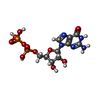
ChemComp-GDP:
GUANOSINE-5'-DIPHOSPHATE / GDP, energy-carrying molecule*YM

ChemComp-MG:
Unknown entry

Source
  • homo sapiens (human)
  • synthetic construct (others)
KeywordsTRANSFERASE / Kinase / GTPase / STRUCTURAL PROTEIN / Complex / GTPases / HYDROLASE / LRRK2 / PROTEIN BINDING / DARPins

+
About Yorodumi Papers

-
News

-
Feb 9, 2022. New format data for meta-information of EMDB entries

New format data for meta-information of EMDB entries

  • Version 3 of the EMDB header file is now the official format.
  • The previous official version 1.9 will be removed from the archive.

Related info.:EMDB header

External links:wwPDB to switch to version 3 of the EMDB data model

-
Aug 12, 2020. Covid-19 info

Covid-19 info

URL: https://pdbj.org/emnavi/covid19.php

New page: Covid-19 featured information page in EM Navigator.

Related info.:Covid-19 info / Mar 5, 2020. Novel coronavirus structure data

+
Mar 5, 2020. Novel coronavirus structure data

Novel coronavirus structure data

Related info.:Yorodumi Speices / Aug 12, 2020. Covid-19 info

External links:COVID-19 featured content - PDBj / Molecule of the Month (242):Coronavirus Proteases

+
Jan 31, 2019. EMDB accession codes are about to change! (news from PDBe EMDB page)

EMDB accession codes are about to change! (news from PDBe EMDB page)

  • The allocation of 4 digits for EMDB accession codes will soon come to an end. Whilst these codes will remain in use, new EMDB accession codes will include an additional digit and will expand incrementally as the available range of codes is exhausted. The current 4-digit format prefixed with “EMD-” (i.e. EMD-XXXX) will advance to a 5-digit format (i.e. EMD-XXXXX), and so on. It is currently estimated that the 4-digit codes will be depleted around Spring 2019, at which point the 5-digit format will come into force.
  • The EM Navigator/Yorodumi systems omit the EMD- prefix.

Related info.:Q: What is EMD? / ID/Accession-code notation in Yorodumi/EM Navigator

External links:EMDB Accession Codes are Changing Soon! / Contact to PDBj

+
Jul 12, 2017. Major update of PDB

Major update of PDB

  • wwPDB released updated PDB data conforming to the new PDBx/mmCIF dictionary.
  • This is a major update changing the version number from 4 to 5, and with Remediation, in which all the entries are updated.
  • In this update, many items about electron microscopy experimental information are reorganized (e.g. em_software).
  • Now, EM Navigator and Yorodumi are based on the updated data.

External links:wwPDB Remediation / Enriched Model Files Conforming to OneDep Data Standards Now Available in the PDB FTP Archive

-
Yorodumi Papers

Database of articles cited by EMDB/PDB/SASBDB data

  • Database of articles cited by EMDB, PDB, and SASBDB entries
  • Using PubMed data

Related info.:EMDB / PDB / SASBDB / Yorodumi / EMN Papers / Changes in new EM Navigator and Yorodumi

Read more