 Movie
Movie Controller


+ Open data

- Basic information
| Entry |  | |||||||||
|---|---|---|---|---|---|---|---|---|---|---|
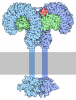
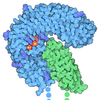
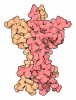
| Title | Full length LRRK2 bound to G10 DARPin | |||||||||
 Map data Map data | ||||||||||
 Sample Sample |
| |||||||||
 Keywords Keywords | Complex / Kinase / GTPases / STRUCTURAL PROTEIN | |||||||||
| Function / homology |  Function and homology information Function and homology informationregulation of neuron maturation / caveola neck / Wnt signalosome assembly / beta-catenin destruction complex binding / regulation of branching morphogenesis of a nerve / negative regulation of motile cilium assembly / regulation of kidney size / tangential migration from the subventricular zone to the olfactory bulb / regulation of cell projection organization / regulation of dopamine receptor signaling pathway ...regulation of neuron maturation / caveola neck / Wnt signalosome assembly / beta-catenin destruction complex binding / regulation of branching morphogenesis of a nerve / negative regulation of motile cilium assembly / regulation of kidney size / tangential migration from the subventricular zone to the olfactory bulb / regulation of cell projection organization / regulation of dopamine receptor signaling pathway / regulation of ER to Golgi vesicle-mediated transport / GTP-dependent protein kinase activity / regulation of SNARE complex assembly / regulation of neuroblast proliferation / protein localization to endoplasmic reticulum exit site / negative regulation of late endosome to lysosome transport / regulation of mitochondrial depolarization / peroxidase inhibitor activity / amphisome / regulation of synaptic vesicle transport / regulation of CAMKK-AMPK signaling cascade / positive regulation of dopamine receptor signaling pathway / striatum development / negative regulation of autophagosome assembly / co-receptor binding / positive regulation of microglial cell activation / olfactory bulb development / regulation of retrograde transport, endosome to Golgi / negative regulation of GTPase activity / cellular response to curcumin / positive regulation of synaptic vesicle endocytosis / regulation of locomotion / JUN kinase kinase kinase activity / cytoplasmic side of mitochondrial outer membrane / endoplasmic reticulum organization / regulation of cAMP/PKA signal transduction / negative regulation of excitatory postsynaptic potential / multivesicular body, internal vesicle / neuron projection arborization / positive regulation of mitochondrial outer membrane permeabilization involved in apoptotic signaling pathway / regulation of dendritic spine morphogenesis / mitochondrion localization / cellular response to dopamine / negative regulation of protein processing / Wnt signalosome / positive regulation of protein autoubiquitination / GTP metabolic process / syntaxin-1 binding / regulation of reactive oxygen species metabolic process / exploration behavior / lysosome organization / regulation of canonical Wnt signaling pathway / positive regulation of programmed cell death / PTK6 promotes HIF1A stabilization / negative regulation of macroautophagy / Golgi-associated vesicle / clathrin binding / protein localization to mitochondrion / regulation of synaptic vesicle exocytosis / locomotory exploration behavior / negative regulation of protein localization to mitochondrion / regulation of mitochondrial fission / Lewy body / Golgi organization / intracellular distribution of mitochondria / canonical Wnt signaling pathway / microvillus / protein kinase A binding / neuromuscular junction development / autolysosome / endoplasmic reticulum exit site / Rho protein signal transduction / determination of adult lifespan / MAP kinase kinase kinase activity / JNK cascade / regulation of synaptic vesicle endocytosis / negative regulation of endoplasmic reticulum stress-induced intrinsic apoptotic signaling pathway / regulation of synaptic transmission, glutamatergic / presynaptic cytosol / cellular response to manganese ion / phagocytic vesicle / positive regulation of autophagy / neuron projection morphogenesis / GTPase activator activity / dendrite cytoplasm / excitatory postsynaptic potential / positive regulation of protein ubiquitination / cellular response to starvation / calcium-mediated signaling / mitochondrion organization / SNARE binding / negative regulation of neuron projection development / regulation of protein stability / trans-Golgi network / cellular response to reactive oxygen species / endocytosis / regulation of membrane potential / tubulin binding / regulation of autophagy / kinase activity Similarity search - Function | |||||||||
| Biological species |  Homo sapiens (human) Homo sapiens (human) | |||||||||
| Method | single particle reconstruction / cryo EM / Resolution: 3.15 Å | |||||||||
 Authors Authors | Villagran AV / Bodrug T / Leschziner A | |||||||||
| Funding support |  United States, 1 items United States, 1 items
| |||||||||
 Citation Citation | Journal: Cell / Year: 2026 Title: The structural basis for LRRK2's activation and autoinhibition. Authors: Amalia Villagran Suarez / Kathryn S Hatch / Tatyana Bodrug / Wei Gai / Katherine J Surridge / Elizabeth Moussikhina / Kendrick H V Nguyen / Marta Sanz-Murillo / Robert Callahan / Erica Xiong ...Authors: Amalia Villagran Suarez / Kathryn S Hatch / Tatyana Bodrug / Wei Gai / Katherine J Surridge / Elizabeth Moussikhina / Kendrick H V Nguyen / Marta Sanz-Murillo / Robert Callahan / Erica Xiong / Delisa Ramos / Lawrence Zhu / Verena Dederer / Sebastian Mathea / Janet Iwasa / Stefan Knapp / Kevan M Shokat / Samara L Reck-Peterson / Andres E Leschziner /  Abstract: Mutations in leucine-rich repeat kinase 2 (LRRK2) are the second most common cause of autosomal-dominant Parkinson's disease (PD), and increased LRRK2 kinase activity is also observed in idiopathic ...Mutations in leucine-rich repeat kinase 2 (LRRK2) are the second most common cause of autosomal-dominant Parkinson's disease (PD), and increased LRRK2 kinase activity is also observed in idiopathic PD, making LRRK2 a major actionable therapeutic target. LRRK2 is a 286-kDa multidomain enzyme containing a Ras-like GTPase (ROC) and a kinase domain. Using cryo-electron microscopy (cryo-EM), biochemical reconstitution, and cell-based assays, we show that the ROC GTPase governs switching between autoinhibited and active states: GTP binding promotes activation, whereas GDP binding enforces autoinhibition. Two common PD-linked mutations, G2019S and R1441C/G/H, activate LRRK2 through distinct structural mechanisms, revealing genotype-specific routes to dysregulation. These findings provide a unified framework for understanding LRRK2 regulation with broad therapeutic implications. Stabilizing the guanosine diphosphate (GDP)-bound state may inhibit LRRK2 by maintaining autoinhibition, whereas promoting the GTP-bound state could be advantageous in specific cellular contexts, such as the lung, where increased LRRK2 kinase activity may play protective or regulatory roles. | |||||||||
| History |
|
- Structure visualization
| Supplemental images |
|---|

- Downloads & links
-EMDB archive
| Map data | emd_70981.map.gz | 307 MB | EMDB map data format | |
|---|---|---|---|---|
| Header (meta data) | emd-70981-v30.xmlemd-70981.xml | 25.7 KB 25.7 KB | Display Display | EMDB header |
| Images |  emd_70981.png emd_70981.png | 58.1 KB | ||
| Filedesc metadata | emd-70981.cif.gz | 8.1 KB | ||
| Others | emd_70981_additional_1.map.gzemd_70981_additional_2.map.gzemd_70981_half_map_1.map.gzemd_70981_half_map_2.map.gz | 307 MB 306.9 MB 301.5 MB 301.5 MB | ||
| Archive directory |  https://data.pdbj.org/pub/emdb/structures/EMD-70981ftp://data.pdbj.org/pub/emdb/structures/EMD-70981 https://data.pdbj.org/pub/emdb/structures/EMD-70981ftp://data.pdbj.org/pub/emdb/structures/EMD-70981 | HTTPS FTP |
-Related structure data
| Related structure data |  9oxhMC  9om2C  9oxiC  9oyaC  9y67C  9y68C  9y7aC  9y7iC  9yblC  9ybpC  9yc8C  9ycdC  9ygtC  9yqkC M: atomic model generated by this map C: citing same article ( |
|---|---|
| Similar structure data |


-Links
| EMDB pages | EMDB (EBI/PDBe) / EMDataResource |
|---|---|
| Related items in Molecule of the Month |

-Map
| File | Download / File: emd_70981.map.gz / Format: CCP4 / Size: 325 MB / Type: IMAGE STORED AS FLOATING POINT NUMBER (4 BYTES) | ||||||||||||||||||||||||||||||||||||
|---|---|---|---|---|---|---|---|---|---|---|---|---|---|---|---|---|---|---|---|---|---|---|---|---|---|---|---|---|---|---|---|---|---|---|---|---|---|
| Projections & slices | Image control
Images are generated by Spider. | ||||||||||||||||||||||||||||||||||||
| Voxel size | X=Y=Z: 0.935 Å | ||||||||||||||||||||||||||||||||||||
| Density |
| ||||||||||||||||||||||||||||||||||||
| Symmetry | Space group: 1 | ||||||||||||||||||||||||||||||||||||
| Details | EMDB XML:
|
 Z (Sec.)
 Y (Row.)
 X (Col.)


-Supplemental data
-Additional map: #2
| File | emd_70981_additional_1.map | ||||||||||||
|---|---|---|---|---|---|---|---|---|---|---|---|---|---|
| Projections & Slices |
| ||||||||||||
| Density Histograms |


-Additional map: #1
| File | emd_70981_additional_2.map | ||||||||||||
|---|---|---|---|---|---|---|---|---|---|---|---|---|---|
| Projections & Slices |
| ||||||||||||
| Density Histograms |


-Half map: #2
| File | emd_70981_half_map_1.map | ||||||||||||
|---|---|---|---|---|---|---|---|---|---|---|---|---|---|
| Projections & Slices |
| ||||||||||||
| Density Histograms |


-Half map: #1
| File | emd_70981_half_map_2.map | ||||||||||||
|---|---|---|---|---|---|---|---|---|---|---|---|---|---|
| Projections & Slices |
| ||||||||||||
| Density Histograms |


- Sample components
-Entire : Full length LRRK2 bound to G10 DARPin
| Entire | Name: Full length LRRK2 bound to G10 DARPin |
|---|---|
| Components |
|
-Supramolecule #1: Full length LRRK2 bound to G10 DARPin
| Supramolecule | Name: Full length LRRK2 bound to G10 DARPin / type: complex / ID: 1 / Parent: 0 / Macromolecule list: #2 |
|---|---|
| Source (natural) | Organism: Homo sapiens (human) |
-Macromolecule #1: Leucine-rich repeat serine/threonine-protein kinase 2
| Macromolecule | Name: Leucine-rich repeat serine/threonine-protein kinase 2 / type: protein_or_peptide / ID: 1 / Number of copies: 1 / Enantiomer: LEVO |
|---|---|
| Source (natural) | Organism: Homo sapiens (human) |
| Molecular weight | Theoretical: 286.462781 KDa |
| Recombinant expression | Organism:   Spodoptera frugiperda (fall armyworm) Spodoptera frugiperda (fall armyworm) |
| Sequence | String: MASGSCQGCE EDEETLKKLI VRLNNVQEGK QIETLVQILE DLLVFTYSER ASKLFQGKNI HVPLLIVLDS YMRVASVQQV GWSLLCKLI EVCPGTMQSL MGPQDVGNDW EVLGVHQLIL KMLTVHNASV NLSVIGLKTL DLLLTSGKIT LLILDEESDI F MLIFDAMH ...String: MASGSCQGCE EDEETLKKLI VRLNNVQEGK QIETLVQILE DLLVFTYSER ASKLFQGKNI HVPLLIVLDS YMRVASVQQV GWSLLCKLI EVCPGTMQSL MGPQDVGNDW EVLGVHQLIL KMLTVHNASV NLSVIGLKTL DLLLTSGKIT LLILDEESDI F MLIFDAMH SFPANDEVQK LGCKALHVLF ERVSEEQLTE FVENKDYMIL LSALTNFKDE EEIVLHVLHC LHSLAIPCNN VE VLMSGNV RCYNIVVEAM KAFPMSERIQ EVSCCLLHRL TLGNFFNILV LNEVHEFVVK AVQQYPENAA LQISALSCLA LLT ETIFLN QDLEEKNENQ ENDDEGEEDK LFWLEACYKA LTWHRKNKHV QEAACWALNN LLMYQNSLHE KIGDEDGHFP AHRE VMLSM LMHSSSKEVF QASANALSTL LEQNVNFRKI LLSKGIHLNV LELMQKHIHS PEVAESGCKM LNHLFEGSNT SLDIM AAVV PKILTVMKRH ETSLPVQLEA LRAILHFIVP GMPEESREDT EFHHKLNMVK KQCFKNDIHK LVLAALNRFI GNPGIQ KCG LKVISSIVHF PDALEMLSLE GAMDSVLHTL QMYPDDQEIQ CLGLSLIGYL ITKKNVFIGT GHLLAKILVS SLYRFKD VA EIQTKGFQTI LAILKLSASF SKLLVHHSFD LVIFHQMSSN IMEQKDQQFL NLCCKCFAKV AMDDYLKNVM LERACDQN N SIMVECLLLL GADANQAKEG SSLICQVCEK ESSPKLVELL LNSGSREQDV RKALTISIGK GDSQIISLLL RRLALDVAN NSICLGGFCI GKVEPSWLGP LFPDKTSNLR KQTNIASTLA RMVIRYQMKS AVEEGTASGS DGNFSEDVLS KFDEWTFIPD SSMDSVFAQ SDDLDSEGSE GSFLVKKKSN SISVGEFYRD AVLQRCSPNL QRHSNSLGPI FDHEDLLKRK RKILSSDDSL R SSKLQSHM RHSDSISSLA SEREYITSLD LSANELRDID ALSQKCCISV HLEHLEKLEL HQNALTSFPQ QLCETLKSLT HL DLHSNKF TSFPSYLLKM SCIANLDVSR NDIGPSVVLD PTVKCPTLKQ FNLSYNQLSF VPENLTDVVE KLEQLILEGN KIS GICSPL RLKELKILNL SKNHISSLSE NFLEACPKVE SFSARMNFLA AMPFLPPSMT ILKLSQNKFS CIPEAILNLP HLRS LDMSS NDIQYLPGPA HWKSLNLREL LFSHNQISIL DLSEKAYLWS RVEKLHLSHN KLKEIPPEIG CLENLTSLDV SYNLE LRSF PNEMGKLSKI WDLPLDELHL NFDFKHIGCK AKDIIRFLQQ RLKKAVPYNR MKLMIVGNTG SGKTTLLQQL MKTKKS DLG MQSATVGIDV KDWPIQIRDK RKRDLVLNVW DFAGREEFYS THPHFMTQRA LYLAVYDLSK GQAEVDAMKP WLFNIKA RA SSSPVILVGT HLDVSDEKQR KACMSKITKE LLNKRGFPAI RDYHFVNATE ESDALAKLRK TIINESLNFK IRDQLVVG Q LIPDCYVELE KIILSERKNV PIEFPVIDRK RLLQLVRENQ LQLDENELPH AVHFLNESGV LLHFQDPALQ LSDLYFVEP KWLCKIMAQI LTVKVEGCPK HPKGIISRRD VEKFLSKKRK FPKNYMSQYF KLLEKFQIAL PIGEEYLLVP SSLSDHRPVI ELPHCENSE IIIRLYEMPY FPMGFWSRLI NRLLEISPYM LSGRERALRP NRMYWRQGIY LNWSPEAYCL VGSEVLDNHP E SFLKITVP SCRKGCILLG QVVDHIDSLM EEWFPGLLEI DICGEGETLL KKWALYSFND GEEHQKILLD DLMKKAEEGD LL VNPDQPR LTIPISQIAP DLILADLPRN IMLNNDELEF EQAPEFLLGD GSFGSVYRAA YEGEEVAVKI FNKHTSLRLL RQE LVVLCH LHHPSLISLL AAGIRPRMLV MELASKGSLD RLLQQDKASL TRTLQHRIAL HVADGLRYLH SAMIIYRDLK PHNV LLFTL YPNAAIIAKI ADYGIAQYCC RMGIKTSEGT PGFRAPEVAR GNVIYNQQAD VYSFGLLLYD ILTTGGRIVE GLKFP NEFD ELEIQGKLPD PVKEYGCAPW PMVEKLIKQC LKENPQERPT SAQVFDILNS AELVCLTRRI LLPKNVIVEC MVATHH NSR NASIWLGCGH TDRGQLSFLD LNTEGYTSEE VADSRILCLA LVHLPVEKES WIVSGTQSGT LLVINTEDGK KRHTLEK MT DSVTCLYCNS FSKQSKQKNF LLVGTADGKL AIFEDKTVKL KGAAPLKILN IGNVSTPLMC LSESTNSTER NVMWGGCG T KIFSFSNDFT IQKLIETRTS QLFSYAAFSD SNIITVVVDT ALYIAKQNSP VVEVWDKKTE KLCGLIDCVH FLREVMVKE NKESKHKMSY SGRVKTLCLQ KNTALWIGTG GGHILLLDLS TRRLIRVIYN FCNSVRVMMT AQLGSLKNVM LVLGYNRKNT EGTQKQKEI QSCLTVWDIN LPHEVQNLEK HIEVRKELAE KMRRTSVE UniProtKB: Leucine-rich repeat serine/threonine-protein kinase 2 |
-Macromolecule #2: DARPin G10
| Macromolecule | Name: DARPin G10 / type: protein_or_peptide / ID: 2 / Number of copies: 1 / Enantiomer: LEVO |
|---|---|
| Source (natural) | Organism: Homo sapiens (human) |
| Molecular weight | Theoretical: 19.951035 KDa |
| Recombinant expression | Organism: Bacteria (eubacteria) |
| Sequence | String: MRGSHHHHHH HHGSDLGKKL LEAAAYGQDD EVRILMANGA DVNATDQWGF TPLHLAAFNG HLEIVEVLLK TGADVNADDV VGQTPLHLA AWQGHLEIVE VLLKAGADVN AWDFWGQTPL HLAAQLGHLE IVEVLLKHGA DVNAQDDWGE TPFDLAIDNG N EDIAEVLQ KAAKLNDYKD DDDK |
-Macromolecule #3: MAGNESIUM ION
| Macromolecule | Name: MAGNESIUM ION / type: ligand / ID: 3 / Number of copies: 1 / Formula: MG |
|---|---|
| Molecular weight | Theoretical: 24.305 Da |
-Macromolecule #4: GUANOSINE-5'-DIPHOSPHATE
| Macromolecule | Name: GUANOSINE-5'-DIPHOSPHATE / type: ligand / ID: 4 / Number of copies: 1 / Formula: GDP |
|---|---|
| Molecular weight | Theoretical: 443.201 Da |
| Chemical component information | 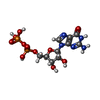 ChemComp-GDP: |
-Experimental details
-Structure determination
| Method | cryo EM |
|---|---|
 Processing Processing | single particle reconstruction |
| Aggregation state | particle |
-Sample preparation
| Buffer | pH: 7.4 |
|---|---|
| Grid | Model: UltrAuFoil R1.2/1.3 / Pretreatment - Type: GLOW DISCHARGE |
| Vitrification | Cryogen name: ETHANE / Chamber humidity: 95 % |
- Electron microscopy
| Microscope | TFS KRIOS |
|---|---|
| Image recording | Film or detector model: FEI FALCON IV (4k x 4k) / Number grids imaged: 1 / Number real images: 6878 / Average electron dose: 50.0 e/Å2 |
| Electron beam | Acceleration voltage: 300 kV / Electron source:  FIELD EMISSION GUN FIELD EMISSION GUN |
| Electron optics | C2 aperture diameter: 50.0 µm / Illumination mode: FLOOD BEAM / Imaging mode: BRIGHT FIELD / Cs: 2.7 mm / Nominal defocus max: 3.0 µm / Nominal defocus min: 1.0 µm / Nominal magnification: 3000 |
| Sample stage | Specimen holder model: FEI TITAN KRIOS AUTOGRID HOLDER / Cooling holder cryogen: NITROGEN |
| Experimental equipment |  Model: Titan Krios / Image courtesy: FEI Company |
