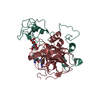
Movie
Movie Controller


+ Open data

- Basic information
| Entry | Database: PDB / ID: 9yq8 | ||||||||||||||||||
|---|---|---|---|---|---|---|---|---|---|---|---|---|---|---|---|---|---|---|---|
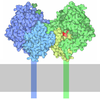
| Title | Cryo-EM complex of meizothrombinDESF1, factor Xa, and factor Va | ||||||||||||||||||
 Components Components |
| ||||||||||||||||||
 Keywords Keywords | BLOOD CLOTTING / Coagulation cascade / Serine Proteases / Thrombotic / Clotting Factors | ||||||||||||||||||
| Function / homology |  Function and homology information Function and homology informationresponse to vitamin K / coagulation factor Xa / platelet alpha granule / Cargo concentration in the ER / COPII-coated ER to Golgi transport vesicle / Defective factor IX causes thrombophilia / Defective cofactor function of FVIIIa variant / Defective F9 variant does not activate FX / COPII-mediated vesicle transport / : ...response to vitamin K / coagulation factor Xa / platelet alpha granule / Cargo concentration in the ER / COPII-coated ER to Golgi transport vesicle / Defective factor IX causes thrombophilia / Defective cofactor function of FVIIIa variant / Defective F9 variant does not activate FX / COPII-mediated vesicle transport / : / blood circulation / negative regulation of astrocyte differentiation / : / thrombospondin receptor activity / thrombin / thrombin-activated receptor signaling pathway / Defective factor XII causes hereditary angioedema / regulation of blood coagulation / neutrophil-mediated killing of gram-negative bacterium / positive regulation of phospholipase C-activating G protein-coupled receptor signaling pathway / Defective F8 cleavage by thrombin / Platelet Aggregation (Plug Formation) / positive regulation of collagen biosynthetic process / negative regulation of platelet activation / negative regulation of blood coagulation / negative regulation of fibrinolysis / positive regulation of blood coagulation / negative regulation of proteolysis / : / positive regulation of TOR signaling / Transport of gamma-carboxylated protein precursors from the endoplasmic reticulum to the Golgi apparatus / Gamma-carboxylation of protein precursors / Removal of aminoterminal propeptides from gamma-carboxylated proteins / fibrinolysis / regulation of cytosolic calcium ion concentration / : / negative regulation of cytokine production involved in inflammatory response / endoplasmic reticulum-Golgi intermediate compartment membrane / platelet alpha granule lumen / Regulation of Complement cascade / acute-phase response / positive regulation of release of sequestered calcium ion into cytosol / positive regulation of receptor signaling pathway via JAK-STAT / Cell surface interactions at the vascular wall / Peptide ligand-binding receptors / growth factor activity / Post-translational protein phosphorylation / response to wounding / lipopolysaccharide binding / platelet activation / positive regulation of protein localization to nucleus / phospholipid binding / Golgi lumen / Regulation of Insulin-like Growth Factor (IGF) transport and uptake by Insulin-like Growth Factor Binding Proteins (IGFBPs) / positive regulation of reactive oxygen species metabolic process / blood coagulation / Platelet degranulation / heparin binding / extracellular vesicle / Thrombin signalling through proteinase activated receptors (PARs) / Dengue Virus-Host Interactions / antimicrobial humoral immune response mediated by antimicrobial peptide / blood microparticle / extracellular matrix / G alpha (q) signalling events / cell surface receptor signaling pathway / positive regulation of cell migration / endoplasmic reticulum lumen / receptor ligand activity / copper ion binding / serine-type endopeptidase activity / external side of plasma membrane / signaling receptor binding / calcium ion binding / proteolysis / : / extracellular exosome / extracellular region / membrane / plasma membrane Similarity search - Function | ||||||||||||||||||
| Biological species |  Homo sapiens (human) Homo sapiens (human) | ||||||||||||||||||
| Method | ELECTRON MICROSCOPY / single particle reconstruction / cryo EM / Resolution: 3.84 Å | ||||||||||||||||||
 Authors Authors | Stojanovski, B.M. / Mohammed, B.M. / Basore, K. / Di Cera, E. | ||||||||||||||||||
| Funding support |  United States, 5items United States, 5items
| ||||||||||||||||||
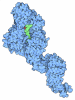
 Citation Citation | Journal: Blood / Year: 2026 Title: Molecular mechanism of cleavage at R271 during prothrombin activation revealed by cryo-EM. Authors: Bosko M Stojanovski / Bassem M Mohammed / Katherine Basore / Enrico Di Cera / Abstract: The conversion of the inactive zymogen prothrombin to the active protease thrombin in the common pathway of the coagulation cascade is the molecular event responsible for the pathophysiology of ...The conversion of the inactive zymogen prothrombin to the active protease thrombin in the common pathway of the coagulation cascade is the molecular event responsible for the pathophysiology of hemostasis and thrombosis. The conversion entails 2 proteolytic cleavages at R320 and R271 by the prothrombinase complex composed of the enzyme factor Xa (fXa), the cofactor fVa, Ca2+, and phospholipids. A recent cryogenic electron microscopy (cryo-EM) structure revealed how cleavage at R320 generates the active intermediate meizothrombin in the first step of the activation pathway. Here we present the 3.8 Å resolution cryo-EM structure of a truncated form of meizothrombin (mzTΔF1) bound to fVa and fXa that reveals how the second cleavage at R271 generates thrombin. The cleavage is brokered by molecular contacts that involve mostly the protease domains of mzTΔF1 and fXa and largely validate the results from biochemical studies. The switch in cleavage site from R320 to R271 involves a significant reorientation rather than conformational transitions of the protease domain of mzTΔF1 that moves the guanidinium group of R271 more than 20 Å into the primary specificity pocket of fXa. The findings complete the cryo-EM structural analysis of prothrombin activation along the meizothrombin pathway and advance our molecular understanding of a reaction critical to the pathophysiology of blood coagulation. | ||||||||||||||||||
| History |
|
- Structure visualization
| Structure viewer | Molecule: MolmilJmol/JSmol |
|---|
- Downloads & links
-Download
| PDBx/mmCIF format | 9yq8.cif.gz | 357.2 KB | Display | PDBx/mmCIF format |
|---|---|---|---|---|
| PDB format | pdb9yq8.ent.gz | 279.5 KB | Display | PDB format |
| PDBx/mmJSON format | 9yq8.json.gz | Tree view | PDBx/mmJSON format | |
| Others |  Other downloads Other downloads |
-Validation report
| Arichive directory | https://data.pdbj.org/pub/pdb/validation_reports/yq/9yq8ftp://data.pdbj.org/pub/pdb/validation_reports/yq/9yq8 | HTTPS FTP |
|---|
-Related structure data
| Related structure data |  73327MC C: citing same article ( M: map data used to model this data |
|---|---|
| Similar structure data |


-Links
 PDBj
PDBj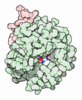
- Assembly
| Deposited unit | 
|
|---|---|
| 1 |
|
-Components
| #1: Protein | Mass: 38589.340 Da / Num. of mol.: 1 / Mutation: S379A Source method: isolated from a genetically manipulated source Source: (gene. exp.) Homo sapiens (human) / Gene: F10 / Production host:  Mesocricetus auratus (golden hamster) / References: UniProt: P00742, coagulation factor Xa Mesocricetus auratus (golden hamster) / References: UniProt: P00742, coagulation factor Xa |
|---|---|
| #2: Protein | Mass: 75283.008 Da / Num. of mol.: 1 / Fragment: Domains C1, C2, and A3 (UNP residues 1574-2224) / Source method: isolated from a natural source / Source: (natural) Homo sapiens (human) / References: UniProt: P12259 |
| #3: Protein | Mass: 16503.898 Da / Num. of mol.: 1 / Fragment: kringle 2/A-chain Source method: isolated from a genetically manipulated source Source: (gene. exp.) Homo sapiens (human) / Gene: F2 / Cell (production host): Baby hamster kidney / Production host: Mesocricetus auratus (golden hamster) / References: UniProt: P00734, thrombin |
| #4: Protein | Mass: 29578.055 Da / Num. of mol.: 1 / Mutation: S525A Source method: isolated from a genetically manipulated source Source: (gene. exp.) Homo sapiens (human) / Gene: F2 / Production host: Mesocricetus auratus (golden hamster) / References: UniProt: P00734, thrombin |
| #5: Protein | Mass: 77205.906 Da / Num. of mol.: 1 / Source method: isolated from a natural source / Source: (natural) Homo sapiens (human) / References: UniProt: P12259 |
| Has protein modification | Y |
-Experimental details
-Experiment
| Experiment | Method: ELECTRON MICROSCOPY |
|---|---|
| EM experiment | Aggregation state: PARTICLE / 3D reconstruction method: single particle reconstruction |
- Sample preparation
| Component |
| ||||||||||||||||||||||||
|---|---|---|---|---|---|---|---|---|---|---|---|---|---|---|---|---|---|---|---|---|---|---|---|---|---|
| Source (natural) |
| ||||||||||||||||||||||||
| Source (recombinant) | Organism: Mesocricetus auratus (golden hamster) | ||||||||||||||||||||||||
| Buffer solution | pH: 7.5 | ||||||||||||||||||||||||
| Specimen | Embedding applied: NO / Shadowing applied: NO / Staining applied: NO / Vitrification applied: YES | ||||||||||||||||||||||||
| Specimen support | Grid material: COPPER / Grid type: Quantifoil R1.2/1.3 | ||||||||||||||||||||||||
| Vitrification | Instrument: FEI VITROBOT MARK IV / Cryogen name: ETHANE |
- Electron microscopy imaging
| Experimental equipment |  Model: Titan Krios / Image courtesy: FEI Company |
|---|---|
| Microscopy | Model: TFS KRIOS / Details: Preliminary grid screening was performed manually. |
| Electron gun | Electron source:  FIELD EMISSION GUN / Accelerating voltage: 300 kV / Illumination mode: FLOOD BEAM FIELD EMISSION GUN / Accelerating voltage: 300 kV / Illumination mode: FLOOD BEAM |
| Electron lens | Mode: BRIGHT FIELD / Nominal magnification: 75000 X / Nominal defocus max: 2400 nm / Nominal defocus min: 1000 nm / Cs: 0.01 mm / C2 aperture diameter: 150 µm / Alignment procedure: ZEMLIN TABLEAU |
| Specimen holder | Cryogen: NITROGEN / Specimen holder model: FEI TITAN KRIOS AUTOGRID HOLDER |
| Image recording | Electron dose: 51 e/Å2 / Film or detector model: FEI FALCON IV (4k x 4k) / Num. of grids imaged: 3 / Num. of real images: 5179 / Details: 28% of images collected at 30 degree stage tilt. |
| EM imaging optics | Spherical aberration corrector: Microscope is outfitted with a Cs image corrector with two hexapole elements. |
| Image scans | Width: 4096 / Height: 4096 |
- Processing
| EM software |
| ||||||||||||||||||||||||||||||||||||||||||||||||||||||||
|---|---|---|---|---|---|---|---|---|---|---|---|---|---|---|---|---|---|---|---|---|---|---|---|---|---|---|---|---|---|---|---|---|---|---|---|---|---|---|---|---|---|---|---|---|---|---|---|---|---|---|---|---|---|---|---|---|---|
| CTF correction | Type: PHASE FLIPPING AND AMPLITUDE CORRECTION | ||||||||||||||||||||||||||||||||||||||||||||||||||||||||
| 3D reconstruction | Resolution: 3.84 Å / Resolution method: FSC 0.143 CUT-OFF / Num. of particles: 38200 / Symmetry type: POINT | ||||||||||||||||||||||||||||||||||||||||||||||||||||||||
| Atomic model building |
| ||||||||||||||||||||||||||||||||||||||||||||||||||||||||
| Atomic model building |
|