 Movie
Movie Controller


+ Open data

- Basic information
| Entry | Database: PDB / ID: 9wsv | |||||||||||||||||||||
|---|---|---|---|---|---|---|---|---|---|---|---|---|---|---|---|---|---|---|---|---|---|---|
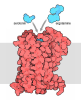
| Title | Cryo-EM structure of DAMGO-muOR-arrestin-1-Fab30 complex | |||||||||||||||||||||
 Components Components |
| |||||||||||||||||||||
 Keywords Keywords | MEMBRANE PROTEIN / G-protein-coupled receptors / mu-opioid receptor / single particle / Cryo-EM | |||||||||||||||||||||
| Function / homology |  Function and homology information Function and homology informationTGFBR3 regulates TGF-beta signaling / Opioid Signalling / MAP2K and MAPK activation / Activation of SMO / Golgi Associated Vesicle Biogenesis / renal water retention / Lysosome Vesicle Biogenesis / Defective AVP does not bind AVPR2 and causes neurohypophyseal diabetes insipidus (NDI) / spine apparatus / sperm ejaculation ...TGFBR3 regulates TGF-beta signaling / Opioid Signalling / MAP2K and MAPK activation / Activation of SMO / Golgi Associated Vesicle Biogenesis / renal water retention / Lysosome Vesicle Biogenesis / Defective AVP does not bind AVPR2 and causes neurohypophyseal diabetes insipidus (NDI) / spine apparatus / sperm ejaculation / regulation of systemic arterial blood pressure by vasopressin / Vasopressin-like receptors / renal water absorption / positive regulation of appetite / G-protein activation / Peptide ligand-binding receptors / vasopressin receptor activity / beta-endorphin receptor activity / morphine receptor activity / negative regulation of Wnt protein secretion / adenylate cyclase-inhibiting opioid receptor signaling pathway / AP-2 adaptor complex binding / Ub-specific processing proteases / clathrin coat of coated pit / negative regulation of luteinizing hormone secretion / Cargo recognition for clathrin-mediated endocytosis / clathrin heavy chain binding / telencephalon development / hemostasis / protein localization to non-motile cilium / G protein-coupled opioid receptor activity / G alpha (i) signalling events / G protein-coupled opioid receptor signaling pathway / Clathrin-mediated endocytosis / negative regulation of nitric oxide biosynthetic process / negative regulation of adenylate cyclase-activating G protein-coupled receptor signaling pathway / desensitization of G protein-coupled receptor signaling pathway / adenylate cyclase-inhibiting G protein-coupled acetylcholine receptor signaling pathway / behavioral response to ethanol / acetylcholine receptor binding / clathrin-dependent endocytosis / G protein-coupled receptor internalization / positive regulation of neurogenesis / inositol hexakisphosphate binding / regulation of NMDA receptor activity / neuropeptide binding / negative regulation of Notch signaling pathway / Thrombin signalling through proteinase activated receptors (PARs) / G alpha (s) signalling events / sensory perception / eating behavior / clathrin binding / positive regulation of smoothened signaling pathway / small molecule binding / negative regulation of cytosolic calcium ion concentration / positive regulation of systemic arterial blood pressure / pseudopodium / positive regulation of intracellular signal transduction / phosphatidylinositol-3,4,5-trisphosphate binding / social behavior / regulation of cellular response to stress / positive regulation of receptor internalization / transmission of nerve impulse / positive regulation of vasoconstriction / G-protein alpha-subunit binding / endocytic vesicle / cellular response to hormone stimulus / activation of adenylate cyclase activity / positive regulation of gluconeogenesis / voltage-gated calcium channel activity / sensory perception of pain / presynaptic modulation of chemical synaptic transmission / T-tubule / locomotory behavior / dendrite cytoplasm / excitatory postsynaptic potential / dendrite membrane / sarcoplasmic reticulum / clathrin-coated endocytic vesicle membrane / neuropeptide signaling pathway / receptor internalization / GABA-ergic synapse / sarcolemma / positive regulation of protein phosphorylation / G protein-coupled receptor binding / G protein-coupled receptor activity / adenylate cyclase-inhibiting G protein-coupled receptor signaling pathway / adenylate cyclase-modulating G protein-coupled receptor signaling pathway / phospholipase C-activating G protein-coupled receptor signaling pathway / Vasopressin regulates renal water homeostasis via Aquaporins / Cargo recognition for clathrin-mediated endocytosis / adenylate cyclase-activating dopamine receptor signaling pathway / Clathrin-mediated endocytosis / G-protein beta-subunit binding / adenylate cyclase-activating G protein-coupled receptor signaling pathway / cytoplasmic vesicle / presynaptic membrane / ubiquitin-dependent protein catabolic process / G alpha (s) signalling events / molecular adaptor activity Similarity search - Function | |||||||||||||||||||||
| Biological species |   Mus musculus (house mouse) Mus musculus (house mouse) Homo sapiens (human) Homo sapiens (human) Bos taurus (domestic cattle) Bos taurus (domestic cattle)synthetic construct (others) | |||||||||||||||||||||
| Method | ELECTRON MICROSCOPY / single particle reconstruction / cryo EM / Resolution: 2.8 Å | |||||||||||||||||||||
 Authors Authors | Zhang, H. / Wang, X. / Xi, K. / Shen, Q. / Xue, J. / Zhu, Y. / Yang, G. / Zhang, Y. | |||||||||||||||||||||
| Funding support | 1items
| |||||||||||||||||||||
 Citation Citation | Journal: Cell Res / Year: 2025 Title: The molecular basis of μ-opioid receptor signaling plasticity. Authors: Huibing Zhang / Xueting Wang / Kun Xi / Qingya Shen / Jianheng Xue / Yanqing Zhu / Shao-Kun Zang / Tianqiang Yu / Dan-Dan Shen / Jia Guo / Li-Nan Chen / Su-Yu Ji / Jiao Qin / Yingjun Dong / ...Authors: Huibing Zhang / Xueting Wang / Kun Xi / Qingya Shen / Jianheng Xue / Yanqing Zhu / Shao-Kun Zang / Tianqiang Yu / Dan-Dan Shen / Jia Guo / Li-Nan Chen / Su-Yu Ji / Jiao Qin / Yingjun Dong / Mingming Zhao / Ming Yang / Haijing Wu / Guoli Yang / Yan Zhang /  Abstract: Activation of the μ-opioid receptor (μOR) alleviates pain but also elicits adverse effects through diverse G proteins and β-arrestins. The structural details of μOR complexes with G and β- ...Activation of the μ-opioid receptor (μOR) alleviates pain but also elicits adverse effects through diverse G proteins and β-arrestins. The structural details of μOR complexes with G and β-arrestins have not been determined, impeding a comprehensive understanding of μOR signaling plasticity. Here, we present the cryo-EM structures of the μOR-G and μOR-βarr1 complexes, revealing selective conformational preferences of μOR when engaged with specific downstream signaling transducers. Integrated receptor pharmacology, including high-resolution structural analysis, cell signaling assays, and molecular dynamics simulations, demonstrated that transmembrane helix 1 (TM1) acts as an allosteric regulator of μOR signaling bias through differential stabilization of the G-, G-, and βarr1-bound states. Mechanistically, outward TM1 displacement confers structural flexibility that promotes G protein recruitment, whereas inward TM1 retraction facilitates βarr1 recruitment by stabilizing the intracellular binding pocket through coordinated interactions with TM2, TM7, and helix8. Structural comparisons between the G-, G-, and βarr1-bound complexes identified a TM1-fusion pocket with significant implications for downstream signaling regulation. Overall, we demonstrate that the conformational and thermodynamic heterogeneity of TM1 allosterically drives the downstream signaling specificity and plasticity of μOR, thereby expanding the understanding of μOR signal transduction mechanisms and providing new avenues for the rational design of analgesics. | |||||||||||||||||||||
| History |
|
- Structure visualization
| Structure viewer | Molecule: MolmilJmol/JSmol |
|---|
- Downloads & links
-Download
| PDBx/mmCIF format | 9wsv.cif.gz | 193 KB | Display | PDBx/mmCIF format |
|---|---|---|---|---|
| PDB format | pdb9wsv.ent.gz | 144 KB | Display | PDB format |
| PDBx/mmJSON format | 9wsv.json.gz | Tree view | PDBx/mmJSON format | |
| Others |  Other downloads Other downloads |
-Validation report
| Arichive directory | https://data.pdbj.org/pub/pdb/validation_reports/ws/9wsvftp://data.pdbj.org/pub/pdb/validation_reports/ws/9wsv | HTTPS FTP |
|---|
-Related structure data
| Related structure data |  66207MC  9wstC  9wswC  9wsxC M: map data used to model this data C: citing same article ( |
|---|---|
| Similar structure data |


-Links
 PDBj
PDBj
- Assembly
| Deposited unit | 
|
|---|---|
| 1 |
|
-Components
-Protein , 2 types, 2 molecules RC
| #1: Protein | Mass: 43316.148 Da / Num. of mol.: 1 Source method: isolated from a genetically manipulated source Source: (gene. exp.) Mus musculus (house mouse), (gene. exp.) Homo sapiens (human)Gene: Oprm1, Mor, Oprm, AVPR2, ADHR, DIR, DIR3, V2R / Production host:   Spodoptera frugiperda (fall armyworm) / References: UniProt: P42866, UniProt: P30518 Spodoptera frugiperda (fall armyworm) / References: UniProt: P42866, UniProt: P30518 |
|---|---|
| #2: Protein | Mass: 44135.273 Da / Num. of mol.: 1 Source method: isolated from a genetically manipulated source Source: (gene. exp.) Bos taurus (domestic cattle) / Gene: ARRB1 / Production host: Spodoptera frugiperda (fall armyworm) / References: UniProt: P17870 |
-Antibody , 2 types, 2 molecules HL
| #3: Antibody | Mass: 25333.227 Da / Num. of mol.: 1 Source method: isolated from a genetically manipulated source Source: (gene. exp.) synthetic construct (others) / Production host:   Escherichia coli (E. coli) Escherichia coli (E. coli) |
|---|---|
| #4: Antibody | Mass: 23566.260 Da / Num. of mol.: 1 Source method: isolated from a genetically manipulated source Source: (gene. exp.) synthetic construct (others) / Production host: Escherichia coli (E. coli) |
-Protein/peptide / Non-polymers , 2 types, 5 molecules P
| #5: Protein/peptide | 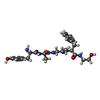 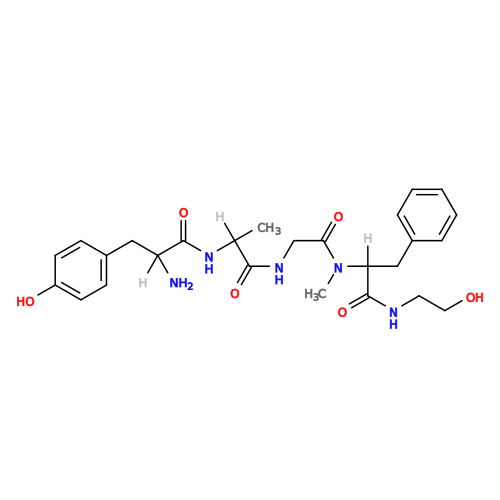 Type: Peptide-like / Class: Synthetic opioid / Mass: 513.587 Da / Num. of mol.: 1 / Source method: obtained synthetically / Source: (synth.) synthetic construct (others) / References: DAMGO Type: Peptide-like / Class: Synthetic opioid / Mass: 513.587 Da / Num. of mol.: 1 / Source method: obtained synthetically / Source: (synth.) synthetic construct (others) / References: DAMGO |
|---|---|
| #6: Water | ChemComp-HOH / Mass: 18.015 Da / Num. of mol.: 4 / Source method: isolated from a natural source / Formula: H2O |
-Details
| Has ligand of interest | Y |
|---|---|
| Has protein modification | Y |
-Experimental details
-Experiment
| Experiment | Method: ELECTRON MICROSCOPY |
|---|---|
| EM experiment | Aggregation state: PARTICLE / 3D reconstruction method: single particle reconstruction |
- Sample preparation
| Component | Name: Complex of DAMGO bound MOR-arrestin2 protein / Type: COMPLEX / Entity ID: #1-#5 / Source: RECOMBINANT | ||||||||||||
|---|---|---|---|---|---|---|---|---|---|---|---|---|---|
| Source (natural) |
| ||||||||||||
| Source (recombinant) |
| ||||||||||||
| Buffer solution | pH: 7.4 | ||||||||||||
| Specimen | Embedding applied: NO / Shadowing applied: NO / Staining applied: NO / Vitrification applied: YES | ||||||||||||
| Vitrification | Cryogen name: ETHANE |
- Electron microscopy imaging
| Experimental equipment |  Model: Titan Krios / Image courtesy: FEI Company |
|---|---|
| Microscopy | Model: TFS KRIOS |
| Electron gun | Electron source:  FIELD EMISSION GUN / Accelerating voltage: 300 kV / Illumination mode: FLOOD BEAM FIELD EMISSION GUN / Accelerating voltage: 300 kV / Illumination mode: FLOOD BEAM |
| Electron lens | Mode: BRIGHT FIELD / Nominal defocus max: 2000 nm / Nominal defocus min: 600 nm |
| Image recording | Electron dose: 52 e/Å2 / Film or detector model: FEI FALCON IV (4k x 4k) |
- Processing
| EM software |
| ||||||||||||||||||||||||
|---|---|---|---|---|---|---|---|---|---|---|---|---|---|---|---|---|---|---|---|---|---|---|---|---|---|
| CTF correction | Type: NONE | ||||||||||||||||||||||||
| 3D reconstruction | Resolution: 2.8 Å / Resolution method: FSC 0.143 CUT-OFF / Num. of particles: 233269 / Symmetry type: POINT | ||||||||||||||||||||||||
| Refinement | Highest resolution: 2.8 Å Stereochemistry target values: REAL-SPACE (WEIGHTED MAP SUM AT ATOM CENTERS) | ||||||||||||||||||||||||
| Refine LS restraints |
|
