 Movie
Movie Controller


+ Open data

- Basic information
| Entry | Database: PDB / ID: 9uxq | ||||||||||||||||||||||||||||||
|---|---|---|---|---|---|---|---|---|---|---|---|---|---|---|---|---|---|---|---|---|---|---|---|---|---|---|---|---|---|---|---|
| Title | Local refinement of AKG bound OXGR1 | ||||||||||||||||||||||||||||||
 Components Components | 2-oxoglutarate receptor 1 | ||||||||||||||||||||||||||||||
 Keywords Keywords | SIGNALING PROTEIN / 2-oxoglutarate / AKG / 2-oxoglutarate receptor 1 / OXGR1 / cryo-EM / membrane protein | ||||||||||||||||||||||||||||||
| Function / homology |  Function and homology information Function and homology informationClass A/1 (Rhodopsin-like receptors) / G protein-coupled receptor activity / phospholipase C-activating G protein-coupled receptor signaling pathway / signaling receptor activity / G alpha (i) signalling events / innate immune response / G protein-coupled receptor signaling pathway / membrane / plasma membrane Similarity search - Function | ||||||||||||||||||||||||||||||
| Biological species |  Homo sapiens (human) Homo sapiens (human) | ||||||||||||||||||||||||||||||
| Method | ELECTRON MICROSCOPY / single particle reconstruction / cryo EM / Resolution: 2.89 Å | ||||||||||||||||||||||||||||||
 Authors Authors | Liu, H. / Zhang, X. / Xu, H.E. | ||||||||||||||||||||||||||||||
| Funding support |  China, 1items China, 1items
| ||||||||||||||||||||||||||||||
 Citation Citation | Journal: EMBO J / Year: 2026 Title: Molecular architecture of OXGR1 reveals an evolutionary conserved mechanisms for metabolite surveillance. Authors: Xinyue Zhang / Yujie Lu / Xinheng He / Shimeng Guo / Changyao Li / Yu Wang / Yuan Gao / Juxia Yao / Qingning Yuan / Yinshan Tang / Jing Hu / Wen Hu / Zijuan Luo / Kai Wu / Yue Wang / Wanchao ...Authors: Xinyue Zhang / Yujie Lu / Xinheng He / Shimeng Guo / Changyao Li / Yu Wang / Yuan Gao / Juxia Yao / Qingning Yuan / Yinshan Tang / Jing Hu / Wen Hu / Zijuan Luo / Kai Wu / Yue Wang / Wanchao Yin / Xin Xie / H Eric Xu / Heng Liu / Abstract: The ability of cells to sense and respond to metabolic signals is fundamental to life, yet the molecular mechanisms underlying metabolite surveillance remain incompletely understood. Here, we ...The ability of cells to sense and respond to metabolic signals is fundamental to life, yet the molecular mechanisms underlying metabolite surveillance remain incompletely understood. Here, we elucidate the structural basis of metabolite recognition by OXGR1, a G Protein-Coupled Receptor (GPCR) that senses key intermediates in the tricarboxylic acid (TCA) cycle. Using cryo-electron microscopy, we determined cryo-EM structures of OXGR1 bound to α-ketoglutarate (AKG), itaconate (ITA), and structurally related metabolites succinate (SUC) and maleate (MA). These structures reveal a positively charged binding pocket and an extensive hydrogen-bond network that mediate selective recognition of dicarboxylic acids. In addition, we identify a distinct arrangement of hydrophobic residues that modulates ligand potency and selectivity. Mutational analysis and molecular dynamics simulations further demonstrate that noncanonical micro-switch motifs, including FRY and NLxxY, are essential for ligand recognition and receptor activation. Comparative structural and evolutionary analyses indicate that these mechanisms are conserved across species, underscoring the critical role of OXGR1 in maintaining metabolic homeostasis. Together, our findings define a mechanistic framework for metabolite sensing by OXGR1 and provide a framework for therapeutic modulation of metabolic and inflammatory diseases. | ||||||||||||||||||||||||||||||
| History |
|
- Structure visualization
| Structure viewer | Molecule: MolmilJmol/JSmol |
|---|
- Downloads & links
-Download
| PDBx/mmCIF format | 9uxq.cif.gz | 71.6 KB | Display | PDBx/mmCIF format |
|---|---|---|---|---|
| PDB format | pdb9uxq.ent.gz | 50 KB | Display | PDB format |
| PDBx/mmJSON format | 9uxq.json.gz | Tree view | PDBx/mmJSON format | |
| Others |  Other downloads Other downloads |
-Validation report
| Arichive directory | https://data.pdbj.org/pub/pdb/validation_reports/ux/9uxqftp://data.pdbj.org/pub/pdb/validation_reports/ux/9uxq | HTTPS FTP |
|---|
-Related structure data
| Related structure data |  64590MC  26xhC  9m1rC  9m1sC  9m1uC  9uxnC  9uxoC  9uxpC M: map data used to model this data C: citing same article ( |
|---|---|
| Similar structure data |


-Links
 PDBj
PDBj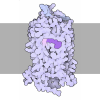
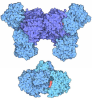
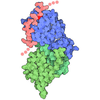
- Assembly
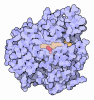
| Deposited unit | 
|
|---|---|
| 1 |
|
-Components
| #1: Protein | Mass: 38284.020 Da / Num. of mol.: 1 Source method: isolated from a genetically manipulated source Source: (gene. exp.) Homo sapiens (human) / Gene: OXGR1, GPR80, GPR99, P2RY15, P2Y15 / Production host:   Spodoptera frugiperda (fall armyworm) / References: UniProt: Q96P68 Spodoptera frugiperda (fall armyworm) / References: UniProt: Q96P68 |
|---|---|
| #2: Chemical | ChemComp-AKG / 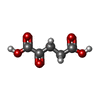 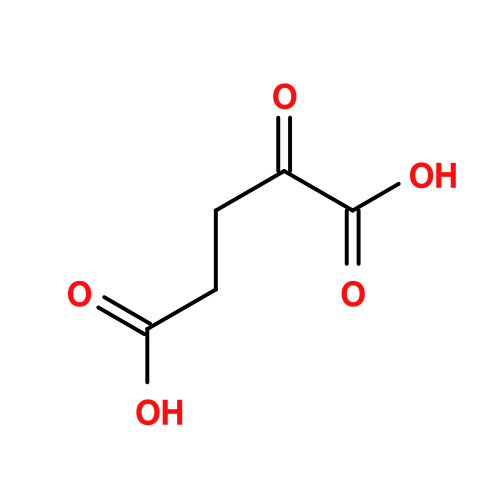 Mass: 146.098 Da / Num. of mol.: 1 / Source method: obtained synthetically / Formula: C5H6O5 / Feature type: SUBJECT OF INVESTIGATION Mass: 146.098 Da / Num. of mol.: 1 / Source method: obtained synthetically / Formula: C5H6O5 / Feature type: SUBJECT OF INVESTIGATION |
| #3: Water | ChemComp-HOH /  Mass: 18.015 Da / Num. of mol.: 2 / Source method: isolated from a natural source / Formula: H2O Mass: 18.015 Da / Num. of mol.: 2 / Source method: isolated from a natural source / Formula: H2O |
| Has ligand of interest | Y |
| Has protein modification | Y |
-Experimental details
-Experiment
| Experiment | Method: ELECTRON MICROSCOPY |
|---|---|
| EM experiment | Aggregation state: PARTICLE / 3D reconstruction method: single particle reconstruction |
- Sample preparation
| Component | Name: AKG bound OXGR1 / Type: COMPLEX / Entity ID: #1 / Source: RECOMBINANT |
|---|---|
| Source (natural) | Organism: Homo sapiens (human) |
| Source (recombinant) | Organism: Spodoptera frugiperda (fall armyworm) |
| Buffer solution | pH: 7.4 |
| Specimen | Embedding applied: NO / Shadowing applied: NO / Staining applied: NO / Vitrification applied: YES |
| Vitrification | Cryogen name: ETHANE |
- Electron microscopy imaging
| Experimental equipment | 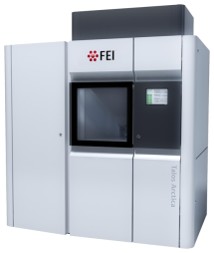 Model: Talos Arctica / Image courtesy: FEI Company |
|---|---|
| Microscopy | Model: FEI TALOS ARCTICA |
| Electron gun | Electron source:  FIELD EMISSION GUN / Accelerating voltage: 300 kV / Illumination mode: FLOOD BEAM FIELD EMISSION GUN / Accelerating voltage: 300 kV / Illumination mode: FLOOD BEAM |
| Electron lens | Mode: DARK FIELD / Nominal defocus max: 2000 nm / Nominal defocus min: 1000 nm |
| Image recording | Electron dose: 50 e/Å2 / Film or detector model: GATAN K3 (6k x 4k) |
- Processing
| EM software | Name: PHENIX / Version: 1.20.1_4487 / Category: model refinement | ||||||||||||||||||||||||
|---|---|---|---|---|---|---|---|---|---|---|---|---|---|---|---|---|---|---|---|---|---|---|---|---|---|
| CTF correction | Type: NONE | ||||||||||||||||||||||||
| 3D reconstruction | Resolution: 2.89 Å / Resolution method: FSC 0.143 CUT-OFF / Num. of particles: 405687 / Symmetry type: POINT | ||||||||||||||||||||||||
| Refinement | Highest resolution: 2.89 Å Stereochemistry target values: REAL-SPACE (WEIGHTED MAP SUM AT ATOM CENTERS) | ||||||||||||||||||||||||
| Refine LS restraints |
|
