 Movie
Movie Controller

[English] 日本語
 Yorodumi
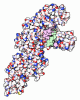
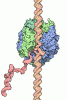
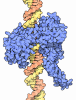
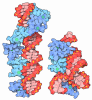
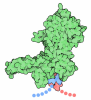
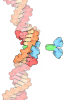
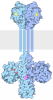
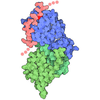
- PDB-9tay: Structure of the human inner kinetochore CCAN bound to a di-CENP-... -
+ Open data

- Basic information
| Entry | Database: PDB / ID: 9tay | |||||||||||||||
|---|---|---|---|---|---|---|---|---|---|---|---|---|---|---|---|---|
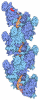
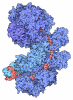
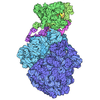
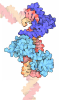
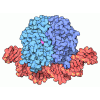
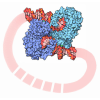
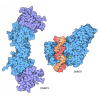
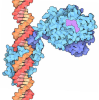
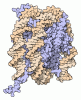
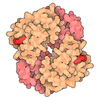
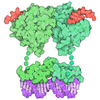
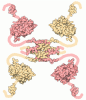
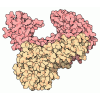
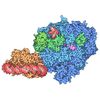
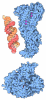
| Title | Structure of the human inner kinetochore CCAN bound to a di-CENP-A nucleosome | |||||||||||||||
 Components Components |
| |||||||||||||||
 Keywords Keywords | CELL CYCLE / Centromeres / Kinetochores | |||||||||||||||
| Function / homology |  Function and homology information Function and homology informationMGMT-mediated DNA damage reversal / FANCM-MHF complex / positive regulation of protein localization to kinetochore / Mis6-Sim4 complex / kinetochore organization / Fanconi anaemia nuclear complex / methylated-DNA-[protein]-cysteine S-methyltransferase / methylated-DNA-[protein]-cysteine S-methyltransferase activity / sex differentiation / metaphase chromosome alignment ...MGMT-mediated DNA damage reversal / FANCM-MHF complex / positive regulation of protein localization to kinetochore / Mis6-Sim4 complex / kinetochore organization / Fanconi anaemia nuclear complex / methylated-DNA-[protein]-cysteine S-methyltransferase / methylated-DNA-[protein]-cysteine S-methyltransferase activity / sex differentiation / metaphase chromosome alignment / kinetochore binding / inner kinetochore / resolution of meiotic recombination intermediates / DNA-methyltransferase activity / protein localization to chromosome, centromeric region / CENP-A containing chromatin assembly / condensed chromosome, centromeric region / chromosome organization / centriolar satellite / kinetochore assembly / positive regulation of double-strand break repair / mitotic sister chromatid segregation / mitotic cytokinesis / chromosome, centromeric region / mitotic metaphase chromosome alignment / pericentric heterochromatin / interstrand cross-link repair / negative regulation of megakaryocyte differentiation / protein localization to CENP-A containing chromatin / Replacement of protamines by nucleosomes in the male pronucleus / CENP-A containing nucleosome / Amplification of signal from unattached kinetochores via a MAD2 inhibitory signal / methyltransferase activity / Packaging Of Telomere Ends / Recognition and association of DNA glycosylase with site containing an affected purine / Cleavage of the damaged purine / Mitotic Prometaphase / EML4 and NUDC in mitotic spindle formation / telomere organization / ChAHP complex assembly / Deposition of new CENPA-containing nucleosomes at the centromere / Recognition and association of DNA glycosylase with site containing an affected pyrimidine / Cleavage of the damaged pyrimidine / replication fork processing / RNA Polymerase I Promoter Opening / positive regulation of protein ubiquitination / Inhibition of DNA recombination at telomere / Resolution of Sister Chromatid Cohesion / Assembly of the ORC complex at the origin of replication / FXIIa activates plasma kallikrein-kinin system / mitotic spindle organization / chromosome segregation / SUMOylation of chromatin organization proteins / NRIF signals cell death from the nucleus / Regulation of endogenous retroelements by the Human Silencing Hub (HUSH) complex / Meiotic synapsis / DNA methylation / Condensation of Prophase Chromosomes / Chromatin modifications during the maternal to zygotic transition (MZT) / HCMV Late Events / SIRT1 negatively regulates rRNA expression / NuRD complex assembly / ERCC6 (CSB) and EHMT2 (G9a) positively regulate rRNA expression / Interaction of NuRD complexes with transcription factors / PRC2 methylates histones and DNA / Regulation of endogenous retroelements by KRAB-ZFP proteins / Defective pyroptosis / CHD1 and CHD2 subfamily / establishment of mitotic spindle orientation / HDACs deacetylate histones / CHD6, CHD7, CHD8, CHD9 subfamily / Transcriptional regulation by small RNAs / Regulation of endogenous retroelements by Piwi-interacting RNAs (piRNAs) / RNA Polymerase I Promoter Escape / Nonhomologous End-Joining (NHEJ) / Fanconi Anemia Pathway / RHO GTPases Activate Formins / HDMs demethylate histones / Activated PKN1 stimulates transcription of AR (androgen receptor) regulated genes KLK2 and KLK3 / RUNX1 regulates genes involved in megakaryocyte differentiation and platelet function / Negative Regulation of CDH1 Gene Transcription / NoRC negatively regulates rRNA expression / PKR-mediated signaling / PKMTs methylate histone lysines / G2/M DNA damage checkpoint / Formation of the beta-catenin:TCF transactivating complex / B-WICH complex positively regulates rRNA expression / DNA Damage/Telomere Stress Induced Senescence / Meiotic recombination / kinetochore / Pre-NOTCH Transcription and Translation / Activation of anterior HOX genes in hindbrain development during early embryogenesis / Transcriptional regulation of granulopoiesis / nucleosomal DNA binding / nuclear matrix / RMTs methylate histone arginines / HCMV Early Events / Metalloprotease DUBs / innate immune response in mucosa / structural constituent of chromatin Similarity search - Function | |||||||||||||||
| Biological species |  Homo sapiens (human) Homo sapiens (human)  Mus musculus (house mouse) Mus musculus (house mouse) | |||||||||||||||
| Method | ELECTRON MICROSCOPY / single particle reconstruction / cryo EM / Resolution: 15.5 Å | |||||||||||||||
 Authors Authors | Yu, C. / Barford, D. | |||||||||||||||
| Funding support |  United Kingdom, 2items United Kingdom, 2items
| |||||||||||||||
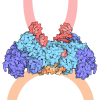
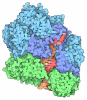
 Citation Citation | Journal: Nat Commun / Year: 2026 Title: Models for the architecture of the human inner kinetochore on centromeric α-satellite CENP-A nucleosome arrays. Authors: Cong Yu / Kyle W Muir / Jing Yang / Ziguo Zhang / Stephen H McLaughlin / David Barford / Abstract: Human kinetochores assemble onto centromeric DNA comprising repetitive arrays of the 171 bp α-satellite sequence. To understand the higher-order architecture of the inner kinetochore assembled ...Human kinetochores assemble onto centromeric DNA comprising repetitive arrays of the 171 bp α-satellite sequence. To understand the higher-order architecture of the inner kinetochore assembled onto α-satellite arrays, we show cryo-EM structures of CCAN with free DNA, and α-satellite repeat monomers and dimers with CENP-A nucleosomes. CCAN bound to free DNA and a monomeric CENP-A nucleosome engages 70 bp of DNA comprising 30 bp of an upstream α-satellite repeat. This upstream DNA interacts with the histone-fold domain subunits of the CENP-TWSX module in a manner resembling how nucleosomes wrap DNA gyres. A complex of CCAN assembled onto a dimeric α-satellite repeat with two CENP-A nucleosomes shows that CCAN can only be accommodated on the linker DNA by unwrapping DNA from both the CENP-TWSX module and the upstream nucleosome. We discuss the implications of these results for models of CCAN assembly on arrays of α-satellite chromatin containing CENP-A nucleosomes. | |||||||||||||||
| History |
|
- Structure visualization
| Structure viewer | Molecule: MolmilJmol/JSmol |
|---|
- Downloads & links
-Download
| PDBx/mmCIF format | 9tay.cif.gz | 1.3 MB | Display | PDBx/mmCIF format |
|---|---|---|---|---|
| PDB format | pdb9tay.ent.gz | Display | PDB format | |
| PDBx/mmJSON format | 9tay.json.gz | Tree view | PDBx/mmJSON format | |
| Others |  Other downloads Other downloads |
-Validation report
| Arichive directory | https://data.pdbj.org/pub/pdb/validation_reports/ta/9tayftp://data.pdbj.org/pub/pdb/validation_reports/ta/9tay | HTTPS FTP |
|---|
-Related structure data
| Related structure data |  55759MC  28opC  9tawC  9taxC C: citing same article ( M: map data used to model this data |
|---|---|
| Similar structure data |


-Links
 PDBj
PDBj



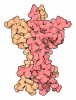

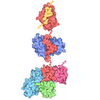
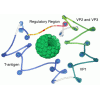
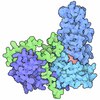

- Assembly
| Deposited unit | 
|
|---|---|
| 1 |
|
-Components
-Centromere protein ... , 14 types, 14 molecules HIKLMNOQUPRWSX
| #1: Protein | Mass: 28520.941 Da / Num. of mol.: 1 Source method: isolated from a genetically manipulated source Source: (gene. exp.) Homo sapiens (human) / Gene: CENPH, ICEN35 / Production host:  Trichoplusia ni (cabbage looper) / References: UniProt: Q9H3R5 Trichoplusia ni (cabbage looper) / References: UniProt: Q9H3R5 |
|---|---|
| #2: Protein | Mass: 87615.031 Da / Num. of mol.: 1 Source method: isolated from a genetically manipulated source Source: (gene. exp.) Homo sapiens (human) / Gene: CENPI, FSHPRH1, ICEN19, LRPR1 / Production host: Trichoplusia ni (cabbage looper) / References: UniProt: Q92674 |
| #3: Protein | Mass: 31696.070 Da / Num. of mol.: 1 Source method: isolated from a genetically manipulated source Source: (gene. exp.) Homo sapiens (human) / Gene: CENPK, ICEN37, FKSG14 / Production host: Trichoplusia ni (cabbage looper) / References: UniProt: Q9BS16 |
| #4: Protein | Mass: 39364.016 Da / Num. of mol.: 1 Source method: isolated from a genetically manipulated source Source: (gene. exp.) Homo sapiens (human) / Gene: CENPL, C1orf155, ICEN33 / Production host: Trichoplusia ni (cabbage looper) / References: UniProt: Q8N0S6 |
| #5: Protein | Mass: 19761.945 Da / Num. of mol.: 1 Source method: isolated from a genetically manipulated source Source: (gene. exp.) Homo sapiens (human) / Gene: CENPM, C22orf18, ICEN39, PANE1 / Production host: Trichoplusia ni (cabbage looper) / References: UniProt: Q9NSP4 |
| #6: Protein | Mass: 40541.641 Da / Num. of mol.: 1 Source method: isolated from a genetically manipulated source Source: (gene. exp.) Homo sapiens (human) / Gene: CENPN, C16orf60, ICEN32, BM-309 / Production host: Trichoplusia ni (cabbage looper) / References: UniProt: Q96H22 |
| #7: Protein | Mass: 33830.637 Da / Num. of mol.: 1 Source method: isolated from a genetically manipulated source Source: (gene. exp.) Homo sapiens (human) / Gene: CENPO, ICEN36, MCM21R / Production host: Trichoplusia ni (cabbage looper) / References: UniProt: Q9BU64 |
| #8: Protein | Mass: 24634.549 Da / Num. of mol.: 1 Source method: isolated from a genetically manipulated source Source: (gene. exp.) Homo sapiens (human) / Gene: CENPQ, C6orf139 / Production host: Trichoplusia ni (cabbage looper) / References: UniProt: Q7L2Z9 |
| #9: Protein | Mass: 24484.873 Da / Num. of mol.: 1 Source method: isolated from a genetically manipulated source Source: (gene. exp.) Homo sapiens (human) / Gene: CENPU, ICEN24, KLIP1, MLF1IP, PBIP1 / Production host: Trichoplusia ni (cabbage looper) / References: UniProt: Q71F23 |
| #10: Protein | Mass: 33210.949 Da / Num. of mol.: 1 Source method: isolated from a genetically manipulated source Source: (gene. exp.) Homo sapiens (human) / Gene: CENPP / Production host: Trichoplusia ni (cabbage looper) / References: UniProt: Q6IPU0 |
| #11: Protein | Mass: 20228.297 Da / Num. of mol.: 1 Source method: isolated from a genetically manipulated source Source: (gene. exp.) Homo sapiens (human) / Gene: ITGB3BP, CENPR, NRIF3 / Production host: Trichoplusia ni (cabbage looper) / References: UniProt: Q13352 |
| #13: Protein | Mass: 10087.236 Da / Num. of mol.: 1 Source method: isolated from a genetically manipulated source Source: (gene. exp.) Homo sapiens (human) / Gene: CENPW, C6orf173, CUG2 / Production host: Trichoplusia ni (cabbage looper) / References: UniProt: Q5EE01 |
| #14: Protein | Mass: 15917.875 Da / Num. of mol.: 1 Source method: isolated from a genetically manipulated source Source: (gene. exp.) Homo sapiens (human) / Gene: CENPS, APITD1, FAAP16, MHF1 / Production host: Trichoplusia ni (cabbage looper) / References: UniProt: Q8N2Z9 |
| #15: Protein | Mass: 8972.415 Da / Num. of mol.: 1 Source method: isolated from a genetically manipulated source Source: (gene. exp.) Homo sapiens (human) / Gene: CENPX, FAAP10, MHF2, STRA13 / Production host: Trichoplusia ni (cabbage looper) / References: UniProt: A8MT69 |
-Protein , 5 types, 17 molecules TAEcgBFdhCGeiDJfj
| #12: Protein | Mass: 84067.680 Da / Num. of mol.: 1 Source method: isolated from a genetically manipulated source Source: (gene. exp.) Homo sapiens (human) / Gene: MGMT, CENPT, C16orf56, ICEN22 / Production host: Trichoplusia ni (cabbage looper)References: UniProt: P16455, UniProt: Q96BT3, methylated-DNA-[protein]-cysteine S-methyltransferase | ||||||
|---|---|---|---|---|---|---|---|
| #16: Protein | Mass: 16023.630 Da / Num. of mol.: 4 Source method: isolated from a genetically manipulated source Source: (gene. exp.) Homo sapiens (human) / Gene: CENPA / Production host:   Escherichia coli (E. coli) / References: UniProt: P49450 Escherichia coli (E. coli) / References: UniProt: P49450#17: Protein | Mass: 11394.426 Da / Num. of mol.: 4 Source method: isolated from a genetically manipulated source Source: (gene. exp.) Homo sapiens (human)Gene: H4C1, H4/A, H4FA, HIST1H4A, H4C2, H4/I, H4FI, HIST1H4B, H4C3, H4/G, H4FG, HIST1H4C, H4C4, H4/B, H4FB, HIST1H4D, H4C5, H4/J, H4FJ, HIST1H4E, H4C6, H4/C, H4FC, HIST1H4F, H4C8, H4/H, H4FH, ...Gene: H4C1, H4/A, H4FA, HIST1H4A, H4C2, H4/I, H4FI, HIST1H4B, H4C3, H4/G, H4FG, HIST1H4C, H4C4, H4/B, H4FB, HIST1H4D, H4C5, H4/J, H4FJ, HIST1H4E, H4C6, H4/C, H4FC, HIST1H4F, H4C8, H4/H, H4FH, HIST1H4H, H4C9, H4/M, H4FM, HIST1H4I, H4C11, H4/E, H4FE, HIST1H4J, H4C12, H4/D, H4FD, HIST1H4K, H4C13, H4/K, H4FK, HIST1H4L, H4C14, H4/N, H4F2, H4FN, HIST2H4, HIST2H4A, H4C15, H4/O, H4FO, HIST2H4B, H4C16, H4-16, HIST4H4 Production host: Escherichia coli (E. coli) / References: UniProt: P62805#18: Protein | Mass: 16666.334 Da / Num. of mol.: 4 Source method: isolated from a genetically manipulated source Source: (gene. exp.) Homo sapiens (human) / Gene: H2AC6, H2AFL, HIST1H2AC / Production host: Escherichia coli (E. coli) / References: UniProt: Q93077#19: Protein | Mass: 13937.213 Da / Num. of mol.: 4 Source method: isolated from a genetically manipulated source Source: (gene. exp.) Homo sapiens (human)Gene: HIST1H2BC, H2BFL, HIST1H2BE, H2BFH, HIST1H2BF, H2BFG, HIST1H2BG, H2BFA, HIST1H2BI, H2BFK Production host: Escherichia coli (E. coli) / References: UniProt: P62807 |
-DNA chain , 2 types, 2 molecules VY
| #20: DNA chain | Mass: 99810.586 Da / Num. of mol.: 1 Source method: isolated from a genetically manipulated source Source: (gene. exp.) Homo sapiens (human) / Production host: Escherichia coli (E. coli) |
|---|---|
| #21: DNA chain | Mass: 100290.844 Da / Num. of mol.: 1 Source method: isolated from a genetically manipulated source Source: (gene. exp.) Homo sapiens (human) / Production host: Escherichia coli (E. coli) |
-Antibody , 1 types, 4 molecules Zamn
| #22: Antibody | Mass: 29161.340 Da / Num. of mol.: 4 Source method: isolated from a genetically manipulated source Source: (gene. exp.) Mus musculus (house mouse) / Production host: Escherichia coli (E. coli) |
|---|
-Details
| Has protein modification | Y |
|---|
-Experimental details
-Experiment
| Experiment | Method: ELECTRON MICROSCOPY |
|---|---|
| EM experiment | Aggregation state: PARTICLE / 3D reconstruction method: single particle reconstruction |
- Sample preparation
| Component | Name: Human inner kinetochore CCAN bound to a di-CENP-A nucleosome Type: COMPLEX / Entity ID: #1-#18, #22 / Source: RECOMBINANT |
|---|---|
| Source (natural) | Organism: Homo sapiens (human) |
| Source (recombinant) | Organism: Trichoplusia ni (cabbage looper) |
| Buffer solution | pH: 7.4 |
| Specimen | Embedding applied: NO / Shadowing applied: NO / Staining applied: NO / Vitrification applied: YES |
| Vitrification | Cryogen name: ETHANE |
- Electron microscopy imaging
| Experimental equipment |  Model: Titan Krios / Image courtesy: FEI Company |
|---|---|
| Microscopy | Model: TFS KRIOS |
| Electron gun | Electron source:  FIELD EMISSION GUN / Accelerating voltage: 300 kV / Illumination mode: FLOOD BEAM FIELD EMISSION GUN / Accelerating voltage: 300 kV / Illumination mode: FLOOD BEAM |
| Electron lens | Mode: BRIGHT FIELD / Nominal defocus max: 2000 nm / Nominal defocus min: 1000 nm |
| Specimen holder | Specimen holder model: FEI TITAN KRIOS AUTOGRID HOLDER |
| Image recording | Electron dose: 40 e/Å2 / Film or detector model: GATAN K3 BIOQUANTUM (6k x 4k) |
- Processing
| EM software |
| ||||||||||||||||||||||||
|---|---|---|---|---|---|---|---|---|---|---|---|---|---|---|---|---|---|---|---|---|---|---|---|---|---|
| CTF correction | Type: PHASE FLIPPING AND AMPLITUDE CORRECTION | ||||||||||||||||||||||||
| Symmetry | Point symmetry: C1 (asymmetric) | ||||||||||||||||||||||||
| 3D reconstruction | Resolution: 15.5 Å / Resolution method: FSC 0.143 CUT-OFF / Num. of particles: 15057 / Symmetry type: POINT | ||||||||||||||||||||||||
| Refinement | Highest resolution: 15.5 Å Stereochemistry target values: REAL-SPACE (WEIGHTED MAP SUM AT ATOM CENTERS) | ||||||||||||||||||||||||
| Refine LS restraints |
|
