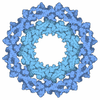
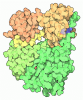
- EMDB-55757: Structure of the human inner kinetochore CCAN bound to DNA -
+
Open data
ID or keywords:
Loading...
-
Basic information
Entry
Database: EMDB / ID: EMD-55757
Title
Structure of the human inner kinetochore CCAN bound to DNA
Map data
Sample
Complex: Human inner kinetochore CCAN bound to alpha-satellite DNA
DNA: x 2 types
Protein or peptide: x 16 types
Keywords
Centromeres / Kinetochores / CELL CYCLE
Function / homology
Function and homology information
FANCM-MHF complex / positive regulation of protein localization to kinetochore / kinetochore binding / Mis6-Sim4 complex / kinetochore organization / spindle attachment to meiosis I kinetochore / inner kinetochore / Fanconi anaemia nuclear complex / metaphase chromosome alignment / sex differentiation ...FANCM-MHF complex / positive regulation of protein localization to kinetochore / kinetochore binding / Mis6-Sim4 complex / kinetochore organization / spindle attachment to meiosis I kinetochore / inner kinetochore / Fanconi anaemia nuclear complex / metaphase chromosome alignment / sex differentiation / centromeric DNA binding / resolution of meiotic recombination intermediates / CENP-A containing chromatin assembly / attachment of mitotic spindle microtubules to kinetochore / condensed chromosome, centromeric region / chromosome organization / kinetochore assembly / centriolar satellite / mitotic sister chromatid segregation / chromosome, centromeric region / pericentric heterochromatin / interstrand cross-link repair / Amplification of signal from unattached kinetochores via a MAD2 inhibitory signal / Mitotic Prometaphase / EML4 and NUDC in mitotic spindle formation / Deposition of new CENPA-containing nucleosomes at the centromere / replication fork processing / positive regulation of protein ubiquitination / Resolution of Sister Chromatid Cohesion / NRIF signals cell death from the nucleus / mitotic spindle organization / chromosome segregation / Fanconi Anemia Pathway / RHO GTPases Activate Formins / PKR-mediated signaling / kinetochore / nuclear matrix / Separation of Sister Chromatids / mitotic cell cycle / chromosome / nuclear body / cell adhesion / protein heterodimerization activity / cell division / DNA repair / apoptotic process / chromatin binding / DNA damage response / nucleolus / regulation of DNA-templated transcription / chromatin / signal transduction / DNA binding / DNA-templated transcription / nucleoplasm / membrane / identical protein binding / nucleus / cytosol / cytoplasm Similarity search - Function
Centromere protein W / : / CENP-W protein / Centromere protein T / Centromere kinetochore component CENP-T, N-terminal domain / Centromere kinetochore component CENP-T N-terminus / Centromere protein R / Centromere protein Q / Centromere protein P / Kinetochore component, CENP-R ...Centromere protein W / : / CENP-W protein / Centromere protein T / Centromere kinetochore component CENP-T, N-terminal domain / Centromere kinetochore component CENP-T N-terminus / Centromere protein R / Centromere protein Q / Centromere protein P / Kinetochore component, CENP-R / CENP-Q, a CENPA-CAD centromere complex subunit / CENP-A-nucleosome distal (CAD) centromere subunit, CENP-P / Centromere protein H, C-terminal / Centromere protein Cenp-K / Centromere protein H / Centromere protein H (CENP-H) / Centromere-associated protein K / Centromere protein U / CENP-A nucleosome associated complex (NAC) subunit / Centromere protein X / CENP-S/Mhf1 / CENP-S associating Centromere protein X / CENP-S protein / Centromere subunit L / Centromere protein L / Centromere protein Cenp-M / CENP-C, middle DNMT3B-binding domain / Centromere protein M (CENP-M) / Centromere assembly component CENP-C middle DNMT3B-binding region / Centromere protein I / Mis6 / Kinetochore assembly subunit CENP-C, N-terminal domain / Kinetochore assembly subunit CENP-C N-terminal / : / Centromere protein O / Mif2/CENP-C cupin domain / Centromere protein C/Mif2/cnp3 / Cenp-O kinetochore centromere component / Mif2/CENP-C like / Centromere protein Chl4/mis15/CENP-N / Centromere protein Chl4/mis15/CENP-N / RmlC-like cupin domain superfamily / RmlC-like jelly roll fold / CENP-T/Histone H4, histone fold / Centromere kinetochore component CENP-T histone fold / Histone-fold / P-loop containing nucleoside triphosphate hydrolase Similarity search - Domain/homology
Centromere protein X / Centromere protein C / Centromere protein R / Centromere protein W / Centromere protein P / Centromere protein U / Centromere protein Q / Centromere protein L / Centromere protein S / Centromere protein I ...Centromere protein X / Centromere protein C / Centromere protein R / Centromere protein W / Centromere protein P / Centromere protein U / Centromere protein Q / Centromere protein L / Centromere protein S / Centromere protein I / Centromere protein T / Centromere protein N / Centromere protein K / Centromere protein O / Centromere protein H / Centromere protein M Similarity search - Component
Biological species
Homo sapiens (human)
Method
single particle reconstruction / cryo EM / Resolution: 3.54 Å
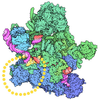
Journal: Nat Commun / Year: 2026 Title: Models for the architecture of the human inner kinetochore on centromeric α-satellite CENP-A nucleosome arrays. Authors: Cong Yu / Kyle W Muir / Jing Yang / Ziguo Zhang / Stephen H McLaughlin / David Barford / Abstract: Human kinetochores assemble onto centromeric DNA comprising repetitive arrays of the 171 bp α-satellite sequence. To understand the higher-order architecture of the inner kinetochore assembled ...Human kinetochores assemble onto centromeric DNA comprising repetitive arrays of the 171 bp α-satellite sequence. To understand the higher-order architecture of the inner kinetochore assembled onto α-satellite arrays, we show cryo-EM structures of CCAN with free DNA, and α-satellite repeat monomers and dimers with CENP-A nucleosomes. CCAN bound to free DNA and a monomeric CENP-A nucleosome engages 70 bp of DNA comprising 30 bp of an upstream α-satellite repeat. This upstream DNA interacts with the histone-fold domain subunits of the CENP-TWSX module in a manner resembling how nucleosomes wrap DNA gyres. A complex of CCAN assembled onto a dimeric α-satellite repeat with two CENP-A nucleosomes shows that CCAN can only be accommodated on the linker DNA by unwrapping DNA from both the CENP-TWSX module and the upstream nucleosome. We discuss the implications of these results for models of CCAN assembly on arrays of α-satellite chromatin containing CENP-A nucleosomes.
Entire : Human inner kinetochore CCAN bound to alpha-satellite DNA
Entire
Name: Human inner kinetochore CCAN bound to alpha-satellite DNA
Components
Complex: Human inner kinetochore CCAN bound to alpha-satellite DNA
DNA: DNA (82-MER)
DNA: DNA (80-MER)
Protein or peptide: Centromere protein H
Protein or peptide: Centromere protein I
Protein or peptide: Centromere protein K
Protein or peptide: Centromere protein L
Protein or peptide: Centromere protein M
Protein or peptide: Centromere protein N
Protein or peptide: Centromere protein O
Protein or peptide: Centromere protein P
Protein or peptide: Centromere protein Q
Protein or peptide: Centromere protein R
Protein or peptide: Centromere protein S
Protein or peptide: Centromere protein T
Protein or peptide: Centromere protein U
Protein or peptide: Centromere protein W
Protein or peptide: Centromere protein X
Protein or peptide: Centromere protein C,Centromere protein C,Centromere protein C,Centromere protein C,Methylated-DNA--protein-cysteine methyltransferase
+
Supramolecule #1: Human inner kinetochore CCAN bound to alpha-satellite DNA
Supramolecule
Name: Human inner kinetochore CCAN bound to alpha-satellite DNA type: complex / ID: 1 / Parent: 0 / Macromolecule list: all
Source (natural)
Organism: Homo sapiens (human)
+
Macromolecule #1: DNA (82-MER)
Macromolecule
Name: DNA (82-MER) / type: dna / ID: 1 / Number of copies: 1 / Classification: DNA
Name: Centromere protein X / type: protein_or_peptide / ID: 17 / Number of copies: 1 / Enantiomer: LEVO
Source (natural)
Organism: Homo sapiens (human)
Molecular weight
Theoretical: 8.972415 KDa
Recombinant expression
Organism: Trichoplusia ni (cabbage looper)
Sequence
String:
MEGAGAGSGF RKELVSRLLH LHFKDDKTKV SGDALQLMVE LLKVFVVEAA VRGVRQAQAE DALRVDVDQL EKVLPQLLLD F
UniProtKB: Centromere protein X
+
Macromolecule #18: Centromere protein C,Centromere protein C,Centromere protein C,Ce...
Macromolecule
Name: Centromere protein C,Centromere protein C,Centromere protein C,Centromere protein C,Methylated-DNA--protein-cysteine methyltransferase type: protein_or_peptide / ID: 18 / Number of copies: 1 / Enantiomer: LEVO EC number: methylated-DNA-[protein]-cysteine S-methyltransferase
In the structure databanks used in Yorodumi, some data are registered as the other names, "COVID-19 virus" and "2019-nCoV". Here are the details of the virus and the list of structure data.
Jan 31, 2019. EMDB accession codes are about to change! (news from PDBe EMDB page)
EMDB accession codes are about to change! (news from PDBe EMDB page)
The allocation of 4 digits for EMDB accession codes will soon come to an end. Whilst these codes will remain in use, new EMDB accession codes will include an additional digit and will expand incrementally as the available range of codes is exhausted. The current 4-digit format prefixed with “EMD-” (i.e. EMD-XXXX) will advance to a 5-digit format (i.e. EMD-XXXXX), and so on. It is currently estimated that the 4-digit codes will be depleted around Spring 2019, at which point the 5-digit format will come into force.
The EM Navigator/Yorodumi systems omit the EMD- prefix.
Related info.:Q: What is EMD? / ID/Accession-code notation in Yorodumi/EM Navigator
Yorodumi is a browser for structure data from EMDB, PDB, SASBDB, etc.
This page is also the successor to EM Navigator detail page, and also detail information page/front-end page for Omokage search.
The word "yorodu" (or yorozu) is an old Japanese word meaning "ten thousand". "mi" (miru) is to see.
Related info.:EMDB / PDB / SASBDB / Comparison of 3 databanks / Yorodumi Search / Aug 31, 2016. New EM Navigator & Yorodumi / Yorodumi Papers / Jmol/JSmol / Function and homology information / Changes in new EM Navigator and Yorodumi
 Movie
Movie Controller


 Open data
 Basic information
 Map data
 Sample
 Keywords
 Function and homology information
 Homo sapiens (human)
 Authors
 United Kingdom, 2 items
  Citation
 Structure visualization
 Downloads & links
 emd_55757.png
 http://ftp.pdbj.org/pub/emdb/structures/EMD-55757





 Z (Sec.)
 Y (Row.)
 X (Col.)


 Sample components
 Trichoplusia ni (cabbage looper)
 Processing
 Electron microscopy
 FIELD EMISSION GUN
