Movie
Movie Controller

[English] 日本語
 Yorodumi
- PDB-9s5z: Primed-state RyR1 with activating ligand mixture (Calcium/ACP/Caf... -
+ Open data

- Basic information
| Entry | Database: PDB / ID: 9s5z | |||||||||||||||
|---|---|---|---|---|---|---|---|---|---|---|---|---|---|---|---|---|
| Title | Primed-state RyR1 with activating ligand mixture (Calcium/ACP/Caffeine) in the native membrane solved by StA | |||||||||||||||
 Components Components |
| |||||||||||||||
 Keywords Keywords | MEMBRANE PROTEIN / ryanodine receptor type 1 / ryr1 / skeletal muscle / sarcoplasmic reticulum / SR / native membrane | |||||||||||||||
| Function / homology |  Function and homology information Function and homology informationATP-gated ion channel activity / cytoplasmic side of membrane / ryanodine-sensitive calcium-release channel activity / terminal cisterna / release of sequestered calcium ion into cytosol by sarcoplasmic reticulum / ossification involved in bone maturation / cellular response to caffeine / skin development / ryanodine receptor complex / organelle membrane ...ATP-gated ion channel activity / cytoplasmic side of membrane / ryanodine-sensitive calcium-release channel activity / terminal cisterna / release of sequestered calcium ion into cytosol by sarcoplasmic reticulum / ossification involved in bone maturation / cellular response to caffeine / skin development / ryanodine receptor complex / organelle membrane / outflow tract morphogenesis / smooth endoplasmic reticulum / intracellularly gated calcium channel activity / intracellular membrane-bounded organelle / regulation of ryanodine-sensitive calcium-release channel activity / toxic substance binding / skeletal muscle fiber development / voltage-gated calcium channel activity / release of sequestered calcium ion into cytosol / regulation of release of sequestered calcium ion into cytosol by sarcoplasmic reticulum / cellular response to calcium ion / muscle contraction / sarcoplasmic reticulum membrane / peptidylprolyl isomerase / sarcoplasmic reticulum / peptidyl-prolyl cis-trans isomerase activity / striated muscle contraction / sarcolemma / intracellular calcium ion homeostasis / calcium channel activity / Z disc / calcium ion transmembrane transport / disordered domain specific binding / calmodulin binding / protein homotetramerization / transmembrane transporter binding / calcium ion binding / ATP binding / membrane / identical protein binding / cytosol Similarity search - Function | |||||||||||||||
| Biological species |   Oryctolagus cuniculus (rabbit) Oryctolagus cuniculus (rabbit) | |||||||||||||||
| Method | ELECTRON MICROSCOPY / subtomogram averaging / cryo EM / Resolution: 4.43 Å | |||||||||||||||
 Authors Authors | Mikirtumov, V. | |||||||||||||||
| Funding support |  Germany, 2items Germany, 2items
| |||||||||||||||
 Citation Citation | Journal: To Be Published Title: Activation of RyR1 in native membranes Authors: Mikirtumov, V. / Golusik, S. / Sprink, T. / Balyschew, N. / Yang, W. / Kotecha, A. / Kudryashev, M. | |||||||||||||||
| History |
|
- Structure visualization
| Structure viewer | Molecule: MolmilJmol/JSmol |
|---|
- Downloads & links
-Download
| PDBx/mmCIF format | 9s5z.cif.gz | 5.7 MB | Display | PDBx/mmCIF format |
|---|---|---|---|---|
| PDB format | pdb9s5z.ent.gz | Display | PDB format | |
| PDBx/mmJSON format | 9s5z.json.gz | Tree view | PDBx/mmJSON format | |
| Others |  Other downloads Other downloads |
-Validation report
| Arichive directory | https://data.pdbj.org/pub/pdb/validation_reports/s5/9s5zftp://data.pdbj.org/pub/pdb/validation_reports/s5/9s5z | HTTPS FTP |
|---|
-Related structure data
| Related structure data |  54617MC  9s16C  9s1hC  9s2rC  9s2sC  9s3uC  9s3vC  9s4lC  9s4nC  9s54C  9s55C  9s5aC  9s5cC  9s5eC  9s5fC  9s5wC  9s5yC C: citing same article ( M: map data used to model this data |
|---|---|
| Similar structure data |


-Links
 PDBj
PDBj
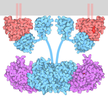
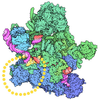
- Assembly
| Deposited unit | 
|
|---|---|
| 1 |
|
-Components
-Protein , 2 types, 8 molecules ABCDEFGH
| #1: Protein | Mass: 565908.625 Da / Num. of mol.: 4 / Source method: isolated from a natural source / Source: (natural) Oryctolagus cuniculus (rabbit) / References: UniProt: P11716#2: Protein | Mass: 11967.705 Da / Num. of mol.: 4 / Source method: isolated from a natural source / Source: (natural) Oryctolagus cuniculus (rabbit) / References: UniProt: P62943, peptidylprolyl isomerase |
|---|
-Non-polymers , 4 types, 16 molecules 

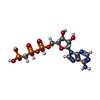
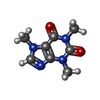
| #3: Chemical | ChemComp-ZN / 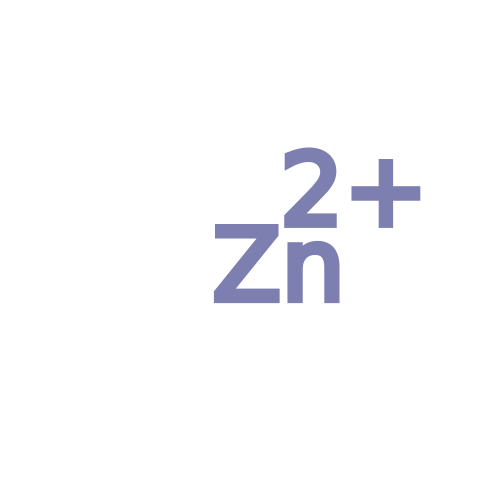 Mass: 65.409 Da / Num. of mol.: 4 / Source method: obtained synthetically / Formula: Zn / Feature type: SUBJECT OF INVESTIGATION Mass: 65.409 Da / Num. of mol.: 4 / Source method: obtained synthetically / Formula: Zn / Feature type: SUBJECT OF INVESTIGATION#4: Chemical | ChemComp-CA / 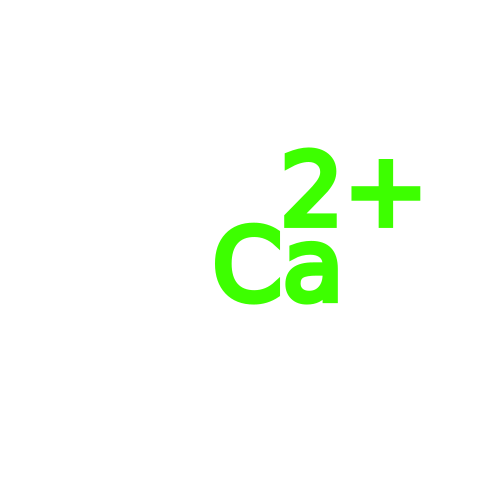 Mass: 40.078 Da / Num. of mol.: 4 / Source method: obtained synthetically / Formula: Ca / Feature type: SUBJECT OF INVESTIGATION Mass: 40.078 Da / Num. of mol.: 4 / Source method: obtained synthetically / Formula: Ca / Feature type: SUBJECT OF INVESTIGATION#5: Chemical | ChemComp-ACP / 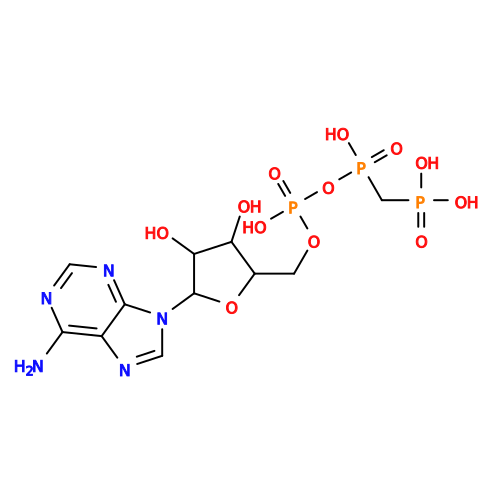 Mass: 505.208 Da / Num. of mol.: 4 / Source method: obtained synthetically / Formula: C11H18N5O12P3 / Feature type: SUBJECT OF INVESTIGATION / Comment: AMP-PCP, energy-carrying molecule analogue*YM Mass: 505.208 Da / Num. of mol.: 4 / Source method: obtained synthetically / Formula: C11H18N5O12P3 / Feature type: SUBJECT OF INVESTIGATION / Comment: AMP-PCP, energy-carrying molecule analogue*YM#6: Chemical | ChemComp-CFF / 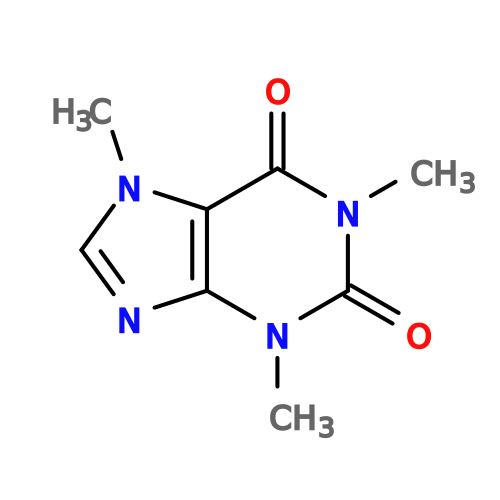 Mass: 194.191 Da / Num. of mol.: 4 / Source method: obtained synthetically / Formula: C8H10N4O2 / Feature type: SUBJECT OF INVESTIGATION / Comment: medication*YM Mass: 194.191 Da / Num. of mol.: 4 / Source method: obtained synthetically / Formula: C8H10N4O2 / Feature type: SUBJECT OF INVESTIGATION / Comment: medication*YM |
|---|
-Details
| Has ligand of interest | Y |
|---|---|
| Has protein modification | Y |
-Experimental details
-Experiment
| Experiment | Method: ELECTRON MICROSCOPY |
|---|---|
| EM experiment | Aggregation state: PARTICLE / 3D reconstruction method: subtomogram averaging |
- Sample preparation
| Component | Name: Ryanodine receptor type 1 in complex with FKBP12 in the sarcoplasmic reticulum membrane Type: ORGANELLE OR CELLULAR COMPONENT Details: Sarcoplasmic reticulum membrane vesicles purified from the native skeletal muscle tissue Entity ID: #1-#2 / Source: NATURAL |
|---|---|
| Molecular weight | Value: 2.2 MDa / Experimental value: NO |
| Source (natural) | Organism: Oryctolagus cuniculus (rabbit) / Organ: hind leg and back / Organelle: sarcoplasmic reticulum / Tissue: skeletal muscle |
| Buffer solution | pH: 7.1 |
| Specimen | Conc.: 29.5 mg/ml / Embedding applied: NO / Shadowing applied: NO / Staining applied: NO / Vitrification applied: YES |
| Specimen support | Grid material: GOLD / Grid mesh size: 200 divisions/in. / Grid type: UltrAuFoil R2/2 |
| Vitrification | Instrument: FEI VITROBOT MARK IV / Cryogen name: ETHANE / Humidity: 95 % / Chamber temperature: 277.15 K |
- Electron microscopy imaging
| Experimental equipment |  Model: Titan Krios / Image courtesy: FEI Company |
|---|---|
| Microscopy | Model: TFS KRIOS |
| Electron gun | Electron source:  FIELD EMISSION GUN / Accelerating voltage: 300 kV / Illumination mode: FLOOD BEAM FIELD EMISSION GUN / Accelerating voltage: 300 kV / Illumination mode: FLOOD BEAM |
| Electron lens | Mode: BRIGHT FIELD / Nominal magnification: 64000 X / Calibrated magnification: 64000 X / Nominal defocus max: 7000 nm / Nominal defocus min: 2000 nm / Calibrated defocus min: 2000 nm / Calibrated defocus max: 7000 nm / Cs: 2.7 mm / C2 aperture diameter: 50 µm |
| Specimen holder | Cryogen: NITROGEN / Specimen holder model: FEI TITAN KRIOS AUTOGRID HOLDER |
| Image recording | Average exposure time: 2 sec. / Electron dose: 4.17 e/Å2 / Avg electron dose per subtomogram: 117 e/Å2 / Film or detector model: GATAN K3 (6k x 4k) / Num. of real images: 1 |
| EM imaging optics | Energyfilter name: GIF Bioquantum / Energyfilter slit width: 20 eV |
| Image scans | Width: 11520 / Height: 8184 |
- Processing
| EM software |
| ||||||||||||||||||||||||||||||||||||||||||||||||||||
|---|---|---|---|---|---|---|---|---|---|---|---|---|---|---|---|---|---|---|---|---|---|---|---|---|---|---|---|---|---|---|---|---|---|---|---|---|---|---|---|---|---|---|---|---|---|---|---|---|---|---|---|---|---|
| CTF correction | Type: PHASE FLIPPING AND AMPLITUDE CORRECTION | ||||||||||||||||||||||||||||||||||||||||||||||||||||
| Particle selection | Num. of particles selected: 2171564 | ||||||||||||||||||||||||||||||||||||||||||||||||||||
| Symmetry | Point symmetry: C4 (4 fold cyclic) | ||||||||||||||||||||||||||||||||||||||||||||||||||||
| 3D reconstruction | Resolution: 4.43 Å / Resolution method: FSC 0.143 CUT-OFF / Num. of particles: 13358 / Algorithm: FOURIER SPACE / Num. of class averages: 1 / Symmetry type: POINT | ||||||||||||||||||||||||||||||||||||||||||||||||||||
| EM volume selection | Method: pyTOM Template Matching / Num. of tomograms: 182 / Num. of volumes extracted: 524185 / Reference model: EMD-17272 | ||||||||||||||||||||||||||||||||||||||||||||||||||||
| Atomic model building | Protocol: FLEXIBLE FIT / Space: REAL | ||||||||||||||||||||||||||||||||||||||||||||||||||||
| Atomic model building | PDB-ID: 7tzc Accession code: 7tzc / Source name: PDB / Type: experimental model |