 Movie
Movie Controller

[English] 日本語
 Yorodumi
- PDB-9oql: Putative ATP-bound class from combined 10, 20, 30 mM ATP datasets -
+ Open data

- Basic information
| Entry | Database: PDB / ID: 9oql | ||||||||||||||||||||||||
|---|---|---|---|---|---|---|---|---|---|---|---|---|---|---|---|---|---|---|---|---|---|---|---|---|---|
| Title | Putative ATP-bound class from combined 10, 20, 30 mM ATP datasets | ||||||||||||||||||||||||
 Components Components | Pannexin-1 | ||||||||||||||||||||||||
 Keywords Keywords | TRANSPORT PROTEIN / Pannexin 1 / ATP release / large-pore ion channel / membrane protein | ||||||||||||||||||||||||
| Function / homology |  Function and homology information Function and homology informationATP transmembrane transporter activity / ATP transport / leak channel activity / Electric Transmission Across Gap Junctions / wide pore channel activity / monoatomic anion transmembrane transport / bleb / monoatomic anion channel activity / gap junction / gap junction channel activity ...ATP transmembrane transporter activity / ATP transport / leak channel activity / Electric Transmission Across Gap Junctions / wide pore channel activity / monoatomic anion transmembrane transport / bleb / monoatomic anion channel activity / gap junction / gap junction channel activity / Mechanical load activates signaling by PIEZO1 and integrins in osteocytes / The NLRP3 inflammasome / monoatomic cation transport / positive regulation of interleukin-1 beta production / calcium channel activity / calcium ion transport / actin filament binding / cell-cell signaling / protease binding / scaffold protein binding / High laminar flow shear stress activates signaling by PIEZO1 and PECAM1:CDH5:KDR in endothelial cells / transmembrane transporter binding / signaling receptor binding / endoplasmic reticulum membrane / structural molecule activity / endoplasmic reticulum / protein-containing complex / membrane / identical protein binding / plasma membrane Similarity search - Function | ||||||||||||||||||||||||
| Biological species |  Homo sapiens (human) Homo sapiens (human) | ||||||||||||||||||||||||
| Method | ELECTRON MICROSCOPY / single particle reconstruction / cryo EM / Resolution: 2.77 Å | ||||||||||||||||||||||||
 Authors Authors | Ruan, Z. / Li, Y. / Du, J. / Lu, W. | ||||||||||||||||||||||||
| Funding support |  United States, 6items United States, 6items
| ||||||||||||||||||||||||
 Citation Citation | Journal: Nat Commun / Year: 2025 Title: Structural basis of PANX1 permeation and positive modulation by mefloquine. Authors: Yangyang Li / Zheng Ruan / Junuk Lee / Ian J Orozco / Edward Zhou / Juan Du / Wei Lü / Abstract: Purinergic signaling relies on ATP release through exocytosis and large-pore channels. Large-pore channels permeate both small anions like chloride and large signaling molecules like ATP, but how ...Purinergic signaling relies on ATP release through exocytosis and large-pore channels. Large-pore channels permeate both small anions like chloride and large signaling molecules like ATP, but how this broad cargo selectivity is structurally controlled remains elusive. Here we investigate PANX1, a prototypical large-pore channel, and uncover structural plasticity at the extracellular entrance formed by seven tryptophan (W74) residues. The W74 sidechains are flexible, sampling conformations that range from a constricted state permissive only to chloride to a dilated state compatible with ATP. These states are coupled to variable cation-π interactions between W74 and arginine 75 (R75), suggesting a mechanism for dynamic tuning of pore architecture and selective cargo permeation. We also identify mefloquine as a positive modulator of PANX1 that binds near the side tunnel to control ion flow through this pathway. Together, these findings define the structural principles underlying PANX1 permeation and modulation. | ||||||||||||||||||||||||
| History |
|
- Structure visualization
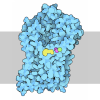
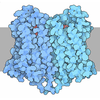
| Structure viewer | Molecule: MolmilJmol/JSmol |
|---|
- Downloads & links
-Download
| PDBx/mmCIF format | 9oql.cif.gz | 902.1 KB | Display | PDBx/mmCIF format |
|---|---|---|---|---|
| PDB format | pdb9oql.ent.gz | 760.5 KB | Display | PDB format |
| PDBx/mmJSON format | 9oql.json.gz | Tree view | PDBx/mmJSON format | |
| Others |  Other downloads Other downloads |
-Validation report
| Arichive directory | https://data.pdbj.org/pub/pdb/validation_reports/oq/9oqlftp://data.pdbj.org/pub/pdb/validation_reports/oq/9oql | HTTPS FTP |
|---|
-Related structure data
| Related structure data |  70765MC  9oqgC  9oqhC  9oqiC  9oqjC  9oqkC  9oqmC  9oqnC  9oqoC  9oqpC  9oqqC M: map data used to model this data C: citing same article ( |
|---|---|
| Similar structure data |


-Links
 PDBj
PDBj
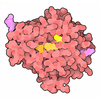
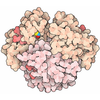
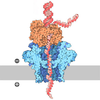
- Assembly
| Deposited unit | 
|
|---|---|
| 1 |
|
-Components
| #1: Protein | Mass: 48093.863 Da / Num. of mol.: 7 Source method: isolated from a genetically manipulated source Source: (gene. exp.) Homo sapiens (human) / Gene: PANX1, MRS1, UNQ2529/PRO6028 / Production host: Homo sapiens (human) / References: UniProt: Q96RD7#2: Chemical | ChemComp-PTY /  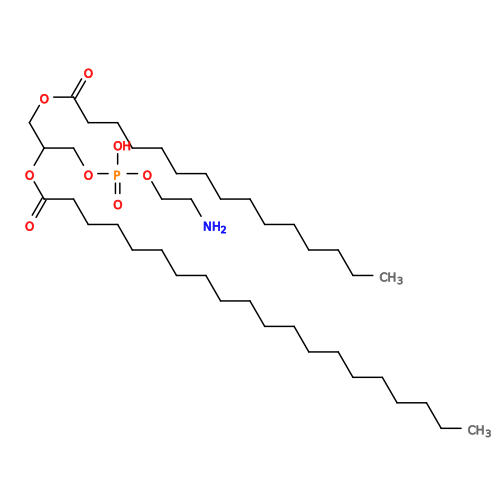 Mass: 734.039 Da / Num. of mol.: 7 / Source method: obtained synthetically / Formula: C40H80NO8P / Comment: phospholipid*YM Mass: 734.039 Da / Num. of mol.: 7 / Source method: obtained synthetically / Formula: C40H80NO8P / Comment: phospholipid*YM#3: Chemical | ChemComp-CLR /  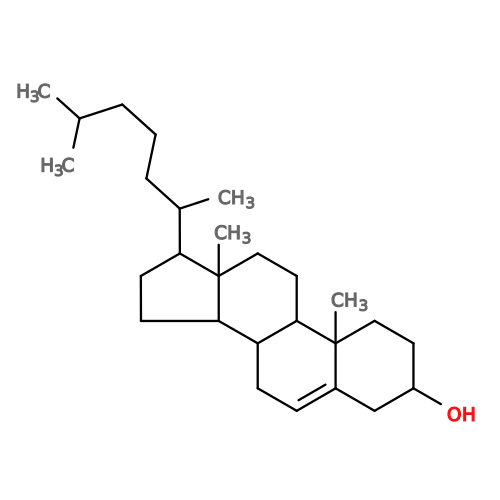 Mass: 386.654 Da / Num. of mol.: 14 / Source method: obtained synthetically / Formula: C27H46O Mass: 386.654 Da / Num. of mol.: 14 / Source method: obtained synthetically / Formula: C27H46O#4: Sugar | ChemComp-NAG / 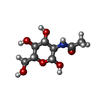 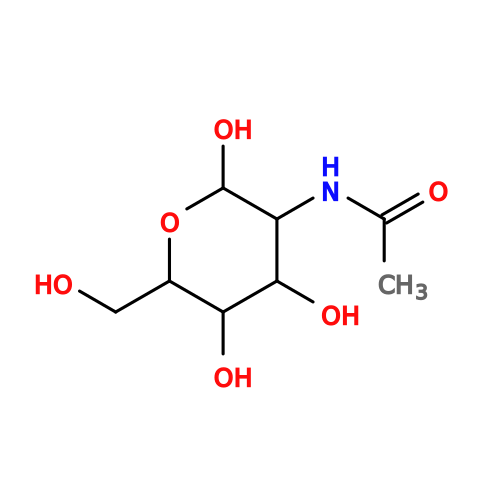 Type: D-saccharide, beta linking / Mass: 221.208 Da / Num. of mol.: 7 / Source method: obtained synthetically / Formula: C8H15NO6 Type: D-saccharide, beta linking / Mass: 221.208 Da / Num. of mol.: 7 / Source method: obtained synthetically / Formula: C8H15NO6#5: Chemical | ChemComp-ATP / | 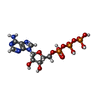 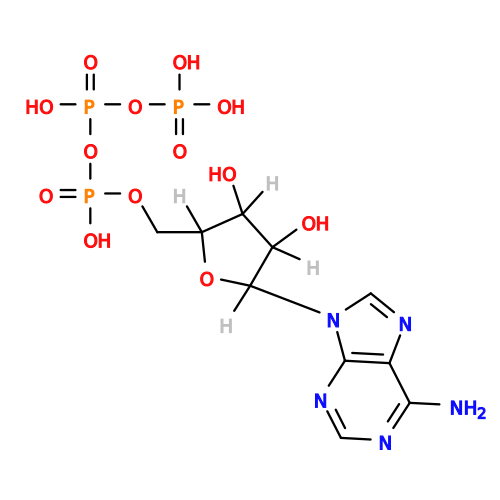 Mass: 507.181 Da / Num. of mol.: 1 / Source method: obtained synthetically / Formula: C10H16N5O13P3 / Feature type: SUBJECT OF INVESTIGATION / Comment: ATP, energy-carrying molecule*YM Mass: 507.181 Da / Num. of mol.: 1 / Source method: obtained synthetically / Formula: C10H16N5O13P3 / Feature type: SUBJECT OF INVESTIGATION / Comment: ATP, energy-carrying molecule*YMHas ligand of interest | Y | Has protein modification | Y | |
|---|
-Experimental details
-Experiment
| Experiment | Method: ELECTRON MICROSCOPY |
|---|---|
| EM experiment | Aggregation state: PARTICLE / 3D reconstruction method: single particle reconstruction |
- Sample preparation
| Component | Name: Putative ATP-bound class from combined 10, 20, 30 mM ATP datasets Type: COMPLEX / Entity ID: #1 / Source: RECOMBINANT |
|---|---|
| Molecular weight | Experimental value: NO |
| Source (natural) | Organism: Homo sapiens (human) |
| Source (recombinant) | Organism: Homo sapiens (human) |
| Buffer solution | pH: 8 |
| Specimen | Embedding applied: NO / Shadowing applied: NO / Staining applied: NO / Vitrification applied: YES |
| Vitrification | Cryogen name: ETHANE |
- Electron microscopy imaging
| Microscopy | Model: TFS GLACIOS |
|---|---|
| Electron gun | Electron source:  FIELD EMISSION GUN / Accelerating voltage: 200 kV / Illumination mode: OTHER FIELD EMISSION GUN / Accelerating voltage: 200 kV / Illumination mode: OTHER |
| Electron lens | Mode: BRIGHT FIELD / Nominal defocus max: 1800 nm / Nominal defocus min: 600 nm |
| Image recording | Electron dose: 40 e/Å2 / Film or detector model: FEI FALCON IV (4k x 4k) |
- Processing
| EM software |
| ||||||||||||||||||||||||
|---|---|---|---|---|---|---|---|---|---|---|---|---|---|---|---|---|---|---|---|---|---|---|---|---|---|
| CTF correction | Type: PHASE FLIPPING AND AMPLITUDE CORRECTION | ||||||||||||||||||||||||
| 3D reconstruction | Resolution: 2.77 Å / Resolution method: FSC 0.143 CUT-OFF / Num. of particles: 408121 / Symmetry type: POINT | ||||||||||||||||||||||||
| Refinement | Highest resolution: 2.77 Å Stereochemistry target values: REAL-SPACE (WEIGHTED MAP SUM AT ATOM CENTERS) | ||||||||||||||||||||||||
| Refine LS restraints |
|
