 ムービー
ムービー コントローラー


+ データを開く

- 基本情報
基本情報
| 登録情報 | データベース: PDB / ID: 9ogd | ||||||||||||||||||||||||
|---|---|---|---|---|---|---|---|---|---|---|---|---|---|---|---|---|---|---|---|---|---|---|---|---|---|
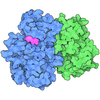
| タイトル | Cryo-EM structure of human exportin-1 conjugated with selinexor and bound to human ASB8(R197A)-ELOB/C | ||||||||||||||||||||||||
 要素 要素 |
| ||||||||||||||||||||||||
 キーワード キーワード | PROTEIN TRANSPORT / nuclear export / inhibitor / protein degradation | ||||||||||||||||||||||||
| 機能・相同性 |  機能・相同性情報 機能・相同性情報cellular response to triglyceride / cellular response to salt / HuR (ELAVL1) binds and stabilizes mRNA / annulate lamellae / regulation of proteasomal ubiquitin-dependent protein catabolic process / nuclear export signal receptor activity / regulation of centrosome duplication / regulation of protein export from nucleus / target-directed miRNA degradation / elongin complex ...cellular response to triglyceride / cellular response to salt / HuR (ELAVL1) binds and stabilizes mRNA / annulate lamellae / regulation of proteasomal ubiquitin-dependent protein catabolic process / nuclear export signal receptor activity / regulation of centrosome duplication / regulation of protein export from nucleus / target-directed miRNA degradation / elongin complex / Rev-mediated nuclear export of HIV RNA / NEP/NS2 Interacts with the Cellular Export Machinery / VCB complex / nucleocytoplasmic transport / Cul5-RING ubiquitin ligase complex / Cul2-RING ubiquitin ligase complex / Maturation of hRSV A proteins / Pausing and recovery of Tat-mediated HIV elongation / Tat-mediated HIV elongation arrest and recovery / HIV elongation arrest and recovery / Pausing and recovery of HIV elongation / ribosomal large subunit export from nucleus / Estrogen-dependent nuclear events downstream of ESR-membrane signaling / protein localization to nucleus / Tat-mediated elongation of the HIV-1 transcript / mRNA export from nucleus / Formation of HIV-1 elongation complex containing HIV-1 Tat / Cajal body / Formation of HIV elongation complex in the absence of HIV Tat / ribosomal subunit export from nucleus / Cyclin A/B1/B2 associated events during G2/M transition / RNA Polymerase II Transcription Elongation / Formation of RNA Pol II elongation complex / ribosomal small subunit export from nucleus / NPAS4 regulates expression of target genes / Amplification of signal from unattached kinetochores via a MAD2 inhibitory signal / RNA Polymerase II Pre-transcription Events / Transcriptional and post-translational regulation of MITF-M expression and activity / Mitotic Prometaphase / EML4 and NUDC in mitotic spindle formation / protein export from nucleus / Resolution of Sister Chromatid Cohesion / Downregulation of TGF-beta receptor signaling / transcription corepressor binding / TP53 Regulates Transcription of DNA Repair Genes / Deactivation of the beta-catenin transactivating complex / transcription initiation at RNA polymerase II promoter / transcription elongation by RNA polymerase II / Heme signaling / RHO GTPases Activate Formins / Vif-mediated degradation of APOBEC3G / MAPK6/MAPK4 signaling / Inactivation of CSF3 (G-CSF) signaling / Oxygen-dependent proline hydroxylation of Hypoxia-inducible Factor Alpha / kinetochore / Evasion by RSV of host interferon responses / small GTPase binding / Regulation of expression of SLITs and ROBOs / Separation of Sister Chromatids / nuclear envelope / Antigen processing: Ubiquitination & Proteasome degradation / positive regulation of proteasomal ubiquitin-dependent protein catabolic process / ribosome biogenesis / Neddylation / protein-containing complex assembly / ubiquitin-dependent protein catabolic process / nuclear membrane / protein-macromolecule adaptor activity / DNA-binding transcription factor binding / intracellular signal transduction / protein ubiquitination / response to xenobiotic stimulus / ribonucleoprotein complex / protein domain specific binding / intracellular membrane-bounded organelle / ubiquitin protein ligase binding / regulation of transcription by RNA polymerase II / nucleolus / negative regulation of transcription by RNA polymerase II / protein-containing complex / RNA binding / nucleoplasm / nucleus / membrane / cytosol / cytoplasm 類似検索 - 分子機能 | ||||||||||||||||||||||||
| 生物種 |  Homo sapiens (ヒト) Homo sapiens (ヒト) | ||||||||||||||||||||||||
| 手法 | 電子顕微鏡法 / 単粒子再構成法 / クライオ電子顕微鏡法 / 解像度: 2.49 Å | ||||||||||||||||||||||||
 データ登録者 データ登録者 | Wing, C.E. / Fung, H.Y.J. / Chook, Y.M. | ||||||||||||||||||||||||
| 資金援助 |  米国, 7件 米国, 7件
| ||||||||||||||||||||||||
 引用 引用 | ジャーナル: bioRxiv / 年: 2025 タイトル: SINE compounds activate exportin-1 degradation via an allosteric mechanism. 著者: Casey Elizabeth Wing / Ho Yee Joyce Fung / Bert Kwanten / Tolga Cagatay / Ashley B Niesman / Maarten Jacquemyn / Mehdi Gharghabi / Brecht Permentier / Binita Shakya / Rhituparna Nandi / ...著者: Casey Elizabeth Wing / Ho Yee Joyce Fung / Bert Kwanten / Tolga Cagatay / Ashley B Niesman / Maarten Jacquemyn / Mehdi Gharghabi / Brecht Permentier / Binita Shakya / Rhituparna Nandi / Joseph M Ready / Trinayan Kashyap / Sharon Shacham / Yosef Landesman / Rosa Lapalombella / Dirk Daelemans / Yuh Min Chook 要旨: The nuclear export receptor exportin 1 (XPO1/CRM1) is often overexpressed in cancer cells, leading to the mislocalization of numerous cancer-related protein cargoes . Selinexor, a covalent XPO1 ...The nuclear export receptor exportin 1 (XPO1/CRM1) is often overexpressed in cancer cells, leading to the mislocalization of numerous cancer-related protein cargoes . Selinexor, a covalent XPO1 inhibitor, and other Selective Inhibitor of Nuclear Export (SINEs) restore proper nuclear localization by blocking XPO1-cargo binding . SINEs also induce XPO1 degradation via the Cullin-RING E3 ubiquitin ligase (CRL) substrate receptor ASB8 . Here we elucidate the mechanism underlying the high-affinity engagement of CRL5 with SINE-conjugated XPO1. Cryogenic electron microscopy (cryoEM) structures reveal that ASB8 binds to a cryptic site on XPO1, which becomes accessible only upon SINE conjugation. While molecular glue degraders typically interact with both CRL and the substrate , SINEs bind to XPO1 without requiring interaction with ASB8 for efficient XPO1 degradation. Instead, an allosteric mechanism facilitates high affinity XPO1-ASB8 interaction, leading to XPO1 ubiquitination and degradation. ASB8-mediated degradation is also observed upon treatment of the endogenous itaconate derivate 4-octyl itaconate, which suggests a native mechanism that is inadvertently exploited by synthesized XPO1 inhibitors. This allosteric XPO1 degradation mechanism of SINE compounds expands the known modes of targeted protein degradation beyond the well-characterized molecular glue degraders and proteolysis targeting chimeras of CRL4. | ||||||||||||||||||||||||
| 履歴 |
|
- 構造の表示
構造の表示
| 構造ビューア | 分子: MolmilJmol/JSmol |
|---|
- ダウンロードとリンク
-ダウンロード
| PDBx/mmCIF形式 | 9ogd.cif.gz | 429.8 KB | 表示 | PDBx/mmCIF形式 |
|---|---|---|---|---|
| PDB形式 | pdb9ogd.ent.gz | 346.6 KB | 表示 | PDB形式 |
| PDBx/mmJSON形式 | 9ogd.json.gz | ツリー表示 | PDBx/mmJSON形式 | |
| その他 |  その他のダウンロード その他のダウンロード |
-検証レポート
| 文書・要旨 | 9ogd_validation.pdf.gz | 1.3 MB | 表示 | wwPDB検証レポート |
|---|---|---|---|---|
| 文書・詳細版 | 9ogd_full_validation.pdf.gz | 1.3 MB | 表示 | |
| XML形式データ | 9ogd_validation.xml.gz | 53.7 KB | 表示 | |
| CIF形式データ | 9ogd_validation.cif.gz | 81 KB | 表示 | |
| アーカイブディレクトリ | https://data.pdbj.org/pub/pdb/validation_reports/og/9ogdftp://data.pdbj.org/pub/pdb/validation_reports/og/9ogd | HTTPS FTP |
-関連構造データ
| 関連構造データ |  70462MC  9og9C  9ogaC  9ogbC  9ogcC  9ogeC  9ogfC  9ognC  9ogoC M: このデータのモデリングに利用したマップデータ C: 同じ文献を引用 ( |
|---|---|
| 類似構造データ |


-リンク
 PDBj
PDBj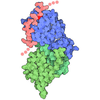
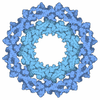
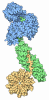

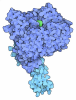

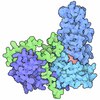

- 集合体
集合体
| 登録構造単位 | 
|
|---|---|
| 1 |
|
-要素
| #1: タンパク質 | 分子量: 123662.484 Da / 分子数: 1 / 由来タイプ: 組換発現 / 詳細: GS remaining after TEV cleavage / 由来: (組換発現) Homo sapiens (ヒト) / 遺伝子: XPO1, CRM1 / 発現宿主:   Escherichia coli BL21(DE3) (大腸菌) / 参照: UniProt: O14980 Escherichia coli BL21(DE3) (大腸菌) / 参照: UniProt: O14980 |
|---|---|
| #2: タンパク質 | 分子量: 29783.045 Da / 分子数: 1 / Fragment: residues 17-288 / Mutation: R197A / 由来タイプ: 組換発現 / 詳細: GS remaining after TEV cleavage / 由来: (組換発現) Homo sapiens (ヒト) / 遺伝子: ASB8, PP14212 / 発現宿主: Escherichia coli BL21(DE3) (大腸菌) / 参照: UniProt: Q9H765 |
| #3: タンパク質 | 分子量: 10974.616 Da / 分子数: 1 / Fragment: residues 17-112 / 由来タイプ: 組換発現 / 由来: (組換発現) Homo sapiens (ヒト) / 遺伝子: ELOC, TCEB1 / 発現宿主: Escherichia coli BL21(DE3) (大腸菌) / 参照: UniProt: Q15369 |
| #4: タンパク質 | 分子量: 13147.781 Da / 分子数: 1 / 由来タイプ: 組換発現 / 詳細: full-length, wildtype / 由来: (組換発現) Homo sapiens (ヒト) / 遺伝子: ELOB, TCEB2 / 発現宿主: Escherichia coli BL21(DE3) (大腸菌) / 参照: UniProt: Q15370 |
| #5: 化合物 | ChemComp-V6A /  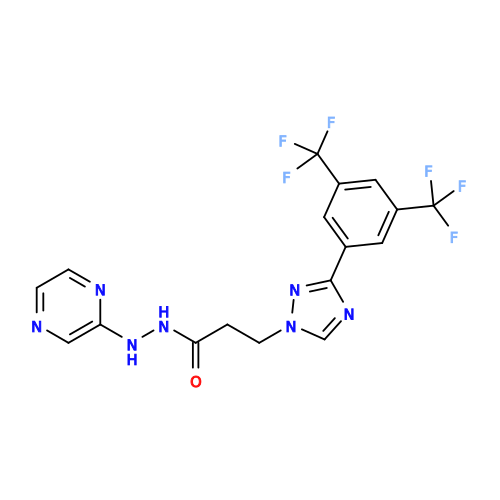 分子量: 445.322 Da / 分子数: 1 / 由来タイプ: 合成 / 式: C17H13F6N7O / タイプ: SUBJECT OF INVESTIGATION 分子量: 445.322 Da / 分子数: 1 / 由来タイプ: 合成 / 式: C17H13F6N7O / タイプ: SUBJECT OF INVESTIGATION |
| 研究の焦点であるリガンドがあるか | Y |
| Has protein modification | Y |
-実験情報
-実験
| 実験 | 手法: 電子顕微鏡法 |
|---|---|
| EM実験 | 試料の集合状態: PARTICLE / 3次元再構成法: 単粒子再構成法 |
- 試料調製
試料調製
| 構成要素 | 名称: Ternary complex of full-length human XPO1 conjugated to KPT-185 and bound to ASB8(R197A)-ELOB/C タイプ: COMPLEX / Entity ID: #1-#4 / 由来: RECOMBINANT |
|---|---|
| 分子量 | 値: 0.178 MDa / 実験値: NO |
| 由来(天然) | 生物種: Homo sapiens (ヒト) |
| 由来(組換発現) | 生物種: Escherichia coli (大腸菌) / 株: BL21(DE3) |
| 緩衝液 | pH: 7.4 詳細: 20 mM HEPES pH 7.4, 110 mM KOAc, 2 mM Mg(OAc)2, 2 mM TCEP |
| 試料 | 濃度: 0.8 mg/ml / 包埋: NO / シャドウイング: NO / 染色: NO / 凍結: YES |
| 試料支持 | グリッドの材料: COPPER / グリッドのサイズ: 300 divisions/in. / グリッドのタイプ: C-flat-1.2/1.3 |
| 急速凍結 | 装置: FEI VITROBOT MARK IV / 凍結剤: ETHANE / 湿度: 95 % / 凍結前の試料温度: 277 K |
- 電子顕微鏡撮影
| 実験機器 |  モデル: Titan Krios / 画像提供: FEI Company |
|---|---|
| 顕微鏡 | モデル: TFS KRIOS |
| 電子銃 | 電子線源:  FIELD EMISSION GUN / 加速電圧: 300 kV / 照射モード: FLOOD BEAM FIELD EMISSION GUN / 加速電圧: 300 kV / 照射モード: FLOOD BEAM |
| 電子レンズ | モード: BRIGHT FIELD / 倍率(公称値): 165000 X / 最大 デフォーカス(公称値): 2400 nm / 最小 デフォーカス(公称値): 900 nm |
| 試料ホルダ | 試料ホルダーモデル: FEI TITAN KRIOS AUTOGRID HOLDER |
| 撮影 | 電子線照射量: 55 e/Å2 フィルム・検出器のモデル: FEI FALCON IV (4k x 4k) 撮影したグリッド数: 1 / 実像数: 6256 |
| 電子光学装置 | エネルギーフィルター名称: TFS Selectris X / エネルギーフィルタースリット幅: 10 eV |
- 解析
解析
| EMソフトウェア |
| ||||||||||||||||||||||||||||||||||||
|---|---|---|---|---|---|---|---|---|---|---|---|---|---|---|---|---|---|---|---|---|---|---|---|---|---|---|---|---|---|---|---|---|---|---|---|---|---|
| CTF補正 | タイプ: PHASE FLIPPING AND AMPLITUDE CORRECTION | ||||||||||||||||||||||||||||||||||||
| 粒子像の選択 | 選択した粒子像数: 3582585 / 詳細: blob picking followed by template picking | ||||||||||||||||||||||||||||||||||||
| 3次元再構成 | 解像度: 2.49 Å / 解像度の算出法: FSC 0.143 CUT-OFF / 粒子像の数: 433178 / 対称性のタイプ: POINT | ||||||||||||||||||||||||||||||||||||
| 原子モデル構築 | B value: 102.26 / プロトコル: OTHER / 空間: REAL 詳細: Initial models were docked into maps using UCSF ChimeraX then manually built using Isolde and Coot and refined in PHENIX | ||||||||||||||||||||||||||||||||||||
| 原子モデル構築 |
| ||||||||||||||||||||||||||||||||||||
| 拘束条件 |
|
