Movie
Movie Controller

[English] 日本語
 Yorodumi
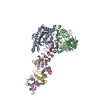
- EMDB-70461: Cryo-EM structure of human exportin-1 conjugated with KPT-185 and... -
+ Open data

- Basic information
| Entry |  | ||||||||||||||||||||||||
|---|---|---|---|---|---|---|---|---|---|---|---|---|---|---|---|---|---|---|---|---|---|---|---|---|---|
| Title | Cryo-EM structure of human exportin-1 conjugated with KPT-185 and bound to human ASB8-ELOB/C | ||||||||||||||||||||||||
 Map data Map data | Final volume from cryoSPARC z-flipped using ChimeraX | ||||||||||||||||||||||||
 Sample Sample |
| ||||||||||||||||||||||||
 Keywords Keywords | nuclear export / inhibitor / protein degradation / PROTEIN TRANSPORT | ||||||||||||||||||||||||
| Function / homology |  Function and homology information Function and homology informationcellular response to triglyceride / cellular response to salt / HuR (ELAVL1) binds and stabilizes mRNA / annulate lamellae / nuclear export signal receptor activity / regulation of proteasomal ubiquitin-dependent protein catabolic process / target-directed miRNA degradation / Rev-mediated nuclear export of HIV RNA / elongin complex / NEP/NS2 Interacts with the Cellular Export Machinery ...cellular response to triglyceride / cellular response to salt / HuR (ELAVL1) binds and stabilizes mRNA / annulate lamellae / nuclear export signal receptor activity / regulation of proteasomal ubiquitin-dependent protein catabolic process / target-directed miRNA degradation / Rev-mediated nuclear export of HIV RNA / elongin complex / NEP/NS2 Interacts with the Cellular Export Machinery / nucleocytoplasmic transport / VCB complex / Cul5-RING ubiquitin ligase complex / ubiquitin-dependent protein catabolic process via the C-end degron rule pathway / Cul2-RING ubiquitin ligase complex / negative regulation of DNA-templated DNA replication / Maturation of hRSV A proteins / Pausing and recovery of Tat-mediated HIV elongation / Tat-mediated HIV elongation arrest and recovery / HIV elongation arrest and recovery / Pausing and recovery of HIV elongation / Estrogen-dependent nuclear events downstream of ESR-membrane signaling / ribosomal large subunit export from nucleus / Tat-mediated elongation of the HIV-1 transcript / protein export from nucleus / Cajal body / Formation of HIV-1 elongation complex containing HIV-1 Tat / ribosomal subunit export from nucleus / Formation of HIV elongation complex in the absence of HIV Tat / mRNA export from nucleus / Cyclin A/B1/B2 associated events during G2/M transition / RNA Polymerase II Transcription Elongation / Formation of RNA Pol II elongation complex / NPAS4 regulates expression of target genes / ribosome-associated ubiquitin-dependent protein catabolic process / RNA Polymerase II Pre-transcription Events / ribosomal small subunit export from nucleus / Transcriptional and post-translational regulation of MITF-M expression and activity / Amplification of signal from unattached kinetochores via a MAD2 inhibitory signal / Mitotic Prometaphase / EML4 and NUDC in mitotic spindle formation / Resolution of Sister Chromatid Cohesion / transcription corepressor binding / Downregulation of TGF-beta receptor signaling / TP53 Regulates Transcription of DNA Repair Genes / Heme signaling / Maturation of DENV proteins / transcription initiation at RNA polymerase II promoter / RHO GTPases Activate Formins / transcription elongation by RNA polymerase II / Deactivation of the beta-catenin transactivating complex / Inactivation of CSF3 (G-CSF) signaling / Vif-mediated degradation of APOBEC3G / MAPK6/MAPK4 signaling / Evasion by RSV of host interferon responses / kinetochore / Oxygen-dependent proline hydroxylation of Hypoxia-inducible Factor Alpha / small GTPase binding / Regulation of expression of SLITs and ROBOs / Ribosome Quality Control (RQC) complex extracts and degrades nascent peptide / Separation of Sister Chromatids / positive regulation of proteasomal ubiquitin-dependent protein catabolic process / nuclear envelope / Antigen processing: Ubiquitination & Proteasome degradation / ribosome biogenesis / Neddylation / protein-containing complex assembly / ubiquitin-dependent protein catabolic process / DNA-binding transcription factor binding / proteasome-mediated ubiquitin-dependent protein catabolic process / protein-macromolecule adaptor activity / intracellular signal transduction / protein ubiquitination / response to xenobiotic stimulus / ribonucleoprotein complex / protein domain specific binding / ubiquitin protein ligase binding / regulation of transcription by RNA polymerase II / nucleolus / negative regulation of transcription by RNA polymerase II / protein-containing complex / nucleoplasm / membrane / cytosol / cytoplasm Similarity search - Function | ||||||||||||||||||||||||
| Biological species |  Homo sapiens (human) Homo sapiens (human) | ||||||||||||||||||||||||
| Method | single particle reconstruction / cryo EM / Resolution: 3.37 Å | ||||||||||||||||||||||||
 Authors Authors | Wing CE / Fung HYJ / Chook YM | ||||||||||||||||||||||||
| Funding support |  United States, 7 items United States, 7 items
| ||||||||||||||||||||||||
 Citation Citation | Journal: Nat Chem Biol / Year: 2025 Title: SINE compounds activate exportin 1 degradation through an allosteric mechanism. Authors: Casey E Wing / Ho Yee Joyce Fung / Bert Kwanten / Tolga Cagatay / Ashley B Niesman / Maarten Jacquemyn / Mehdi Gharghabi / Brecht Permentier / Binita Shakya / Rhituparna Nandi / Joseph M ...Authors: Casey E Wing / Ho Yee Joyce Fung / Bert Kwanten / Tolga Cagatay / Ashley B Niesman / Maarten Jacquemyn / Mehdi Gharghabi / Brecht Permentier / Binita Shakya / Rhituparna Nandi / Joseph M Ready / Trinayan Kashyap / Sharon Shacham / Yosef Landesman / Rosa Lapalombella / Dirk Daelemans / Yuh Min Chook /  Abstract: Overexpression of exportin 1 (XPO1/CRM1) in cancer cells mislocalizes numerous cancer-related nuclear export cargoes. Covalent selective inhibitors of nuclear export (SINEs), including the cancer ...Overexpression of exportin 1 (XPO1/CRM1) in cancer cells mislocalizes numerous cancer-related nuclear export cargoes. Covalent selective inhibitors of nuclear export (SINEs), including the cancer drug selinexor, restore proper nuclear localization by blocking XPO1-cargo interaction. These inhibitors also induce XPO1 degradation through the Cullin-RING E3 ligase (CRL) substrate receptor ASB8. Here we present cryo-electron microscopy structures revealing ASB8 binding to a cryptic XPO1 site that is exposed upon SINE conjugation. Unlike typical molecular glue degraders that directly bridge CRLs and substrates, SINEs bind XPO1 independently of ASB8, triggering an allosteric mechanism that enables high-affinity ASB8 recruitment, leading to XPO1 ubiquitination and degradation. ASB8-mediated degradation is also triggered by the endogenous itaconate derivative 4-octyl itaconate, suggesting that synthetic XPO1 inhibitors exploit a native cellular mechanism. This allosteric XPO1 degradation mechanism expands known modes of targeted protein degradation beyond molecular glue degraders and proteolysis-targeting chimeras of CRL4. | ||||||||||||||||||||||||
| History |
|
- Structure visualization
| Supplemental images |
|---|

- Downloads & links
-EMDB archive
| Map data | emd_70461.map.gz | 85.9 MB | EMDB map data format | |
|---|---|---|---|---|
| Header (meta data) | emd-70461-v30.xmlemd-70461.xml | 32.7 KB 32.7 KB | Display Display | EMDB header |
| FSC (resolution estimation) | emd_70461_fsc.xml | 11.8 KB | Display | FSC data file |
| Images |  emd_70461.png emd_70461.png | 80.5 KB | ||
| Filedesc metadata | emd-70461.cif.gz | 8.7 KB | ||
| Others | emd_70461_additional_1.map.gzemd_70461_half_map_1.map.gzemd_70461_half_map_2.map.gz | 150.8 MB 159.7 MB 159.7 MB | ||
| Archive directory |  https://data.pdbj.org/pub/emdb/structures/EMD-70461ftp://data.pdbj.org/pub/emdb/structures/EMD-70461 https://data.pdbj.org/pub/emdb/structures/EMD-70461ftp://data.pdbj.org/pub/emdb/structures/EMD-70461 | HTTPS FTP |
-Related structure data
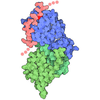
| Related structure data |  9ogcMC  9og9C  9ogaC  9ogbC  9ogdC  9ogeC  9ogfC  9ognC  9ogoC M: atomic model generated by this map C: citing same article ( |
|---|---|
| Similar structure data |


-Links
| EMDB pages | EMDB (EBI/PDBe) / EMDataResource |
|---|---|
| Related items in Molecule of the Month |



-Map
| File | Download / File: emd_70461.map.gz / Format: CCP4 / Size: 172.1 MB / Type: IMAGE STORED AS FLOATING POINT NUMBER (4 BYTES) | ||||||||||||||||||||||||||||||||||||
|---|---|---|---|---|---|---|---|---|---|---|---|---|---|---|---|---|---|---|---|---|---|---|---|---|---|---|---|---|---|---|---|---|---|---|---|---|---|
| Annotation | Final volume from cryoSPARC z-flipped using ChimeraX | ||||||||||||||||||||||||||||||||||||
| Projections & slices | Image control
Images are generated by Spider. | ||||||||||||||||||||||||||||||||||||
| Voxel size | X=Y=Z: 0.84 Å | ||||||||||||||||||||||||||||||||||||
| Density |
| ||||||||||||||||||||||||||||||||||||
| Symmetry | Space group: 1 | ||||||||||||||||||||||||||||||||||||
| Details | EMDB XML:
|
 Z (Sec.)
 Y (Row.)
 X (Col.)


-Supplemental data
-Additional map: DeepEMhancer map used to help modeling of XPO1 N and C-terminus
| File | emd_70461_additional_1.map | ||||||||||||
|---|---|---|---|---|---|---|---|---|---|---|---|---|---|
| Annotation | DeepEMhancer map used to help modeling of XPO1 N and C-terminus | ||||||||||||
| Projections & Slices |
| ||||||||||||
| Density Histograms |


-Half map: Half-map A from cryoSPARC z-flipped using ChimeraX
| File | emd_70461_half_map_1.map | ||||||||||||
|---|---|---|---|---|---|---|---|---|---|---|---|---|---|
| Annotation | Half-map A from cryoSPARC z-flipped using ChimeraX | ||||||||||||
| Projections & Slices |
| ||||||||||||
| Density Histograms |


-Half map: Half-map B from cryoSPARC z-flipped using ChimeraX
| File | emd_70461_half_map_2.map | ||||||||||||
|---|---|---|---|---|---|---|---|---|---|---|---|---|---|
| Annotation | Half-map B from cryoSPARC z-flipped using ChimeraX | ||||||||||||
| Projections & Slices |
| ||||||||||||
| Density Histograms |


- Sample components
-Entire : Ternary complex of full-length human XPO1 conjugated to KPT-185 a...
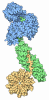
| Entire | Name: Ternary complex of full-length human XPO1 conjugated to KPT-185 and bound to ASB8-ELOB/C |
|---|---|
| Components |
|
-Supramolecule #1: Ternary complex of full-length human XPO1 conjugated to KPT-185 a...
| Supramolecule | Name: Ternary complex of full-length human XPO1 conjugated to KPT-185 and bound to ASB8-ELOB/C type: complex / ID: 1 / Parent: 0 / Macromolecule list: #1-#4 |
|---|---|
| Source (natural) | Organism: Homo sapiens (human) |
| Molecular weight | Theoretical: 178 KDa |
-Macromolecule #1: Exportin-1
| Macromolecule | Name: Exportin-1 / type: protein_or_peptide / ID: 1 / Details: GS remaining after TEV cleavage / Number of copies: 1 / Enantiomer: LEVO |
|---|---|
| Source (natural) | Organism: Homo sapiens (human) |
| Molecular weight | Theoretical: 123.662484 KDa |
| Recombinant expression | Organism:   Escherichia coli BL21(DE3) (bacteria) Escherichia coli BL21(DE3) (bacteria) |
| Sequence | String: GSMPAIMTML ADHAARQLLD FSQKLDINLL DNVVNCLYHG EGAQQRMAQE VLTHLKEHPD AWTRVDTILE FSQNMNTKYY GLQILENVI KTRWKILPRN QCEGIKKYVV GLIIKTSSDP TCVEKEKVYI GKLNMILVQI LKQEWPKHWP TFISDIVGAS R TSESLCQN ...String: GSMPAIMTML ADHAARQLLD FSQKLDINLL DNVVNCLYHG EGAQQRMAQE VLTHLKEHPD AWTRVDTILE FSQNMNTKYY GLQILENVI KTRWKILPRN QCEGIKKYVV GLIIKTSSDP TCVEKEKVYI GKLNMILVQI LKQEWPKHWP TFISDIVGAS R TSESLCQN NMVILKLLSE EVFDFSSGQI TQVKSKHLKD SMCNEFSQIF QLCQFVMENS QNAPLVHATL ETLLRFLNWI PL GYIFETK LISTLIYKFL NVPMFRNVSL KCLTEIAGVS VSQYEEQFVT LFTLTMMQLK QMLPLNTNIR LAYSNGKDDE QNF IQNLSL FLCTFLKEHD QLIEKRLNLR ETLMEALHYM LLVSEVEETE IFKICLEYWN HLAAELYRES PFSTSASPLL SGSQ HFDVP PRRQLYLPML FKVRLLMVSR MAKPEEVLVV ENDQGEVVRE FMKDTDSINL YKNMRETLVY LTHLDYVDTE RIMTE KLHN QVNGTEWSWK NLNTLCWAIG SISGAMHEED EKRFLVTVIK DLLGLCEQKR GKDNKAIIAS NIMYIVGQYP RFLRAH WKF LKTVVNKLFE FMHETHDGVQ DMACDTFIKI AQKCRRHFVQ VQVGEVMPFI DEILNNINTI ICDLQPQQVH TFYEAVG YM IGAQTDQTVQ EHLIEKYMLL PNQVWDSIIQ QATKNVDILK DPETVKQLGS ILKTNVRACK AVGHPFVIQL GRIYLDML N VYKCLSENIS AAIQANGEMV TKQPLIRSMR TVKRETLKLI SGWVSRSNDP QMVAENFVPP LLDAVLIDYQ RNVPAAREP EVLSTMAIIV NKLGGHITAE IPQIFDAVFE CTLNMINKDF EEYPEHRTNF FLLLQAVNSH CFPAFLAIPP TQFKLVLDSI IWAFKHTMR NVADTGLQIL FTLLQNVAQE EAAAQSFYQT YFCDILQHIF SVVTDTSHTA GLTMHASILA YMFNLVEEGK I STSLNPGN PVNNQIFLQE YVANLLKSAF PHLQDAQVKL FVTGLFSLNQ DIPAFKEHLR DFLVQIKEFA GEDTSDLFLE ER EIALRQA DEEKHKRQMS VPGIFNPHEI PEEMCD UniProtKB: Exportin-1 |
-Macromolecule #2: Ankyrin repeat and SOCS box protein 8
| Macromolecule | Name: Ankyrin repeat and SOCS box protein 8 / type: protein_or_peptide / ID: 2 / Details: GS remaining after TEV cleavage / Number of copies: 1 / Enantiomer: LEVO |
|---|---|
| Source (natural) | Organism: Homo sapiens (human) |
| Molecular weight | Theoretical: 29.869162 KDa |
| Recombinant expression | Organism: Escherichia coli BL21(DE3) (bacteria) |
| Sequence | String: GSSLSERLIR TIAAIRSFPH DNVEDLIRGG ADVNCTHGTL KPLHCACMVS DADCVELLLE KGAEVNALDG YNRTALHYAA EKDEACVEV LLEYGANPNA LDGNRDTPLH WAAFKNNAEC VRALLESGAS VNALDYNNDT PLSWAAMKGN LESVSILLDY G AEVRVINL ...String: GSSLSERLIR TIAAIRSFPH DNVEDLIRGG ADVNCTHGTL KPLHCACMVS DADCVELLLE KGAEVNALDG YNRTALHYAA EKDEACVEV LLEYGANPNA LDGNRDTPLH WAAFKNNAEC VRALLESGAS VNALDYNNDT PLSWAAMKGN LESVSILLDY G AEVRVINL IGQTPISRLV ALLVRGLGTE KEDSCFELLH RAVGHFELRK NGTMPREVAR DPQLCEKLTV LCSAPGTLKT LA RYAVRRS LGLQYLPDAV KGLPLPASLK EYLLLLE UniProtKB: Ankyrin repeat and SOCS box protein 8 |
-Macromolecule #3: Elongin-C
| Macromolecule | Name: Elongin-C / type: protein_or_peptide / ID: 3 / Number of copies: 1 / Enantiomer: LEVO |
|---|---|
| Source (natural) | Organism: Homo sapiens (human) |
| Molecular weight | Theoretical: 10.974616 KDa |
| Recombinant expression | Organism: Escherichia coli BL21(DE3) (bacteria) |
| Sequence | String: MMYVKLISSD GHEFIVKREH ALTSGTIKAM LSGPGQFAEN ETNEVNFREI PSHVLSKVCM YFTYKVRYTN SSTEIPEFPI APEIALELL MAANFLDC UniProtKB: Elongin-C |
-Macromolecule #4: Elongin-B
| Macromolecule | Name: Elongin-B / type: protein_or_peptide / ID: 4 / Details: full-length, wildtype / Number of copies: 1 / Enantiomer: LEVO |
|---|---|
| Source (natural) | Organism: Homo sapiens (human) |
| Molecular weight | Theoretical: 13.147781 KDa |
| Recombinant expression | Organism: Escherichia coli BL21(DE3) (bacteria) |
| Sequence | String: MDVFLMIRRH KTTIFTDAKE SSTVFELKRI VEGILKRPPD EQRLYKDDQL LDDGKTLGEC GFTSQTARPQ APATVGLAFR ADDTFEALC IEPFSSPPEL PDVMKPQDSG SSANEQAVQ UniProtKB: Elongin-B |
-Macromolecule #5: propan-2-yl 3-{3-[3-methoxy-5-(trifluoromethyl)phenyl]-1H-1,2,4-t...
| Macromolecule | Name: propan-2-yl 3-{3-[3-methoxy-5-(trifluoromethyl)phenyl]-1H-1,2,4-triazol-1-yl}propanoate type: ligand / ID: 5 / Number of copies: 1 / Formula: K85 |
|---|---|
| Molecular weight | Theoretical: 357.328 Da |
| Chemical component information |  ChemComp-K85: |
-Experimental details
-Structure determination
| Method | cryo EM |
|---|---|
 Processing Processing | single particle reconstruction |
| Aggregation state | particle |
-Sample preparation
| Concentration | 0.4 mg/mL |
|---|---|
| Buffer | pH: 7.4 Details: 20 mM HEPES pH 7.4, 110 mM KOAc, 2 mM Mg(OAc)2, 2 mM TCEP |
| Grid | Model: Quantifoil R1.2/1.3 / Material: COPPER / Mesh: 400 / Pretreatment - Type: GLOW DISCHARGE / Pretreatment - Time: 80 sec. |
| Vitrification | Cryogen name: ETHANE / Chamber humidity: 95 % / Chamber temperature: 277 K / Instrument: FEI VITROBOT MARK IV |
- Electron microscopy
| Microscope | TFS KRIOS |
|---|---|
| Specialist optics | Energy filter - Name: GIF Bioquantum / Energy filter - Slit width: 10 eV |
| Software | Name: SerialEM |
| Image recording | Film or detector model: GATAN K3 (6k x 4k) / Number grids imaged: 1 / Number real images: 4746 / Average electron dose: 50.0 e/Å2 |
| Electron beam | Acceleration voltage: 300 kV / Electron source:  FIELD EMISSION GUN FIELD EMISSION GUN |
| Electron optics | Illumination mode: FLOOD BEAM / Imaging mode: BRIGHT FIELD / Nominal defocus max: 2.4 µm / Nominal defocus min: 1.1 µm / Nominal magnification: 105000 |
| Sample stage | Specimen holder model: FEI TITAN KRIOS AUTOGRID HOLDER |
| Experimental equipment |  Model: Titan Krios / Image courtesy: FEI Company |
+Image processing

-Atomic model buiding 1
| Initial model |
| |||||||||||||||
|---|---|---|---|---|---|---|---|---|---|---|---|---|---|---|---|---|
| Software | Name: UCSF ChimeraX | |||||||||||||||
| Details | Initial models were docked into maps using UCSF ChimeraX then manually built using Isolde and Coot and refined in PHENIX | |||||||||||||||
| Refinement | Space: REAL / Protocol: OTHER / Overall B value: 183.84 | |||||||||||||||
| Output model | PDB-9ogc: |