 Movie
Movie Controller


+ Open data

- Basic information
| Entry | Database: PDB / ID: 9o65 | |||||||||||||||||||||||||||
|---|---|---|---|---|---|---|---|---|---|---|---|---|---|---|---|---|---|---|---|---|---|---|---|---|---|---|---|---|
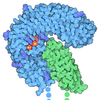
| Title | Cryo-EM structure of SHOC2-KRAS-PP1CA (SKP) complex | |||||||||||||||||||||||||||
 Components Components |
| |||||||||||||||||||||||||||
 Keywords Keywords | SIGNALING PROTEIN / KRAS / SHOC2 / PP1CA | |||||||||||||||||||||||||||
| Function / homology |  Function and homology information Function and homology informationcellular response to growth hormone stimulus / negative regulation of keratinocyte differentiation / regulation of glycogen catabolic process / positive regulation of termination of RNA polymerase II transcription, poly(A)-coupled / negative regulation of neural precursor cell proliferation / glycogen granule / PTW/PP1 phosphatase complex / regulation of translational initiation in response to stress / nerve growth factor signaling pathway / RNA polymerase II promoter clearance ...cellular response to growth hormone stimulus / negative regulation of keratinocyte differentiation / regulation of glycogen catabolic process / positive regulation of termination of RNA polymerase II transcription, poly(A)-coupled / negative regulation of neural precursor cell proliferation / glycogen granule / PTW/PP1 phosphatase complex / regulation of translational initiation in response to stress / nerve growth factor signaling pathway / RNA polymerase II promoter clearance / RNA polymerase II CTD heptapeptide repeat S5 phosphatase activity / cyclic-GMP-AMP transmembrane import across plasma membrane / cadherin binding involved in cell-cell adhesion / protein phosphatase 1 binding / protein phosphatase regulator activity / SHOC2 M1731 mutant abolishes MRAS complex function / Gain-of-function MRAS complexes activate RAF signaling / negative regulation of neuron differentiation / regulation of canonical Wnt signaling pathway / protein dephosphorylation / Phosphorylation and nuclear translocation of the CRY:PER:kinase complex / Triglyceride catabolism / fibroblast growth factor receptor signaling pathway / response to mineralocorticoid / GMP binding / protein-serine/threonine phosphatase / entrainment of circadian clock by photoperiod / negative regulation of transcription elongation by RNA polymerase II / LRR domain binding / telomere maintenance in response to DNA damage / response to gravity / phosphatase activity / myoblast proliferation / protein serine/threonine phosphatase activity / Maturation of hRSV A proteins / cardiac muscle cell proliferation / transition metal ion binding / regulation of MAPK cascade / Signaling by RAS GAP mutants / Signaling by RAS GTPase mutants / Activation of RAS in B cells / GTPase complex / RAS signaling downstream of NF1 loss-of-function variants / positive regulation of glycogen biosynthetic process / RUNX3 regulates p14-ARF / DARPP-32 events / protein phosphatase type 1 complex / SOS-mediated signalling / Activated NTRK3 signals through RAS / Activated NTRK2 signals through RAS / SHC1 events in ERBB4 signaling / ribonucleoprotein complex binding / positive regulation of neuron differentiation / Signalling to RAS / negative regulation of programmed cell death / serine/threonine protein kinase complex / SHC-related events triggered by IGF1R / Activated NTRK2 signals through FRS2 and FRS3 / Estrogen-stimulated signaling through PRKCZ / SHC-mediated cascade:FGFR3 / MET activates RAS signaling / positive regulation of Ras protein signal transduction / response to isolation stress / SHC-mediated cascade:FGFR2 / SHC-mediated cascade:FGFR4 / PTK6 Regulates RHO GTPases, RAS GTPase and MAP kinases / Signaling by PDGFRA transmembrane, juxtamembrane and kinase domain mutants / Signaling by PDGFRA extracellular domain mutants / Erythropoietin activates RAS / SHC-mediated cascade:FGFR1 / Signaling by FGFR4 in disease / phosphoprotein phosphatase activity / Signaling by CSF3 (G-CSF) / FRS-mediated FGFR3 signaling / Signaling by FLT3 ITD and TKD mutants / FRS-mediated FGFR2 signaling / FRS-mediated FGFR4 signaling / p38MAPK events / FRS-mediated FGFR1 signaling / Signaling by FGFR3 in disease / Tie2 Signaling / Signaling by FGFR2 in disease / GRB2 events in EGFR signaling / Signaling by FLT3 fusion proteins / SHC1 events in EGFR signaling / FLT3 Signaling / EGFR Transactivation by Gastrin / Signaling by FGFR1 in disease / NCAM signaling for neurite out-growth / liver development / CD209 (DC-SIGN) signaling / positive regulation of TOR signaling / GRB2 events in ERBB2 signaling / Downstream signal transduction / response to glucocorticoid / Insulin receptor signalling cascade / SHC1 events in ERBB2 signaling / Constitutive Signaling by Overexpressed ERBB2 / Ras activation upon Ca2+ influx through NMDA receptor / Signaling by phosphorylated juxtamembrane, extracellular and kinase domain KIT mutants Similarity search - Function | |||||||||||||||||||||||||||
| Biological species |  Homo sapiens (human) Homo sapiens (human) | |||||||||||||||||||||||||||
| Method | ELECTRON MICROSCOPY / single particle reconstruction / cryo EM / Resolution: 3 Å | |||||||||||||||||||||||||||
 Authors Authors | Finci, L.I. / Bonsor, D.A. / Simanshu, D.K. | |||||||||||||||||||||||||||
| Funding support |  United States, 1items United States, 1items
| |||||||||||||||||||||||||||
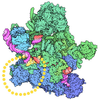
 Citation Citation | Journal: Nat Commun / Year: 2026 Title: Structure of SHOC2-KRAS-PP1C complex reveals RAS isoform-specific determinants and insights into targeting complex assembly by RAS inhibitors. Authors: Daniel A Bonsor / Lorenzo I Finci / Jacob R Potter / Lucy C Young / Vanessa E Wall / Ruby Goldstein de Salazar / Katie R Geis / Tyler Stephens / Joseph Finney / Dwight V Nissley / Frank ...Authors: Daniel A Bonsor / Lorenzo I Finci / Jacob R Potter / Lucy C Young / Vanessa E Wall / Ruby Goldstein de Salazar / Katie R Geis / Tyler Stephens / Joseph Finney / Dwight V Nissley / Frank McCormick / Dhirendra K Simanshu / Abstract: RAF activation is essential for MAPK signaling and is mediated by RAS binding and the dephosphorylation of a conserved phosphoserine by the SHOC2-RAS-PP1C complex. MRAS forms a high-affinity SHOC2- ...RAF activation is essential for MAPK signaling and is mediated by RAS binding and the dephosphorylation of a conserved phosphoserine by the SHOC2-RAS-PP1C complex. MRAS forms a high-affinity SHOC2-MRAS-PP1C (SMP) complex, while canonical RAS isoforms (KRAS, HRAS, NRAS) form analogous but lower-affinity assemblies. Yet, cancers driven by oncogenic KRAS, HRAS, or NRAS remain strongly SHOC2-dependent, suggesting that these weaker complexes contribute to tumorigenesis. To elucidate how canonical RAS proteins form lower-affinity ternary complexes, the cryo-EM structure of the SHOC2-KRAS-PP1C (SKP) complex stabilized by Noonan syndrome mutations is described. The SKP architecture is similar to the SMP complex but forms fewer contacts and buries less surface area due to the absence of MRAS-specific structural features in KRAS that enhance complex stability. RAS inhibitors MRTX1133 and RMC-6236 alter Switch-I/II conformations, thereby blocking SKP assembly more effectively than they disrupt preformed complexes. These RAS inhibitors do not affect SMP formation because they do not bind MRAS. Since MRAS is upregulated in resistance to KRAS inhibition, we characterize a MRAS mutant capable of binding MRTX1133. This MRAS mutant can form an SMP complex, but MRTX1133 blocks its assembly, demonstrating the feasibility of dual SKP and SMP targeting. Overall, our findings define isoform-specific differences in SHOC2-RAS-PP1C complex formation and support a strategy to prevent both SKP and SMP assemblies to overcome resistance in RAS-driven cancers. | |||||||||||||||||||||||||||
| History |
|
- Structure visualization
| Structure viewer | Molecule: MolmilJmol/JSmol |
|---|
- Downloads & links
-Download
| PDBx/mmCIF format | 9o65.cif.gz | 199.5 KB | Display | PDBx/mmCIF format |
|---|---|---|---|---|
| PDB format | pdb9o65.ent.gz | 151.6 KB | Display | PDB format |
| PDBx/mmJSON format | 9o65.json.gz | Tree view | PDBx/mmJSON format | |
| Others |  Other downloads Other downloads |
-Validation report
| Arichive directory | https://data.pdbj.org/pub/pdb/validation_reports/o6/9o65ftp://data.pdbj.org/pub/pdb/validation_reports/o6/9o65 | HTTPS FTP |
|---|
-Related structure data
| Related structure data |  70159MC  9o0nC  9o0oC  9o0pC  9o0qC M: map data used to model this data C: citing same article ( |
|---|---|
| Similar structure data |
-Links
 PDBj
PDBj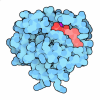


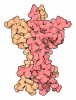
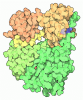
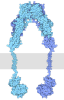
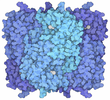
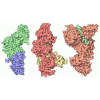
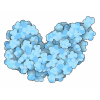
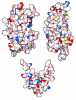
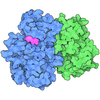
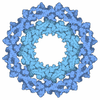
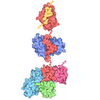
- Assembly
| Deposited unit | 
|
|---|---|
| 1 |
|
-Components
-Protein , 3 types, 3 molecules ABC
| #1: Protein | Mass: 64954.840 Da / Num. of mol.: 1 / Mutation: M173I Source method: isolated from a genetically manipulated source Source: (gene. exp.) Homo sapiens (human) / Gene: SHOC2, KIAA0862 / Production host:  Trichoplusia ni (cabbage looper) / References: UniProt: Q9UQ13 Trichoplusia ni (cabbage looper) / References: UniProt: Q9UQ13 |
|---|---|
| #2: Protein | Mass: 19300.824 Da / Num. of mol.: 1 / Mutation: Q61R Source method: isolated from a genetically manipulated source Source: (gene. exp.) Homo sapiens (human) / Gene: KRAS, KRAS2, RASK2 / Production host: Trichoplusia ni (cabbage looper) / References: UniProt: P01116, small monomeric GTPase |
| #3: Protein | Mass: 37543.984 Da / Num. of mol.: 1 / Mutation: P50R Source method: isolated from a genetically manipulated source Source: (gene. exp.) Homo sapiens (human) / Gene: PPP1CA, PPP1A / Production host: Trichoplusia ni (cabbage looper)References: UniProt: P62136, protein-serine/threonine phosphatase |
-Non-polymers , 3 types, 4 molecules 


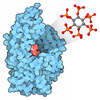
| #4: Chemical | ChemComp-GNP / 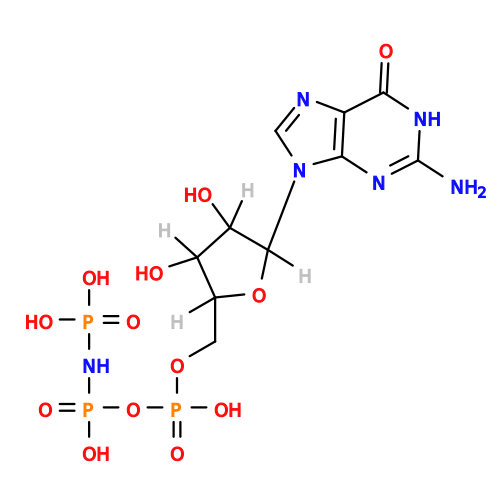 Mass: 522.196 Da / Num. of mol.: 1 / Source method: obtained synthetically / Formula: C10H17N6O13P3 Mass: 522.196 Da / Num. of mol.: 1 / Source method: obtained synthetically / Formula: C10H17N6O13P3Comment: GppNHp, GMPPNP, energy-carrying molecule analogue*YM |
|---|---|
| #5: Chemical | ChemComp-MG /  Mass: 24.305 Da / Num. of mol.: 1 / Source method: obtained synthetically / Formula: Mg Mass: 24.305 Da / Num. of mol.: 1 / Source method: obtained synthetically / Formula: Mg |
| #6: Chemical |  Mass: 54.938 Da / Num. of mol.: 2 / Source method: obtained synthetically / Formula: Mn Mass: 54.938 Da / Num. of mol.: 2 / Source method: obtained synthetically / Formula: Mn |
-Details
| Has ligand of interest | N |
|---|---|
| Has protein modification | N |
-Experimental details
-Experiment
| Experiment | Method: ELECTRON MICROSCOPY |
|---|---|
| EM experiment | Aggregation state: PARTICLE / 3D reconstruction method: single particle reconstruction |
- Sample preparation
| Component | Name: Ternary complex of SHOC2, KRAS, and PP1CA / Type: COMPLEX / Entity ID: #1-#3 / Source: RECOMBINANT | |||||||||||||||||||||||||
|---|---|---|---|---|---|---|---|---|---|---|---|---|---|---|---|---|---|---|---|---|---|---|---|---|---|---|
| Molecular weight | Value: 0.12 MDa / Experimental value: YES | |||||||||||||||||||||||||
| Source (natural) | Organism: Homo sapiens (human) | |||||||||||||||||||||||||
| Source (recombinant) | Organism: Trichoplusia ni (cabbage looper) | |||||||||||||||||||||||||
| Buffer solution | pH: 7.4 | |||||||||||||||||||||||||
| Buffer component |
| |||||||||||||||||||||||||
| Specimen | Conc.: 0.08 mg/ml / Embedding applied: NO / Shadowing applied: NO / Staining applied: NO / Vitrification applied: YES | |||||||||||||||||||||||||
| Specimen support | Grid material: GRAPHENE OXIDE / Grid mesh size: 200 divisions/in. / Grid type: Quantifoil R2/2 | |||||||||||||||||||||||||
| Vitrification | Instrument: FEI VITROBOT MARK IV / Cryogen name: ETHANE / Humidity: 95 % |
- Electron microscopy imaging
| Experimental equipment |  Model: Titan Krios / Image courtesy: FEI Company |
|---|---|
| Microscopy | Model: TFS KRIOS |
| Electron gun | Electron source:  FIELD EMISSION GUN / Accelerating voltage: 300 kV / Illumination mode: FLOOD BEAM FIELD EMISSION GUN / Accelerating voltage: 300 kV / Illumination mode: FLOOD BEAM |
| Electron lens | Mode: BRIGHT FIELD / Nominal magnification: 105000 X / Nominal defocus max: 2250 nm / Nominal defocus min: 750 nm |
| Image recording | Electron dose: 52.3 e/Å2 / Film or detector model: GATAN K3 BIOQUANTUM (6k x 4k) |
- Processing
| EM software |
| ||||||||||||||||||||||||||||||||||||
|---|---|---|---|---|---|---|---|---|---|---|---|---|---|---|---|---|---|---|---|---|---|---|---|---|---|---|---|---|---|---|---|---|---|---|---|---|---|
| CTF correction | Type: PHASE FLIPPING AND AMPLITUDE CORRECTION | ||||||||||||||||||||||||||||||||||||
| Particle selection | Num. of particles selected: 518550 | ||||||||||||||||||||||||||||||||||||
| 3D reconstruction | Resolution: 3 Å / Resolution method: FSC 0.143 CUT-OFF / Num. of particles: 199681 / Symmetry type: POINT | ||||||||||||||||||||||||||||||||||||
| Refinement | Highest resolution: 3 Å Stereochemistry target values: REAL-SPACE (WEIGHTED MAP SUM AT ATOM CENTERS) |
