[English] 日本語
Yorodumi
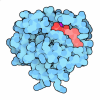
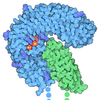
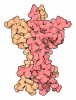
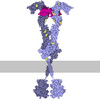
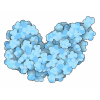
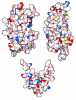
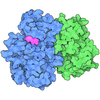
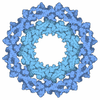
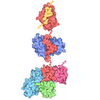
- EMDB-70159: Cryo-EM structure of SHOC2-KRAS-PP1CA (SKP) complex -

+
Open data


ID or keywords:

Loading...

-
Basic information

Entry
Database: EMDB / ID: EMD-70159
TitleCryo-EM structure of SHOC2-KRAS-PP1CA (SKP) complex
Map dataUn-Sharpened Map
Sample
  • Complex: Ternary complex of SHOC2, KRAS, and PP1CA
    • Protein or peptide: Leucine-rich repeat protein SHOC-2
    • Protein or peptide: Isoform 2B of GTPase KRas
    • Protein or peptide: Serine/threonine-protein phosphatase PP1-alpha catalytic subunit
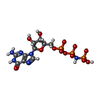
  • Ligand: PHOSPHOAMINOPHOSPHONIC ACID-GUANYLATE ESTER
  • Ligand: MAGNESIUM ION
  • Ligand: MANGANESE (II) ION
KeywordsKRAS / SHOC2 / PP1CA / SIGNALING PROTEIN
Function / homology
Function and homology information


cellular response to growth hormone stimulus / regulation of glycogen catabolic process / positive regulation of termination of RNA polymerase II transcription, poly(A)-coupled / PTW/PP1 phosphatase complex / negative regulation of neural precursor cell proliferation / protein phosphatase type 1 complex / volume-sensitive anion channel activity / glycogen granule / RNA polymerase II promoter clearance / RNA polymerase II CTD heptapeptide repeat S5 phosphatase activity ...cellular response to growth hormone stimulus / regulation of glycogen catabolic process / positive regulation of termination of RNA polymerase II transcription, poly(A)-coupled / PTW/PP1 phosphatase complex / negative regulation of neural precursor cell proliferation / protein phosphatase type 1 complex / volume-sensitive anion channel activity / glycogen granule / RNA polymerase II promoter clearance / RNA polymerase II CTD heptapeptide repeat S5 phosphatase activity / nerve growth factor signaling pathway / cyclic-GMP-AMP transmembrane import across plasma membrane / cadherin binding involved in cell-cell adhesion / protein phosphatase 1 binding / regulation of translational initiation in response to stress / protein phosphatase regulator activity / positive regulation of extrinsic apoptotic signaling pathway in absence of ligand / SHOC2 M1731 mutant abolishes MRAS complex function / Gain-of-function MRAS complexes activate RAF signaling / positive regulation of Ras protein signal transduction / dephosphorylation / regulation of canonical Wnt signaling pathway / response to mineralocorticoid / GMP binding / forebrain astrocyte development / LRR domain binding / glycogen metabolic process / regulation of synaptic transmission, GABAergic / entrainment of circadian clock by photoperiod / protein-serine/threonine phosphatase / negative regulation of epithelial cell differentiation / negative regulation of neuron differentiation / branching morphogenesis of an epithelial tube / response to isolation stress / Triglyceride catabolism / response to gravity / epithelial tube branching involved in lung morphogenesis / type I pneumocyte differentiation / Rac protein signal transduction / protein serine/threonine phosphatase activity / phosphatase activity / telomere maintenance in response to DNA damage / Maturation of hRSV A proteins / regulation of MAPK cascade / positive regulation of Rac protein signal transduction / Signaling by RAS GAP mutants / Signaling by RAS GTPase mutants / Activation of RAS in B cells / phosphoprotein phosphatase activity / myoblast proliferation / negative regulation of transcription elongation by RNA polymerase II / RAS signaling downstream of NF1 loss-of-function variants / RUNX3 regulates p14-ARF / skeletal muscle cell differentiation / transition metal ion binding / positive regulation of glial cell proliferation / SOS-mediated signalling / fibroblast growth factor receptor signaling pathway / Activated NTRK3 signals through RAS / Activated NTRK2 signals through RAS / DARPP-32 events / SHC1 events in ERBB4 signaling / positive regulation of glycogen biosynthetic process / cardiac muscle cell proliferation / Signalling to RAS / ribonucleoprotein complex binding / SHC-related events triggered by IGF1R / Activated NTRK2 signals through FRS2 and FRS3 / Estrogen-stimulated signaling through PRKCZ / SHC-mediated cascade:FGFR3 / MET activates RAS signaling / glial cell proliferation / protein dephosphorylation / SHC-mediated cascade:FGFR2 / Signaling by PDGFRA transmembrane, juxtamembrane and kinase domain mutants / Signaling by PDGFRA extracellular domain mutants / SHC-mediated cascade:FGFR4 / PTK6 Regulates RHO GTPases, RAS GTPase and MAP kinases / Erythropoietin activates RAS / SHC-mediated cascade:FGFR1 / Signaling by FGFR4 in disease / Signaling by CSF3 (G-CSF) / FRS-mediated FGFR3 signaling / Signaling by FLT3 ITD and TKD mutants / FRS-mediated FGFR2 signaling / FRS-mediated FGFR4 signaling / p38MAPK events / Signaling by FGFR3 in disease / FRS-mediated FGFR1 signaling / protein-membrane adaptor activity / Tie2 Signaling / striated muscle cell differentiation / Signaling by FGFR2 in disease / GRB2 events in EGFR signaling / Signaling by FLT3 fusion proteins / SHC1 events in EGFR signaling / FLT3 Signaling / positive regulation of neuron differentiation / Signaling by FGFR1 in disease / EGFR Transactivation by Gastrin
Similarity search - Function
Serine-threonine protein phosphatase, N-terminal / : / Serine-threonine protein phosphatase N-terminal domain / : / Serine/threonine specific protein phosphatases signature. / Protein phosphatase 2A homologues, catalytic domain. / Serine/threonine-specific protein phosphatase/bis(5-nucleosyl)-tetraphosphatase / : / Leucine-rich repeat region / Leucine-rich repeats, bacterial type ...Serine-threonine protein phosphatase, N-terminal / : / Serine-threonine protein phosphatase N-terminal domain / : / Serine/threonine specific protein phosphatases signature. / Protein phosphatase 2A homologues, catalytic domain. / Serine/threonine-specific protein phosphatase/bis(5-nucleosyl)-tetraphosphatase / : / Leucine-rich repeat region / Leucine-rich repeats, bacterial type / Leucine-rich repeat, SDS22-like subfamily / Calcineurin-like phosphoesterase domain, ApaH type / Calcineurin-like phosphoesterase / Metallo-dependent phosphatase-like / Small GTPase, Ras-type / Small GTPase Ras domain profile. / Leucine rich repeat / Leucine-rich repeat, typical subtype / Leucine-rich repeats, typical (most populated) subfamily / Ran (Ras-related nuclear proteins) /TC4 subfamily of small GTPases / Leucine-rich repeat profile. / Leucine-rich repeat / Rho (Ras homology) subfamily of Ras-like small GTPases / Ras subfamily of RAS small GTPases / Small GTPase / Ras family / Rab subfamily of small GTPases / Leucine-rich repeat domain superfamily / Small GTP-binding protein domain / P-loop containing nucleoside triphosphate hydrolase
Similarity search - Domain/homology
GTPase KRas / Serine/threonine-protein phosphatase PP1-alpha catalytic subunit / Leucine-rich repeat protein SHOC-2
Similarity search - Component
Biological speciesHomo sapiens (human)
Methodsingle particle reconstruction / cryo EM / Resolution: 3.0 Å
AuthorsFinci LI / Bonsor DA / Simanshu DK
Funding support United States, 1 items
OrganizationGrant numberCountry
National Institutes of Health/National Cancer Institute (NIH/NCI)75N91019D00024 United States
CitationJournal: Nat Commun / Year: 2026
Title: Structure of SHOC2-KRAS-PP1C complex reveals RAS isoform-specific determinants and insights into targeting complex assembly by RAS inhibitors.
Authors: Daniel A Bonsor / Lorenzo I Finci / Jacob R Potter / Lucy C Young / Vanessa E Wall / Ruby Goldstein de Salazar / Katie R Geis / Tyler Stephens / Joseph Finney / Dwight V Nissley / Frank ...Authors: Daniel A Bonsor / Lorenzo I Finci / Jacob R Potter / Lucy C Young / Vanessa E Wall / Ruby Goldstein de Salazar / Katie R Geis / Tyler Stephens / Joseph Finney / Dwight V Nissley / Frank McCormick / Dhirendra K Simanshu /
Abstract: RAF activation is essential for MAPK signaling and is mediated by RAS binding and the dephosphorylation of a conserved phosphoserine by the SHOC2-RAS-PP1C complex. MRAS forms a high-affinity SHOC2- ...RAF activation is essential for MAPK signaling and is mediated by RAS binding and the dephosphorylation of a conserved phosphoserine by the SHOC2-RAS-PP1C complex. MRAS forms a high-affinity SHOC2-MRAS-PP1C (SMP) complex, while canonical RAS isoforms (KRAS, HRAS, NRAS) form analogous but lower-affinity assemblies. Yet, cancers driven by oncogenic KRAS, HRAS, or NRAS remain strongly SHOC2-dependent, suggesting that these weaker complexes contribute to tumorigenesis. To elucidate how canonical RAS proteins form lower-affinity ternary complexes, the cryo-EM structure of the SHOC2-KRAS-PP1C (SKP) complex stabilized by Noonan syndrome mutations is described. The SKP architecture is similar to the SMP complex but forms fewer contacts and buries less surface area due to the absence of MRAS-specific structural features in KRAS that enhance complex stability. RAS inhibitors MRTX1133 and RMC-6236 alter Switch-I/II conformations, thereby blocking SKP assembly more effectively than they disrupt preformed complexes. These RAS inhibitors do not affect SMP formation because they do not bind MRAS. Since MRAS is upregulated in resistance to KRAS inhibition, we characterize a MRAS mutant capable of binding MRTX1133. This MRAS mutant can form an SMP complex, but MRTX1133 blocks its assembly, demonstrating the feasibility of dual SKP and SMP targeting. Overall, our findings define isoform-specific differences in SHOC2-RAS-PP1C complex formation and support a strategy to prevent both SKP and SMP assemblies to overcome resistance in RAS-driven cancers.
History
DepositionApr 11, 2025-
Header (metadata) releaseJan 21, 2026-
Map releaseJan 21, 2026-
UpdateJan 21, 2026-
Current statusJan 21, 2026Processing site: RCSB / Status: Released

-
Structure visualization

Supplemental images

Downloads & links

-
Map

FileDownload / File: emd_70159.map.gz / Format: CCP4 / Size: 64 MB / Type: IMAGE STORED AS FLOATING POINT NUMBER (4 BYTES)
AnnotationUn-Sharpened Map
Projections & slices

Image control

Size
Brightness
Contrast
Others
AxesZ (Sec.)Y (Row.)X (Col.)
0.87 Å/pix.
x 256 pix.
= 223.488 Å
0.87 Å/pix.
x 256 pix.
= 223.488 Å
0.87 Å/pix.
x 256 pix.
= 223.488 Å

Surface

Projections

Slices (1/3)

Slices (1/2)

Slices (2/3)

Images are generated by Spider.

Voxel sizeX=Y=Z: 0.873 Å
Density
Contour LevelBy AUTHOR: 0.05
Minimum - Maximum-0.20583856 - 0.512715
Average (Standard dev.)-0.00019118497 (±0.014256234)
SymmetrySpace group: 1
Details

EMDB XML:

Map geometry
Axis orderXYZ
Origin000
Dimensions256256256
Spacing256256256
CellA=B=C: 223.488 Å
α=β=γ: 90.0 °

-
Supplemental data

-
Additional map: DeepEMhancer Sharpened Map

Fileemd_70159_additional_1.map
AnnotationDeepEMhancer Sharpened Map
Projections & Slices
AxesZYX

Projections

Slices (1/2)
Density Histograms

-
Half map: #2

Fileemd_70159_half_map_1.map
Projections & Slices
AxesZYX

Projections

Slices (1/2)
Density Histograms

-
Half map: #1

Fileemd_70159_half_map_2.map
Projections & Slices
AxesZYX

Projections

Slices (1/2)
Density Histograms

-
Sample components

-
Entire : Ternary complex of SHOC2, KRAS, and PP1CA

EntireName: Ternary complex of SHOC2, KRAS, and PP1CA
Components
  • Complex: Ternary complex of SHOC2, KRAS, and PP1CA
    • Protein or peptide: Leucine-rich repeat protein SHOC-2
    • Protein or peptide: Isoform 2B of GTPase KRas
    • Protein or peptide: Serine/threonine-protein phosphatase PP1-alpha catalytic subunit
  • Ligand: PHOSPHOAMINOPHOSPHONIC ACID-GUANYLATE ESTER
  • Ligand: MAGNESIUM ION
  • Ligand: MANGANESE (II) ION

-
Supramolecule #1: Ternary complex of SHOC2, KRAS, and PP1CA

SupramoleculeName: Ternary complex of SHOC2, KRAS, and PP1CA / type: complex / ID: 1 / Parent: 0 / Macromolecule list: #1-#3
Source (natural)Organism: Homo sapiens (human)
Molecular weightTheoretical: 120 KDa

-
Macromolecule #1: Leucine-rich repeat protein SHOC-2

MacromoleculeName: Leucine-rich repeat protein SHOC-2 / type: protein_or_peptide / ID: 1 / Number of copies: 1 / Enantiomer: LEVO
Source (natural)Organism: Homo sapiens (human)
Molecular weightTheoretical: 64.95484 KDa
Recombinant expressionOrganism: Trichoplusia ni (cabbage looper)
SequenceString: MSSSLGKEKD SKEKDPKVPS AKEREKEAKA SGGFGKESKE KEPKTKGKDA KDGKKDSSAA QPGVAFSVDN TIKRPNPAPG TRKKSSNAE VIKELNKCRE ENSMRLDLSK RSIHILPSSI KELTQLTELY LYSNKLQSLP AEVGCLVNLM TLALSENSLT S LPDSLDNL ...String:
MSSSLGKEKD SKEKDPKVPS AKEREKEAKA SGGFGKESKE KEPKTKGKDA KDGKKDSSAA QPGVAFSVDN TIKRPNPAPG TRKKSSNAE VIKELNKCRE ENSMRLDLSK RSIHILPSSI KELTQLTELY LYSNKLQSLP AEVGCLVNLM TLALSENSLT S LPDSLDNL KKLRILDLRH NKLREIPSVV YRLDSLTTLY LRFNRITTVE KDIKNLSKLS MLSIRENKIK QLPAEIGELC NL ITLDVAH NQLEHLPKEI GNCTQITNLD LQHNELLDLP DTIGNLSSLS RLGLRYNRLS AIPRSLAKCS ALEELNLENN NIS TLPESL LSSLVKLNSL TLARNCFQLY PVGGPSQFST IYSLNMEHNR INKIPFGIFS RAKVLSKLNM KDNQLTSLPL DFGT WTSMV ELNLATNQLT KIPEDVSGLV SLEVLILSNN LLKKLPHGLG NLRKLRELDL EENKLESLPN EIAYLKDLQK LVLTN NQLT TLPRGIGHLT NLTHLGLGEN LLTHLPEEIG TLENLEELYL NDNPNLHSLP FELALCSKLS IMSIENCPLS HLPPQI VAG GPSFIIQFLK MQGPYRAMV

UniProtKB: Leucine-rich repeat protein SHOC-2

-
Macromolecule #2: Isoform 2B of GTPase KRas

MacromoleculeName: Isoform 2B of GTPase KRas / type: protein_or_peptide / ID: 2 / Number of copies: 1 / Enantiomer: LEVO / EC number: small monomeric GTPase
Source (natural)Organism: Homo sapiens (human)
Molecular weightTheoretical: 19.300824 KDa
Recombinant expressionOrganism: Trichoplusia ni (cabbage looper)
SequenceString:
MTEYKLVVVG AGGVGKSALT IQLIQNHFVD EYDPTIEDSY RKQVVIDGET CLLDILDTAG REEYSAMRDQ YMRTGEGFLC VFAINNTKS FEDIHHYREQ IKRVKDSEDV PMVLVGNKCD LPSRTVDTKQ AQDLARSYGI PFIETSAKTR QGVDDAFYTL V REIRKHKE K

UniProtKB: GTPase KRas

-
Macromolecule #3: Serine/threonine-protein phosphatase PP1-alpha catalytic subunit

MacromoleculeName: Serine/threonine-protein phosphatase PP1-alpha catalytic subunit
type: protein_or_peptide / ID: 3 / Number of copies: 1 / Enantiomer: LEVO / EC number: protein-serine/threonine phosphatase
Source (natural)Organism: Homo sapiens (human)
Molecular weightTheoretical: 37.543984 KDa
Recombinant expressionOrganism: Trichoplusia ni (cabbage looper)
SequenceString: GSDSEKLNLD SIIGRLLEVQ GSRPGKNVQL TENEIRGLCL KSREIFLSQR ILLELEAPLK ICGDIHGQYY DLLRLFEYGG FPPESNYLF LGDYVDRGKQ SLETICLLLA YKIKYPENFF LLRGNHECAS INRIYGFYDE CKRRYNIKLW KTFTDCFNCL P IAAIVDEK ...String:
GSDSEKLNLD SIIGRLLEVQ GSRPGKNVQL TENEIRGLCL KSREIFLSQR ILLELEAPLK ICGDIHGQYY DLLRLFEYGG FPPESNYLF LGDYVDRGKQ SLETICLLLA YKIKYPENFF LLRGNHECAS INRIYGFYDE CKRRYNIKLW KTFTDCFNCL P IAAIVDEK IFCCHGGLSP DLQSMEQIRR IMRPTDVPDQ GLLCDLLWSD PDKDVQGWGE NDRGVSFTFG AEVVAKFLHK HD LDLICRA HQVVEDGYEF FAKRQLVTLF SAPNYCGEFD NAGAMMSVDE TLMCSFQILK PADKNKGKYG QFSGLNPGGR PIT PPRNSA KAKK

UniProtKB: Serine/threonine-protein phosphatase PP1-alpha catalytic subunit

-
Macromolecule #4: PHOSPHOAMINOPHOSPHONIC ACID-GUANYLATE ESTER

MacromoleculeName: PHOSPHOAMINOPHOSPHONIC ACID-GUANYLATE ESTER / type: ligand / ID: 4 / Number of copies: 1 / Formula: GNP
Molecular weightTheoretical: 522.196 Da
Chemical component information

ChemComp-GNP:
PHOSPHOAMINOPHOSPHONIC ACID-GUANYLATE ESTER / GppNHp, GMPPNP, energy-carrying molecule analogue*YM

-
Macromolecule #5: MAGNESIUM ION

MacromoleculeName: MAGNESIUM ION / type: ligand / ID: 5 / Number of copies: 1 / Formula: MG
Molecular weightTheoretical: 24.305 Da

-
Macromolecule #6: MANGANESE (II) ION

MacromoleculeName: MANGANESE (II) ION / type: ligand / ID: 6 / Number of copies: 2 / Formula: MN
Molecular weightTheoretical: 54.938 Da

-
Experimental details

-
Structure determination

Methodcryo EM
Processingsingle particle reconstruction
Aggregation stateparticle

-
Sample preparation

Concentration0.08 mg/mL
BufferpH: 7.4
Component:
ConcentrationFormulaName
20.0 mMC8H18N2O4SHEPES
150.0 mMNaClsodium chloride
1.0 mMC9H15O6PTCEP
1.0 mMMgCl2Magnesium Chloride
GridModel: Quantifoil R2/2 / Material: GRAPHENE OXIDE / Mesh: 200
VitrificationCryogen name: ETHANE / Chamber humidity: 95 % / Instrument: FEI VITROBOT MARK IV

-
Electron microscopy

MicroscopeTFS KRIOS
Image recordingFilm or detector model: GATAN K3 BIOQUANTUM (6k x 4k) / Average electron dose: 52.3 e/Å2
Electron beamAcceleration voltage: 300 kV / Electron source: FIELD EMISSION GUN
Electron opticsIllumination mode: FLOOD BEAM / Imaging mode: BRIGHT FIELD / Nominal defocus max: 2.25 µm / Nominal defocus min: 0.75 µm / Nominal magnification: 105000
Experimental equipment
Model: Titan Krios / Image courtesy: FEI Company

+
Image processing

Particle selectionNumber selected: 518550
CTF correctionSoftware - Name: cryoSPARC / Type: PHASE FLIPPING AND AMPLITUDE CORRECTION
Startup modelType of model: INSILICO MODEL
Final reconstructionResolution.type: BY AUTHOR / Resolution: 3.0 Å / Resolution method: FSC 0.143 CUT-OFF / Software - Name: cryoSPARC / Number images used: 199681
Initial angle assignmentType: MAXIMUM LIKELIHOOD / Software - Name: cryoSPARC
Final angle assignmentType: MAXIMUM LIKELIHOOD / Software - Name: cryoSPARC
FSC plot (resolution estimation)

+
About Yorodumi

-
News

-
Feb 9, 2022. New format data for meta-information of EMDB entries

New format data for meta-information of EMDB entries

  • Version 3 of the EMDB header file is now the official format.
  • The previous official version 1.9 will be removed from the archive.

Related info.:EMDB header

External links:wwPDB to switch to version 3 of the EMDB data model

-
Aug 12, 2020. Covid-19 info

Covid-19 info

URL: https://pdbj.org/emnavi/covid19.php

New page: Covid-19 featured information page in EM Navigator.

Related info.:Covid-19 info / Mar 5, 2020. Novel coronavirus structure data

+
Mar 5, 2020. Novel coronavirus structure data

Novel coronavirus structure data

Related info.:Yorodumi Speices / Aug 12, 2020. Covid-19 info

External links:COVID-19 featured content - PDBj / Molecule of the Month (242):Coronavirus Proteases

+
Jan 31, 2019. EMDB accession codes are about to change! (news from PDBe EMDB page)

EMDB accession codes are about to change! (news from PDBe EMDB page)

  • The allocation of 4 digits for EMDB accession codes will soon come to an end. Whilst these codes will remain in use, new EMDB accession codes will include an additional digit and will expand incrementally as the available range of codes is exhausted. The current 4-digit format prefixed with “EMD-” (i.e. EMD-XXXX) will advance to a 5-digit format (i.e. EMD-XXXXX), and so on. It is currently estimated that the 4-digit codes will be depleted around Spring 2019, at which point the 5-digit format will come into force.
  • The EM Navigator/Yorodumi systems omit the EMD- prefix.

Related info.:Q: What is EMD? / ID/Accession-code notation in Yorodumi/EM Navigator

External links:EMDB Accession Codes are Changing Soon! / Contact to PDBj

+
Jul 12, 2017. Major update of PDB

Major update of PDB

  • wwPDB released updated PDB data conforming to the new PDBx/mmCIF dictionary.
  • This is a major update changing the version number from 4 to 5, and with Remediation, in which all the entries are updated.
  • In this update, many items about electron microscopy experimental information are reorganized (e.g. em_software).
  • Now, EM Navigator and Yorodumi are based on the updated data.

External links:wwPDB Remediation / Enriched Model Files Conforming to OneDep Data Standards Now Available in the PDB FTP Archive

-
Yorodumi

Thousand views of thousand structures

  • Yorodumi is a browser for structure data from EMDB, PDB, SASBDB, etc.
  • This page is also the successor to EM Navigator detail page, and also detail information page/front-end page for Omokage search.
  • The word "yorodu" (or yorozu) is an old Japanese word meaning "ten thousand". "mi" (miru) is to see.

Related info.:EMDB / PDB / SASBDB / Comparison of 3 databanks / Yorodumi Search / Aug 31, 2016. New EM Navigator & Yorodumi / Yorodumi Papers / Jmol/JSmol / Function and homology information / Changes in new EM Navigator and Yorodumi

Read more