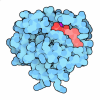
- PDB-9o0p: Crystal structure of GDP-bound mutant MRAS in complex with MRTX1133 -
+
Open data
ID or keywords:
Loading...
-
Basic information
Entry
Database: PDB / ID: 9o0p
Title
Crystal structure of GDP-bound mutant MRAS in complex with MRTX1133
Components
Ras-related protein M-Ras
Keywords
ONCOPROTEIN / MRAS / RAS
Function / homology
Function and homology information
protein phosphatase type 1 complex / GTP-dependent protein binding / SHOC2 M1731 mutant abolishes MRAS complex function / Gain-of-function MRAS complexes activate RAF signaling / establishment or maintenance of cell polarity / positive regulation of Ras protein signal transduction / small monomeric GTPase / RAF activation / actin cytoskeleton organization / G protein activity ...protein phosphatase type 1 complex / GTP-dependent protein binding / SHOC2 M1731 mutant abolishes MRAS complex function / Gain-of-function MRAS complexes activate RAF signaling / establishment or maintenance of cell polarity / positive regulation of Ras protein signal transduction / small monomeric GTPase / RAF activation / actin cytoskeleton organization / G protein activity / Ras protein signal transduction / GTPase activity / GTP binding / plasma membrane / cytoplasm Similarity search - Function
Small GTPase, Ras-type / Small GTPase Ras domain profile. / Ran (Ras-related nuclear proteins) /TC4 subfamily of small GTPases / Rho (Ras homology) subfamily of Ras-like small GTPases / Ras subfamily of RAS small GTPases / Small GTPase / Ras family / Rab subfamily of small GTPases / Small GTP-binding protein domain / P-loop containing nucleoside triphosphate hydrolase Similarity search - Domain/homology
National Institutes of Health/National Cancer Institute (NIH/NCI)
75N91019D00024
United States
Citation
Journal: Nat Commun / Year: 2026 Title: Structure of SHOC2-KRAS-PP1C complex reveals RAS isoform-specific determinants and insights into targeting complex assembly by RAS inhibitors. Authors: Daniel A Bonsor / Lorenzo I Finci / Jacob R Potter / Lucy C Young / Vanessa E Wall / Ruby Goldstein de Salazar / Katie R Geis / Tyler Stephens / Joseph Finney / Dwight V Nissley / Frank ...Authors: Daniel A Bonsor / Lorenzo I Finci / Jacob R Potter / Lucy C Young / Vanessa E Wall / Ruby Goldstein de Salazar / Katie R Geis / Tyler Stephens / Joseph Finney / Dwight V Nissley / Frank McCormick / Dhirendra K Simanshu / Abstract: RAF activation is essential for MAPK signaling and is mediated by RAS binding and the dephosphorylation of a conserved phosphoserine by the SHOC2-RAS-PP1C complex. MRAS forms a high-affinity SHOC2- ...RAF activation is essential for MAPK signaling and is mediated by RAS binding and the dephosphorylation of a conserved phosphoserine by the SHOC2-RAS-PP1C complex. MRAS forms a high-affinity SHOC2-MRAS-PP1C (SMP) complex, while canonical RAS isoforms (KRAS, HRAS, NRAS) form analogous but lower-affinity assemblies. Yet, cancers driven by oncogenic KRAS, HRAS, or NRAS remain strongly SHOC2-dependent, suggesting that these weaker complexes contribute to tumorigenesis. To elucidate how canonical RAS proteins form lower-affinity ternary complexes, the cryo-EM structure of the SHOC2-KRAS-PP1C (SKP) complex stabilized by Noonan syndrome mutations is described. The SKP architecture is similar to the SMP complex but forms fewer contacts and buries less surface area due to the absence of MRAS-specific structural features in KRAS that enhance complex stability. RAS inhibitors MRTX1133 and RMC-6236 alter Switch-I/II conformations, thereby blocking SKP assembly more effectively than they disrupt preformed complexes. These RAS inhibitors do not affect SMP formation because they do not bind MRAS. Since MRAS is upregulated in resistance to KRAS inhibition, we characterize a MRAS mutant capable of binding MRTX1133. This MRAS mutant can form an SMP complex, but MRTX1133 blocks its assembly, demonstrating the feasibility of dual SKP and SMP targeting. Overall, our findings define isoform-specific differences in SHOC2-RAS-PP1C complex formation and support a strategy to prevent both SKP and SMP assemblies to overcome resistance in RAS-driven cancers.
In the structure databanks used in Yorodumi, some data are registered as the other names, "COVID-19 virus" and "2019-nCoV". Here are the details of the virus and the list of structure data.
Jan 31, 2019. EMDB accession codes are about to change! (news from PDBe EMDB page)
EMDB accession codes are about to change! (news from PDBe EMDB page)
The allocation of 4 digits for EMDB accession codes will soon come to an end. Whilst these codes will remain in use, new EMDB accession codes will include an additional digit and will expand incrementally as the available range of codes is exhausted. The current 4-digit format prefixed with “EMD-” (i.e. EMD-XXXX) will advance to a 5-digit format (i.e. EMD-XXXXX), and so on. It is currently estimated that the 4-digit codes will be depleted around Spring 2019, at which point the 5-digit format will come into force.
The EM Navigator/Yorodumi systems omit the EMD- prefix.
Related info.:Q: What is EMD? / ID/Accession-code notation in Yorodumi/EM Navigator
Yorodumi is a browser for structure data from EMDB, PDB, SASBDB, etc.
This page is also the successor to EM Navigator detail page, and also detail information page/front-end page for Omokage search.
The word "yorodu" (or yorozu) is an old Japanese word meaning "ten thousand". "mi" (miru) is to see.
Related info.:EMDB / PDB / SASBDB / Comparison of 3 databanks / Yorodumi Search / Aug 31, 2016. New EM Navigator & Yorodumi / Yorodumi Papers / Jmol/JSmol / Function and homology information / Changes in new EM Navigator and Yorodumi
 Movie
Movie Controller

 Yorodumi
 Open data
 Basic information
 Components
 Keywords
 Function and homology information
 Homo sapiens (human)
 X-RAY DIFFRACTION /
  Authors
 United States, 1items
  Citation
 Structure visualization
 Downloads & links
 Other downloads


 PDBj
PDBj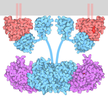
 Assembly


 Escherichia coli BL21(DE3) (bacteria) / References: UniProt: O14807, small monomeric GTPase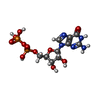



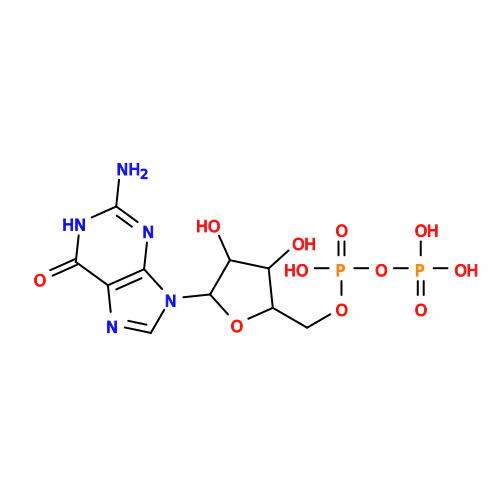 Type: RNA linking / Mass: 443.201 Da / Num. of mol.: 2 / Source method: obtained synthetically / Formula: C10H15N5O11P2 / Comment: GDP, energy-carrying molecule*YM
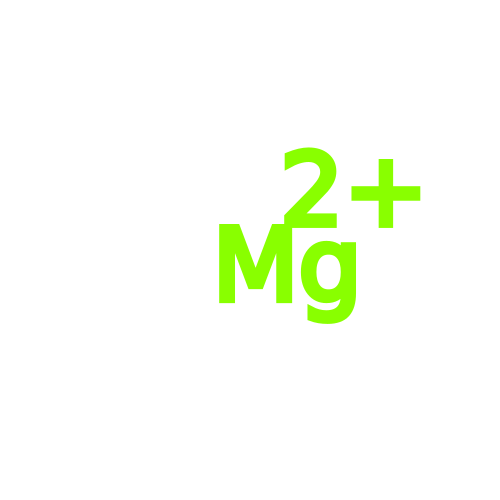 Mass: 24.305 Da / Num. of mol.: 1 / Source method: obtained synthetically / Formula: Mg
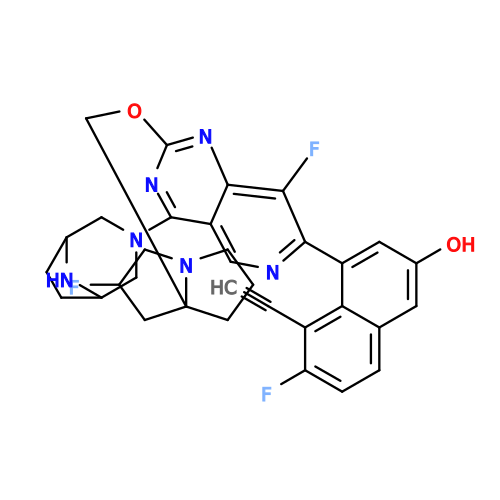 Mass: 600.633 Da / Num. of mol.: 2 / Source method: obtained synthetically / Formula: C33H31F3N6O2 / Feature type: SUBJECT OF INVESTIGATION
 Mass: 35.453 Da / Num. of mol.: 1 / Source method: obtained synthetically / Formula: Cl
 Sample preparation
 / Beamline: I03 / Wavelength: 0.81515 Å
 Processing