 Movie
Movie Controller

[English] 日本語
 Yorodumi
- PDB-9npm: Composite map of three pairs of dimeric VRC36 Fabs bound to HIV-1... -
+ Open data

- Basic information
| Entry | Database: PDB / ID: 9npm | |||||||||
|---|---|---|---|---|---|---|---|---|---|---|
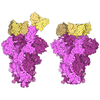
| Title | Composite map of three pairs of dimeric VRC36 Fabs bound to HIV-1 BG505.T332N DS-SOSIP.664 Env trimer | |||||||||
 Components Components |
| |||||||||
 Keywords Keywords | VIRAL PROTEIN/IMMUNE SYSTEM / HIV-1 / N-linked glycan / high mannose / broadly neutralizing antibody / VIRAL PROTEIN / VIRAL PROTEIN-IMMUNE SYSTEM complex | |||||||||
| Function / homology |  Function and homology information Function and homology informationmembrane fusion involved in viral entry into host cell / positive regulation of plasma membrane raft polarization / positive regulation of receptor clustering / symbiont-mediated perturbation of host defense response / host cell endosome membrane / clathrin-dependent endocytosis of virus by host cell / viral protein processing / fusion of virus membrane with host plasma membrane / fusion of virus membrane with host endosome membrane / viral envelope ...membrane fusion involved in viral entry into host cell / positive regulation of plasma membrane raft polarization / positive regulation of receptor clustering / symbiont-mediated perturbation of host defense response / host cell endosome membrane / clathrin-dependent endocytosis of virus by host cell / viral protein processing / fusion of virus membrane with host plasma membrane / fusion of virus membrane with host endosome membrane / viral envelope / symbiont entry into host cell / virion attachment to host cell / host cell plasma membrane / virion membrane / structural molecule activity / membrane Similarity search - Function | |||||||||
| Biological species |   Human immunodeficiency virus 1 Human immunodeficiency virus 1 Homo sapiens (human) Homo sapiens (human) | |||||||||
| Method | ELECTRON MICROSCOPY / single particle reconstruction / cryo EM / Resolution: 3.59 Å | |||||||||
 Authors Authors | Cheng, J. / Cale, E.M. / Longo, N. / Sutton, M.S. / Lei, H. / Huang, R. / Morton, A.J. / Lang, Z.C. / Morano, N.C. / Roark, R.S. ...Cheng, J. / Cale, E.M. / Longo, N. / Sutton, M.S. / Lei, H. / Huang, R. / Morton, A.J. / Lang, Z.C. / Morano, N.C. / Roark, R.S. / Becker, J.E. / Tsybovsky, Y. / Li, N. / Zhang, B. / Du, H. / Rubin, S. / Shapiro, L. / Pierson, T.C. / Doria-Rose, N.A. / Zhou, T. / Kwong, P.D. | |||||||||
| Funding support |  United States, 1items United States, 1items
| |||||||||
 Citation Citation | Journal: Adv Sci (Weinh) / Year: 2026 Title: Canonical Antibodies Adopt Distinct Binding Modes to Recognize Viral Glycan Shields. Authors: Jiaxuan Cheng / Evan M Cale / Amirabbas Maghsoudi / Matthew S Sutton / Nancy S Longo / Rebecca A Gillespie / Lingshu Wang / Ivan Kosik / Sue Chong / Atsuhiro Yasuhara / Tatsiana Bylund / ...Authors: Jiaxuan Cheng / Evan M Cale / Amirabbas Maghsoudi / Matthew S Sutton / Nancy S Longo / Rebecca A Gillespie / Lingshu Wang / Ivan Kosik / Sue Chong / Atsuhiro Yasuhara / Tatsiana Bylund / Arne Schön / Prabhanshu Tripathi / Yaroslav Tsybovsky / Haotian Lei / Nicholas C Morano / Allison B Lupatkin / Abraham J Morton / Zabrina C Lang / Jordan E Becker / Isabella R Frascilla / Myungjin Lee / Ning Li / Cuiping Liu / Ryan S Roark / Chen-Hsiang Shen / I-Ting Teng / David J Van Wazer / Danyi Wang / Lingyuan Wu / Goran Ahlsen / Mike Castro / Haijuan Du / Michael J Ernandes / Tiansheng Li / Bob C Lin / Mark K Louder / Krisha McKee / Jonah S Merriam / Sijy O'Dell / Li Ou / Sergei Pletnev / David Prikryl / Qi Qiu / Sarah Rubin / Mallika Sastry / Stephen D Schmidt / Asif Shajahan / Andrea R Shiakolas / Sanjay Srivatsan / Baoshan Zhang / Qiong Zhou / Mark Connors / Jason G Gall / Yicheng Guo / Rick K Huang / Yaoxing Huang / Richard A Koup / Q Paula Lei / John R Mascola / Reda Rawi / Leonid Serebryannyy / Lawrence Shapiro / Zizhang Sheng / David D Ho / Patrick C Wilson / Jonathan W Yewdell / Theodore C Pierson / Masaru Kanekiyo / Nicole A Doria-Rose / Peter D Kwong / Tongqing Zhou / Abstract: Viral entry glycoproteins are often shielded from immune recognition by dense N-linked glycans that limit antibody access to protein epitopes. While glycan-reactive antibodies with unusual ...Viral entry glycoproteins are often shielded from immune recognition by dense N-linked glycans that limit antibody access to protein epitopes. While glycan-reactive antibodies with unusual architectures have been described, how canonical Y-shaped antibodies engage these glycan-rich surfaces remains poorly defined. Here, we characterize two human antibodies, VRC35 and VRC36, isolated from an HIV-1-infected donor, that recognize diverse glycosylated viral glycoproteins. Cryo-electron microscopy structural analyses of these antibodies in complex with viral entry glycoproteins, including HIV-1 envelope, influenza hemagglutinin, SARS-CoV-2 spike, and the Lassa virus glycoprotein complex, reveal adaptive Fab stoichiometries ranging from single-Fab binding to dimeric and higher-order assemblies are mediated by intra- and inter-IgG interactions that depend on local glycan organization. Dense glycan clustering on HIV-1 and influenza glycoproteins supports multivalent Fab assemblies and correlates with neutralization activity, whereas sparse glycan environments on SARS-CoV-2 and Lassa virus favor weak or heterogeneous engagement without neutralization. Structural and mutational analyses further demonstrate that homotypic Fab-Fab interactions stabilize multivalent engagement and contribute to neutralizing activity. Together, these findings define a structural framework in which viral glycan organization constrains antibody valency and engagement, while somatic hypermutation contributes to the acquisition of homotypic Fab-Fab interactions that facilitate multivalent recognition of viral glycan shields. | |||||||||
| History |
|
- Structure visualization
| Structure viewer | Molecule: MolmilJmol/JSmol |
|---|
- Downloads & links
-Download
| PDBx/mmCIF format | 9npm.cif.gz | 793.7 KB | Display | PDBx/mmCIF format |
|---|---|---|---|---|
| PDB format | pdb9npm.ent.gz | 663.9 KB | Display | PDB format |
| PDBx/mmJSON format | 9npm.json.gz | Tree view | PDBx/mmJSON format | |
| Others |  Other downloads Other downloads |
-Validation report
| Arichive directory | https://data.pdbj.org/pub/pdb/validation_reports/np/9npmftp://data.pdbj.org/pub/pdb/validation_reports/np/9npm | HTTPS FTP |
|---|
-Related structure data
| Related structure data |  49628MC  9om5C C: citing same article ( M: map data used to model this data |
|---|---|
| Similar structure data |


-Links
 PDBj
PDBj
- Assembly
| Deposited unit | 
|
|---|---|
| 1 |
|
-Components
-HIV-1 BG505.T332N DS-SOSIP.664 Env glycoprotein ... , 2 types, 6 molecules CEADFB
| #1: Protein | Mass: 53200.469 Da / Num. of mol.: 3 / Fragment: UNP residues 30-505 Source method: isolated from a genetically manipulated source Source: (gene. exp.) Human immunodeficiency virus 1 / Gene: env / Production host: Homo sapiens (human) / References: UniProt: A0A6H1VH54#2: Protein | Mass: 17146.482 Da / Num. of mol.: 3 / Fragment: UNP residues 509-661 Source method: isolated from a genetically manipulated source Source: (gene. exp.) Human immunodeficiency virus 1 / Gene: env / Production host: Homo sapiens (human) / References: UniProt: Q2N0S5 |
|---|
-Antibody , 2 types, 12 molecules KMOQGILNPRHJ
| #3: Antibody | Mass: 24125.166 Da / Num. of mol.: 6 Source method: isolated from a genetically manipulated source Source: (gene. exp.) Homo sapiens (human) / Production host: Homo sapiens (human)#4: Antibody | Mass: 23380.910 Da / Num. of mol.: 6 Source method: isolated from a genetically manipulated source Source: (gene. exp.) Homo sapiens (human) / Production host: Homo sapiens (human) |
|---|
-Sugars , 9 types, 49 molecules 
| #5: Polysaccharide | 2-acetamido-2-deoxy-beta-D-glucopyranose-(1-4)-2-acetamido-2-deoxy-beta-D-glucopyranose Source method: isolated from a genetically manipulated source #6: Polysaccharide | Source method: isolated from a genetically manipulated source #7: Polysaccharide | Type: oligosaccharide / Mass: 1559.386 Da / Num. of mol.: 3 Source method: isolated from a genetically manipulated source #8: Polysaccharide | alpha-D-mannopyranose-(1-2)-alpha-D-mannopyranose-(1-2)-alpha-D-mannopyranose-(1-3)-[alpha-D- ...alpha-D-mannopyranose-(1-2)-alpha-D-mannopyranose-(1-2)-alpha-D-mannopyranose-(1-3)-[alpha-D-mannopyranose-(1-3)-alpha-D-mannopyranose-(1-6)]beta-D-mannopyranose-(1-4)-2-acetamido-2-deoxy-beta-D-glucopyranose-(1-4)-2-acetamido-2-deoxy-beta-D-glucopyranose Source method: isolated from a genetically manipulated source #9: Polysaccharide | alpha-D-mannopyranose-(1-3)-alpha-D-mannopyranose-(1-6)-[alpha-D-mannopyranose-(1-3)]beta-D- ...alpha-D-mannopyranose-(1-3)-alpha-D-mannopyranose-(1-6)-[alpha-D-mannopyranose-(1-3)]beta-D-mannopyranose-(1-4)-2-acetamido-2-deoxy-beta-D-glucopyranose-(1-4)-2-acetamido-2-deoxy-beta-D-glucopyranose Source method: isolated from a genetically manipulated source #10: Polysaccharide | Source method: isolated from a genetically manipulated source #11: Polysaccharide | alpha-D-mannopyranose-(1-2)-alpha-D-mannopyranose-(1-2)-alpha-D-mannopyranose-(1-3)-beta-D- ...alpha-D-mannopyranose-(1-2)-alpha-D-mannopyranose-(1-2)-alpha-D-mannopyranose-(1-3)-beta-D-mannopyranose-(1-4)-2-acetamido-2-deoxy-beta-D-glucopyranose-(1-4)-2-acetamido-2-deoxy-beta-D-glucopyranose | Source method: isolated from a genetically manipulated source #12: Polysaccharide | alpha-D-mannopyranose-(1-3)-alpha-D-mannopyranose | Source method: isolated from a genetically manipulated source #13: Sugar | ChemComp-NAG / 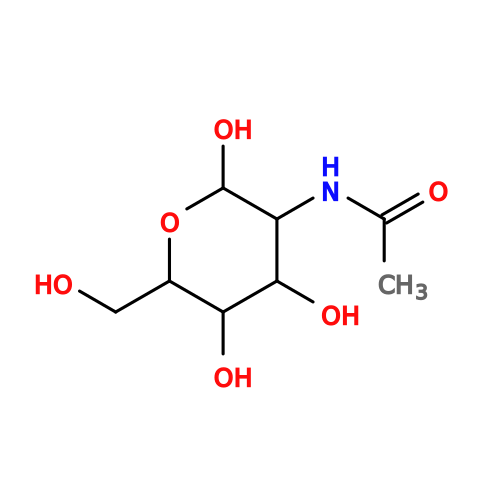 Type: D-saccharide, beta linking / Mass: 221.208 Da / Num. of mol.: 15 Type: D-saccharide, beta linking / Mass: 221.208 Da / Num. of mol.: 15Source method: isolated from a genetically manipulated source Formula: C8H15NO6 / Feature type: SUBJECT OF INVESTIGATION |
|---|
-Details
| Has ligand of interest | Y |
|---|---|
| Has protein modification | Y |
-Experimental details
-Experiment
| Experiment | Method: ELECTRON MICROSCOPY |
|---|---|
| EM experiment | Aggregation state: PARTICLE / 3D reconstruction method: single particle reconstruction |
- Sample preparation
| Component | Name: Three pairs of dimeric VRC36 Fabs in complex with HIV-1 BG505.T332N DS-SOSIP.664 Env Type: COMPLEX / Entity ID: #1-#4 / Source: RECOMBINANT |
|---|---|
| Source (natural) | Organism: Homo sapiens (human) |
| Source (recombinant) | Organism: Homo sapiens (human) |
| Buffer solution | pH: 7.4 |
| Specimen | Embedding applied: NO / Shadowing applied: NO / Staining applied: NO / Vitrification applied: YES |
| Vitrification | Cryogen name: ETHANE |
- Electron microscopy imaging
| Experimental equipment | 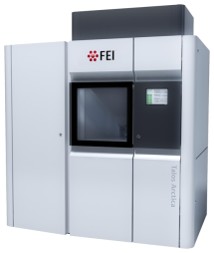 Model: Talos Arctica / Image courtesy: FEI Company |
|---|---|
| Microscopy | Model: FEI TALOS ARCTICA |
| Electron gun | Electron source:  FIELD EMISSION GUN / Accelerating voltage: 200 kV / Illumination mode: FLOOD BEAM FIELD EMISSION GUN / Accelerating voltage: 200 kV / Illumination mode: FLOOD BEAM |
| Electron lens | Mode: BRIGHT FIELD / Nominal defocus max: 2500 nm / Nominal defocus min: 1000 nm |
| Image recording | Electron dose: 70.53 e/Å2 / Film or detector model: GATAN K3 BIOCONTINUUM (6k x 4k) |
- Processing
| EM software | Name: PHENIX / Version: 1.20.1_4487 / Category: model refinement | ||||||||||||||||||||||||
|---|---|---|---|---|---|---|---|---|---|---|---|---|---|---|---|---|---|---|---|---|---|---|---|---|---|
| CTF correction | Type: PHASE FLIPPING AND AMPLITUDE CORRECTION | ||||||||||||||||||||||||
| 3D reconstruction | Resolution: 3.59 Å / Resolution method: FSC 0.143 CUT-OFF / Num. of particles: 111000 / Symmetry type: POINT | ||||||||||||||||||||||||
| Refinement | Highest resolution: 3.59 Å Stereochemistry target values: REAL-SPACE (WEIGHTED MAP SUM AT ATOM CENTERS) | ||||||||||||||||||||||||
| Refine LS restraints |
|
