National Institutes of Health/National Institute Of Allergy and Infectious Diseases (NIH/NIAID)
United States
Citation
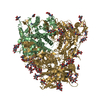
Journal: Adv Sci (Weinh) / Year: 2026 Title: Canonical Antibodies Adopt Distinct Binding Modes to Recognize Viral Glycan Shields. Authors: Jiaxuan Cheng / Evan M Cale / Amirabbas Maghsoudi / Matthew S Sutton / Nancy S Longo / Rebecca A Gillespie / Lingshu Wang / Ivan Kosik / Sue Chong / Atsuhiro Yasuhara / Tatsiana Bylund / ...Authors: Jiaxuan Cheng / Evan M Cale / Amirabbas Maghsoudi / Matthew S Sutton / Nancy S Longo / Rebecca A Gillespie / Lingshu Wang / Ivan Kosik / Sue Chong / Atsuhiro Yasuhara / Tatsiana Bylund / Arne Schön / Prabhanshu Tripathi / Yaroslav Tsybovsky / Haotian Lei / Nicholas C Morano / Allison B Lupatkin / Abraham J Morton / Zabrina C Lang / Jordan E Becker / Isabella R Frascilla / Myungjin Lee / Ning Li / Cuiping Liu / Ryan S Roark / Chen-Hsiang Shen / I-Ting Teng / David J Van Wazer / Danyi Wang / Lingyuan Wu / Goran Ahlsen / Mike Castro / Haijuan Du / Michael J Ernandes / Tiansheng Li / Bob C Lin / Mark K Louder / Krisha McKee / Jonah S Merriam / Sijy O'Dell / Li Ou / Sergei Pletnev / David Prikryl / Qi Qiu / Sarah Rubin / Mallika Sastry / Stephen D Schmidt / Asif Shajahan / Andrea R Shiakolas / Sanjay Srivatsan / Baoshan Zhang / Qiong Zhou / Mark Connors / Jason G Gall / Yicheng Guo / Rick K Huang / Yaoxing Huang / Richard A Koup / Q Paula Lei / John R Mascola / Reda Rawi / Leonid Serebryannyy / Lawrence Shapiro / Zizhang Sheng / David D Ho / Patrick C Wilson / Jonathan W Yewdell / Theodore C Pierson / Masaru Kanekiyo / Nicole A Doria-Rose / Peter D Kwong / Tongqing Zhou / Abstract: Viral entry glycoproteins are often shielded from immune recognition by dense N-linked glycans that limit antibody access to protein epitopes. While glycan-reactive antibodies with unusual ...Viral entry glycoproteins are often shielded from immune recognition by dense N-linked glycans that limit antibody access to protein epitopes. While glycan-reactive antibodies with unusual architectures have been described, how canonical Y-shaped antibodies engage these glycan-rich surfaces remains poorly defined. Here, we characterize two human antibodies, VRC35 and VRC36, isolated from an HIV-1-infected donor, that recognize diverse glycosylated viral glycoproteins. Cryo-electron microscopy structural analyses of these antibodies in complex with viral entry glycoproteins, including HIV-1 envelope, influenza hemagglutinin, SARS-CoV-2 spike, and the Lassa virus glycoprotein complex, reveal adaptive Fab stoichiometries ranging from single-Fab binding to dimeric and higher-order assemblies are mediated by intra- and inter-IgG interactions that depend on local glycan organization. Dense glycan clustering on HIV-1 and influenza glycoproteins supports multivalent Fab assemblies and correlates with neutralization activity, whereas sparse glycan environments on SARS-CoV-2 and Lassa virus favor weak or heterogeneous engagement without neutralization. Structural and mutational analyses further demonstrate that homotypic Fab-Fab interactions stabilize multivalent engagement and contribute to neutralizing activity. Together, these findings define a structural framework in which viral glycan organization constrains antibody valency and engagement, while somatic hypermutation contributes to the acquisition of homotypic Fab-Fab interactions that facilitate multivalent recognition of viral glycan shields.
In the structure databanks used in Yorodumi, some data are registered as the other names, "COVID-19 virus" and "2019-nCoV". Here are the details of the virus and the list of structure data.
Jan 31, 2019. EMDB accession codes are about to change! (news from PDBe EMDB page)
EMDB accession codes are about to change! (news from PDBe EMDB page)
The allocation of 4 digits for EMDB accession codes will soon come to an end. Whilst these codes will remain in use, new EMDB accession codes will include an additional digit and will expand incrementally as the available range of codes is exhausted. The current 4-digit format prefixed with “EMD-” (i.e. EMD-XXXX) will advance to a 5-digit format (i.e. EMD-XXXXX), and so on. It is currently estimated that the 4-digit codes will be depleted around Spring 2019, at which point the 5-digit format will come into force.
The EM Navigator/Yorodumi systems omit the EMD- prefix.
Related info.:Q: What is EMD? / ID/Accession-code notation in Yorodumi/EM Navigator
Yorodumi is a browser for structure data from EMDB, PDB, SASBDB, etc.
This page is also the successor to EM Navigator detail page, and also detail information page/front-end page for Omokage search.
The word "yorodu" (or yorozu) is an old Japanese word meaning "ten thousand". "mi" (miru) is to see.
Related info.:EMDB / PDB / SASBDB / Comparison of 3 databanks / Yorodumi Search / Aug 31, 2016. New EM Navigator & Yorodumi / Yorodumi Papers / Jmol/JSmol / Function and homology information / Changes in new EM Navigator and Yorodumi
 Movie
Movie Controller

 Yorodumi
 Open data
 Basic information
 Map data
 Sample
 Keywords
 Homo sapiens (human)
 Authors
 United States, 1 items
  Citation
 Structure visualization
 Downloads & links
 EMDB map data format
 emd_48133.png
 https://data.pdbj.org/pub/emdb/structures/EMD-48133


 Z (Sec.)
 Y (Row.)
 X (Col.)


 Sample components
 Processing
 Electron microscopy
 FIELD EMISSION GUN