 Movie
Movie Controller

[English] 日本語
 Yorodumi
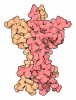
- PDB-9ni7: Cryo-EM structure of the Class 3 PI3K alpha/KRas complex on POPC/... -
+ Open data

- Basic information
| Entry | Database: PDB / ID: 9ni7 | |||||||||||||||||||||||||||
|---|---|---|---|---|---|---|---|---|---|---|---|---|---|---|---|---|---|---|---|---|---|---|---|---|---|---|---|---|
| Title | Cryo-EM structure of the Class 3 PI3K alpha/KRas complex on POPC/POPS nanodiscs | |||||||||||||||||||||||||||
 Components Components |
| |||||||||||||||||||||||||||
 Keywords Keywords | Transferase/Hydrolase / lipid kinase / GTPase / ONCOPROTEIN / Transferase-Hydrolase complex | |||||||||||||||||||||||||||
| Function / homology |  Function and homology information Function and homology informationresponse to muscle inactivity / regulation of actin filament organization / response to butyrate / negative regulation of actin filament depolymerization / IRS-mediated signalling / PI3K events in ERBB4 signaling / response to L-leucine / cellular response to hydrostatic pressure / Activated NTRK2 signals through PI3K / Activated NTRK3 signals through PI3K ...response to muscle inactivity / regulation of actin filament organization / response to butyrate / negative regulation of actin filament depolymerization / IRS-mediated signalling / PI3K events in ERBB4 signaling / response to L-leucine / cellular response to hydrostatic pressure / Activated NTRK2 signals through PI3K / Activated NTRK3 signals through PI3K / phosphatidylinositol 3-kinase complex, class IB / phosphatidylinositol 3-kinase complex / Co-stimulation by ICOS / TORC2 signaling / positive regulation of protein localization to membrane / Signaling by cytosolic FGFR1 fusion mutants / vasculature development / Nephrin family interactions / Signaling by LTK in cancer / 1-phosphatidylinositol-4-phosphate 3-kinase activity / Signaling by LTK / anoikis / phosphatidylinositol 3-kinase complex, class IA / MET activates PI3K/AKT signaling / PI3K/AKT activation / phosphatidylinositol-4,5-bisphosphate 3-kinase / 1-phosphatidylinositol-4,5-bisphosphate 3-kinase activity / relaxation of cardiac muscle / phosphatidylinositol 3-kinase / Signaling by ALK / phosphatidylinositol-3-phosphate biosynthetic process / cardiac muscle cell contraction / vascular endothelial growth factor signaling pathway / 1-phosphatidylinositol-3-kinase activity / Erythropoietin activates Phosphoinositide-3-kinase (PI3K) / PI-3K cascade:FGFR3 / response to dexamethasone / response to mineralocorticoid / GMP binding / PI-3K cascade:FGFR2 / PI-3K cascade:FGFR4 / PI-3K cascade:FGFR1 / LRR domain binding / phosphatidylinositol phosphate biosynthetic process / Synthesis of PIPs at the plasma membrane / response to gravity / positive regulation of protein kinase activity / myoblast proliferation / response to muscle stretch / phosphatidylinositol-mediated signaling / RET signaling / cardiac muscle cell proliferation / negative regulation of anoikis / Interleukin-3, Interleukin-5 and GM-CSF signaling / PI3K events in ERBB2 signaling / insulin receptor substrate binding / Signaling by RAS GAP mutants / Signaling by RAS GTPase mutants / Activation of RAS in B cells / GTPase complex / PI3K Cascade / Role of LAT2/NTAL/LAB on calcium mobilization / RAC2 GTPase cycle / RAS signaling downstream of NF1 loss-of-function variants / Interleukin receptor SHC signaling / RUNX3 regulates p14-ARF / intercalated disc / Role of phospholipids in phagocytosis / CD28 dependent PI3K/Akt signaling / protein phosphatase type 1 complex / GAB1 signalosome / endothelial cell migration / SOS-mediated signalling / Activated NTRK3 signals through RAS / Activated NTRK2 signals through RAS / protein kinase activator activity / SHC1 events in ERBB4 signaling / negative regulation of macroautophagy / positive regulation of lamellipodium assembly / Signalling to RAS / negative regulation of programmed cell death / serine/threonine protein kinase complex / cardiac muscle contraction / SHC-related events triggered by IGF1R / Activated NTRK2 signals through FRS2 and FRS3 / Estrogen-stimulated signaling through PRKCZ / SHC-mediated cascade:FGFR3 / GPVI-mediated activation cascade / MET activates RAS signaling / positive regulation of Ras protein signal transduction / response to isolation stress / SHC-mediated cascade:FGFR2 / SHC-mediated cascade:FGFR4 / PTK6 Regulates RHO GTPases, RAS GTPase and MAP kinases / Signaling by PDGFRA transmembrane, juxtamembrane and kinase domain mutants / Signaling by PDGFRA extracellular domain mutants / insulin-like growth factor receptor signaling pathway / Erythropoietin activates RAS / SHC-mediated cascade:FGFR1 / Signaling by FGFR4 in disease Similarity search - Function | |||||||||||||||||||||||||||
| Biological species |  Homo sapiens (human) Homo sapiens (human) | |||||||||||||||||||||||||||
| Method | ELECTRON MICROSCOPY / single particle reconstruction / cryo EM / Resolution: 3.05 Å | |||||||||||||||||||||||||||
 Authors Authors | Torosyan, H. / Natalia, J. / Verba, K.A. | |||||||||||||||||||||||||||
| Funding support |  United States, 1items United States, 1items
| |||||||||||||||||||||||||||
 Citation Citation | Journal: Mol Cell / Year: 2026 Title: Structures of the PI3Kα/KRas complex on lipid bilayers reveal molecular mechanisms of PI3Kα activation. Authors: Hayarpi Torosyan / Michael D Paul / Brigitte G Meyer / Allison Maker / Natalia Jura / Kliment A Verba / Abstract: PI3Kα is a potent oncogene that converts PIP2 to PIP3 at the plasma membrane upon activation by receptor tyrosine kinases and Ras. To understand the molecular mechanism of PI3Kα activation, we used ...PI3Kα is a potent oncogene that converts PIP2 to PIP3 at the plasma membrane upon activation by receptor tyrosine kinases and Ras. To understand the molecular mechanism of PI3Kα activation, we used cryo-electron microscopy to visualize the conformational states that underlie its transition to an active signaling complex. Here, we present structures of the PI3Kα/KRas complex embedded in lipid nanodiscs, revealing a rich ensemble of PI3Kα conformations that capture the progressive release of key inhibitory domains from the PI3Kα catalytic core. PIP2 triggers significant restructuring of active site regulatory motifs while an activating phosphopeptide induces dimerization of the PI3Kα/KRas complex through a p110α catalytic subunit-mediated interface that is sterically occluded in autoinhibited PI3Kα. In cells, dimeric PI3Kα amplifies Akt signaling in response to growth factor stimulation. Collectively, these structures map the conformational landscape of PI3Kα activation and reveal previously unexplored interfaces for potential therapeutic targeting. #1: Journal: bioRxiv / Year: 2025 Title: Structures of the PI3Kα/KRas complex on lipid bilayers reveal the molecular mechanism of PI3Kα activation. Authors: Hayarpi Torosyan / Michael D Paul / Allison Maker / Brigitte G Meyer / Natalia Jura / Kliment A Verba Abstract: PI3Kα is a potent oncogene that converts PIP2 to PIP3 at the plasma membrane upon activation by receptor tyrosine kinases and Ras GTPases. In the absence of any structures of activated PI3Kα, the ...PI3Kα is a potent oncogene that converts PIP2 to PIP3 at the plasma membrane upon activation by receptor tyrosine kinases and Ras GTPases. In the absence of any structures of activated PI3Kα, the molecular details of its activation remain unknown. Here, we present cryo-EM structures of the PI3Kα/KRas complex embedded in lipid nanodiscs, revealing a rich ensemble of PI3Kα states adopted at the membrane surface. The sequential addition of a lipid bilayer, PIP2 and an activating phosphopeptide leads to the progressive release of key inhibitory domains from the PI3Kα catalytic core, which directly correlates with the reorganization of its active site. While association with POPC/POPS nanodiscs partially relieves PI3Kα autoinhibition, incorporation of PIP2 triggers near-complete displacement of PI3Kα inhibitory domains and significant restructuring of active site regulatory motifs. The addition of the activating phosphopeptide induces dimerization of the PI3Kα/KRas complex through a p110α catalytic subunit-mediated interface that is sterically occluded in autoinhibited PI3Kα. In cells, this dimeric PI3Kα complex amplifies Akt signaling in response to growth factor stimulation. Collectively, our structures map the conformational landscape of PI3Kα activation and reveal previously unexplored interfaces for potential therapeutic targeting. | |||||||||||||||||||||||||||
| History |
|
- Structure visualization
| Structure viewer | Molecule: MolmilJmol/JSmol |
|---|
- Downloads & links
-Download
| PDBx/mmCIF format | 9ni7.cif.gz | 411.8 KB | Display | PDBx/mmCIF format |
|---|---|---|---|---|
| PDB format | pdb9ni7.ent.gz | Display | PDB format | |
| PDBx/mmJSON format | 9ni7.json.gz | Tree view | PDBx/mmJSON format | |
| Others |  Other downloads Other downloads |
-Validation report
| Arichive directory | https://data.pdbj.org/pub/pdb/validation_reports/ni/9ni7ftp://data.pdbj.org/pub/pdb/validation_reports/ni/9ni7 | HTTPS FTP |
|---|
-Related structure data
| Related structure data |  49455MC  9ni3C  9ni4C  9ni5C  9ni6C  9ni8C  9nidC  9nieC  9nifC  9nlcC M: map data used to model this data C: citing same article ( |
|---|---|
| Similar structure data |


-Links
 PDBj
PDBj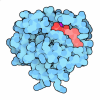
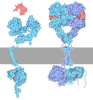
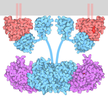
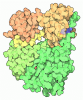
- Assembly
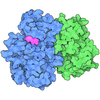
| Deposited unit | 
|
|---|---|
| 1 |
|
-Components
| #1: Protein | Mass: 127822.578 Da / Num. of mol.: 1 Source method: isolated from a genetically manipulated source Source: (gene. exp.) Homo sapiens (human) / Gene: PIK3CA / Production host:   Spodoptera frugiperda (fall armyworm) Spodoptera frugiperda (fall armyworm)References: UniProt: P42336, phosphatidylinositol-4,5-bisphosphate 3-kinase, non-specific serine/threonine protein kinase |
|---|---|
| #2: Protein | Mass: 21516.656 Da / Num. of mol.: 1 Source method: isolated from a genetically manipulated source Source: (gene. exp.) Homo sapiens (human) / Gene: KRAS, KRAS2, RASK2 / Production host: Trichoplusia ni (cabbage looper) / References: UniProt: P01116, small monomeric GTPase |
| #3: Chemical | ChemComp-A1AZD / Mass: 581.658 Da / Num. of mol.: 1 / Source method: obtained synthetically / Formula: C29H32FN5O5S / Feature type: SUBJECT OF INVESTIGATION |
| #4: Chemical | ChemComp-MG /   Mass: 24.305 Da / Num. of mol.: 1 / Source method: obtained synthetically / Formula: Mg / Feature type: SUBJECT OF INVESTIGATION Mass: 24.305 Da / Num. of mol.: 1 / Source method: obtained synthetically / Formula: Mg / Feature type: SUBJECT OF INVESTIGATION |
| #5: Chemical | ChemComp-GNP / 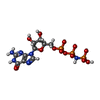 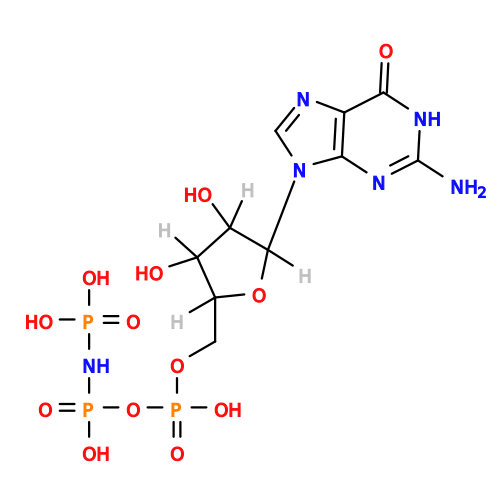 Mass: 522.196 Da / Num. of mol.: 1 / Source method: obtained synthetically / Formula: C10H17N6O13P3 / Feature type: SUBJECT OF INVESTIGATION Mass: 522.196 Da / Num. of mol.: 1 / Source method: obtained synthetically / Formula: C10H17N6O13P3 / Feature type: SUBJECT OF INVESTIGATIONComment: GppNHp, GMPPNP, energy-carrying molecule analogue*YM |
| Has ligand of interest | Y |
| Has protein modification | N |
-Experimental details
-Experiment
| Experiment | Method: ELECTRON MICROSCOPY |
|---|---|
| EM experiment | Aggregation state: PARTICLE / 3D reconstruction method: single particle reconstruction |
- Sample preparation
| Component | Name: full-length p85 alpha and p110 alpha heterodimer/KRas complex bound to POPC/POPS-MSP1E3D1 nanodiscs Type: COMPLEX / Entity ID: #1-#2 / Source: RECOMBINANT |
|---|---|
| Molecular weight | Value: 0.232609 MDa / Experimental value: NO |
| Source (natural) | Organism: Homo sapiens (human) |
| Source (recombinant) | Organism: Spodoptera frugiperda (fall armyworm) |
| Buffer solution | pH: 7.5 / Details: 50 mM Tris-HCL, 150 mM NaCl, 1mM TCEP |
| Specimen | Embedding applied: NO / Shadowing applied: NO / Staining applied: NO / Vitrification applied: YES |
| Specimen support | Grid material: GOLD / Grid mesh size: 300 divisions/in. / Grid type: Quantifoil R1.2/1.3 |
| Vitrification | Instrument: FEI VITROBOT MARK IV / Cryogen name: ETHANE / Humidity: 100 % / Chamber temperature: 5 K |
- Electron microscopy imaging
| Experimental equipment |  Model: Titan Krios / Image courtesy: FEI Company |
|---|---|
| Microscopy | Model: TFS KRIOS |
| Electron gun | Electron source:  FIELD EMISSION GUN / Accelerating voltage: 300 kV / Illumination mode: FLOOD BEAM FIELD EMISSION GUN / Accelerating voltage: 300 kV / Illumination mode: FLOOD BEAM |
| Electron lens | Mode: BRIGHT FIELD / Nominal magnification: 105000 X / Nominal defocus max: 2000 nm / Nominal defocus min: 1000 nm / Cs: 2.7 mm |
| Specimen holder | Specimen holder model: FEI TITAN KRIOS AUTOGRID HOLDER |
| Image recording | Electron dose: 47.7 e/Å2 / Film or detector model: GATAN K3 (6k x 4k) |
- Processing
| EM software |
| ||||||||||||||||||||||||||||||||||||||||
|---|---|---|---|---|---|---|---|---|---|---|---|---|---|---|---|---|---|---|---|---|---|---|---|---|---|---|---|---|---|---|---|---|---|---|---|---|---|---|---|---|---|
| CTF correction | Type: PHASE FLIPPING AND AMPLITUDE CORRECTION | ||||||||||||||||||||||||||||||||||||||||
| Particle selection | Num. of particles selected: 2870914 | ||||||||||||||||||||||||||||||||||||||||
| 3D reconstruction | Resolution: 3.05 Å / Resolution method: FSC 0.143 CUT-OFF / Num. of particles: 117424 / Symmetry type: POINT |
