 Movie
Movie Controller


+ Open data

- Basic information
| Entry | Database: PDB / ID: 9igx | |||||||||||||||||||||||||||
|---|---|---|---|---|---|---|---|---|---|---|---|---|---|---|---|---|---|---|---|---|---|---|---|---|---|---|---|---|
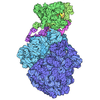
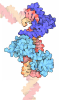
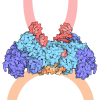
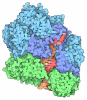
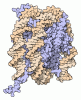
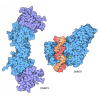
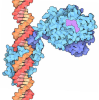
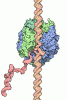
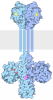
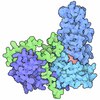
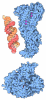
| Title | Ku70/80 bound to 153 bp nucleosome | |||||||||||||||||||||||||||
 Components Components |
| |||||||||||||||||||||||||||
 Keywords Keywords | DNA BINDING PROTEIN / DNA-binding protein / NHEJ / Ku70/80 / nucleosome | |||||||||||||||||||||||||||
| Function / homology |  Function and homology information Function and homology informationKu70:Ku80 complex / negative regulation of t-circle formation / DNA end binding / small-subunit processome assembly / positive regulation of lymphocyte differentiation / DNA-dependent protein kinase-DNA ligase 4 complex / nonhomologous end joining complex / cellular response to X-ray / regulation of smooth muscle cell proliferation / double-strand break repair via classical nonhomologous end joining ...Ku70:Ku80 complex / negative regulation of t-circle formation / DNA end binding / small-subunit processome assembly / positive regulation of lymphocyte differentiation / DNA-dependent protein kinase-DNA ligase 4 complex / nonhomologous end joining complex / cellular response to X-ray / regulation of smooth muscle cell proliferation / double-strand break repair via classical nonhomologous end joining / Cytosolic sensors of pathogen-associated DNA / nuclear telomere cap complex / IRF3-mediated induction of type I IFN / cellular hyperosmotic salinity response / U3 snoRNA binding / regulation of telomere maintenance / recombinational repair / protein localization to chromosome, telomeric region / 2-LTR circle formation / telomeric repeat DNA binding / DNA 3'-5' helicase / 5'-deoxyribose-5-phosphate lyase activity / 3'-5' DNA helicase activity / negative regulation of tumor necrosis factor-mediated signaling pathway / ATP-dependent activity, acting on DNA / telomere maintenance via telomerase / negative regulation of megakaryocyte differentiation / protein localization to CENP-A containing chromatin / Chromatin modifying enzymes / Replacement of protamines by nucleosomes in the male pronucleus / Packaging Of Telomere Ends / activation of innate immune response / Recognition and association of DNA glycosylase with site containing an affected purine / Cleavage of the damaged purine / telomere organization / Interleukin-7 signaling / Deposition of new CENPA-containing nucleosomes at the centromere / telomere maintenance / cyclin binding / Recognition and association of DNA glycosylase with site containing an affected pyrimidine / Cleavage of the damaged pyrimidine / DNA helicase activity / RNA Polymerase I Promoter Opening / Inhibition of DNA recombination at telomere / DNA-(apurinic or apyrimidinic site) lyase / Assembly of the ORC complex at the origin of replication / class I DNA-(apurinic or apyrimidinic site) endonuclease activity / SUMOylation of chromatin organization proteins / Regulation of endogenous retroelements by the Human Silencing Hub (HUSH) complex / Meiotic synapsis / DNA methylation / Condensation of Prophase Chromosomes / site of DNA damage / Chromatin modifications during the maternal to zygotic transition (MZT) / SIRT1 negatively regulates rRNA expression / HCMV Late Events / ERCC6 (CSB) and EHMT2 (G9a) positively regulate rRNA expression / PRC2 methylates histones and DNA / Regulation of endogenous retroelements by KRAB-ZFP proteins / cellular response to gamma radiation / Defective pyroptosis / HDACs deacetylate histones / small-subunit processome / Transcriptional regulation by small RNAs / lipopolysaccharide binding / Regulation of endogenous retroelements by Piwi-interacting RNAs (piRNAs) / RNA Polymerase I Promoter Escape / Nonhomologous End-Joining (NHEJ) / epigenetic regulation of gene expression / HDMs demethylate histones / protein-DNA complex / Activated PKN1 stimulates transcription of AR (androgen receptor) regulated genes KLK2 and KLK3 / RUNX1 regulates genes involved in megakaryocyte differentiation and platelet function / Negative Regulation of CDH1 Gene Transcription / NoRC negatively regulates rRNA expression / PKMTs methylate histone lysines / G2/M DNA damage checkpoint / Formation of the beta-catenin:TCF transactivating complex / double-strand break repair via nonhomologous end joining / B-WICH complex positively regulates rRNA expression / DNA Damage/Telomere Stress Induced Senescence / Meiotic recombination / Pre-NOTCH Transcription and Translation / Activation of anterior HOX genes in hindbrain development during early embryogenesis / enzyme activator activity / Transcriptional regulation of granulopoiesis / nucleosomal DNA binding / RMTs methylate histone arginines / Metalloprotease DUBs / innate immune response in mucosa / HCMV Early Events / double-strand break repair / structural constituent of chromatin / nucleosome / Regulation of PD-L1(CD274) transcription / UCH proteinases / nucleosome assembly / transcription regulator complex / HATs acetylate histones / E3 ubiquitin ligases ubiquitinate target proteins Similarity search - Function | |||||||||||||||||||||||||||
| Biological species |  Homo sapiens (human) Homo sapiens (human) | |||||||||||||||||||||||||||
| Method | ELECTRON MICROSCOPY / single particle reconstruction / cryo EM / Resolution: 3.56 Å | |||||||||||||||||||||||||||
 Authors Authors | Hall, C. / Chaplin, A.K. | |||||||||||||||||||||||||||
| Funding support |  Canada, Canada,  United Kingdom, 2items United Kingdom, 2items
| |||||||||||||||||||||||||||
 Citation Citation | Journal: Nat Commun / Year: 2025 Title: Cryo-EM structures of NHEJ assemblies with nucleosomes. Authors: Chloe Hall / Philippe Frit / Antonia Kefala-Stavridi / Amandine Pelletier / Steven W Hardwick / Himani Amin / Matthew K Bilyard / Taiana Maia De Oliviera / Ammarah Tariq / Sayma Zahid / ...Authors: Chloe Hall / Philippe Frit / Antonia Kefala-Stavridi / Amandine Pelletier / Steven W Hardwick / Himani Amin / Matthew K Bilyard / Taiana Maia De Oliviera / Ammarah Tariq / Sayma Zahid / Dimitri Y Chirgadze / Shankar Balasubramanian / Katheryn Meek / Virginie Ropars / Jean-Baptiste Charbonnier / Mauro Modesti / Patrick Calsou / Sébastien Britton / Tom L Blundell / Thomas Schalch / Amanda K Chaplin /    Abstract: DNA double-strand breaks (DSBs) are highly deleterious lesions that can trigger cell death or carcinogenesis if unrepaired or misrepaired. In mammals, most DSBs are repaired by non-homologous end ...DNA double-strand breaks (DSBs) are highly deleterious lesions that can trigger cell death or carcinogenesis if unrepaired or misrepaired. In mammals, most DSBs are repaired by non-homologous end joining (NHEJ), which begins when Ku70/80 binds DNA ends and recruits DNA-PKcs to form the DNA-PK holoenzyme. Although recent cryo-EM studies have resolved several NHEJ assemblies, how these factors access DSBs within nucleosomes remains unclear. Here, we present cryo-EM structures of human Ku70/80 and DNA-PK bound to nucleosomes. Ku70/80 binds the DNA end and bends it away from the nucleosome core, while the Ku70 C-terminal SAP domain makes an additional, specific DNA contact. Our DNA-PK-nucleosome structure further reveals the opening of the Ku80 vWA domain, and we show that non-hydrolysable ATP promotes synapsis by stabilising the Ku80-mediated DNA-PK dimer. These structures reveal a model for DSB recognition on nucleosomal DNA and provide insights relevant to targeting NHEJ in cancer therapy. | |||||||||||||||||||||||||||
| History |
|
- Structure visualization
| Structure viewer | Molecule: MolmilJmol/JSmol |
|---|
- Downloads & links
-Download
| PDBx/mmCIF format | 9igx.cif.gz | 631.3 KB | Display | PDBx/mmCIF format |
|---|---|---|---|---|
| PDB format | pdb9igx.ent.gz | Display | PDB format | |
| PDBx/mmJSON format | 9igx.json.gz | Tree view | PDBx/mmJSON format | |
| Others |  Other downloads Other downloads |
-Validation report
| Arichive directory | https://data.pdbj.org/pub/pdb/validation_reports/ig/9igxftp://data.pdbj.org/pub/pdb/validation_reports/ig/9igx | HTTPS FTP |
|---|
-Related structure data
| Related structure data |  52861MC  9igwC  9q80C  9q8xC  9q9fC  9qcrC  9qcsC  9qmsC M: map data used to model this data C: citing same article ( |
|---|---|
| Similar structure data |


-Links
 PDBj
PDBj

- Assembly
| Deposited unit | 
|
|---|---|
| 1 |
|
-Components
-X-ray repair cross-complementing protein ... , 3 types, 4 molecules KLNM
| #1: Protein | Mass: 57562.305 Da / Num. of mol.: 1 Source method: isolated from a genetically manipulated source Source: (gene. exp.) Homo sapiens (human) / Gene: XRCC6, G22P1 / Production host:  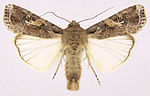 Spodoptera frugiperda (fall armyworm) Spodoptera frugiperda (fall armyworm)References: UniProt: P12956, Hydrolases; Acting on acid anhydrides; Acting on acid anhydrides to facilitate cellular and subcellular movement, Lyases; Carbon-oxygen lyases; Other carbon-oxygen lyases | ||
|---|---|---|---|
| #2: Protein | Mass: 61431.590 Da / Num. of mol.: 2 Source method: isolated from a genetically manipulated source Source: (gene. exp.) Homo sapiens (human) / Gene: XRCC5, G22P2 / Production host: Spodoptera frugiperda (fall armyworm)References: UniProt: P13010, Hydrolases; Acting on acid anhydrides; Acting on acid anhydrides to facilitate cellular and subcellular movement #7: Protein | | Mass: 57619.352 Da / Num. of mol.: 1 Source method: isolated from a genetically manipulated source Source: (gene. exp.) Homo sapiens (human) / Gene: XRCC6, G22P1 / Production host: Spodoptera frugiperda (fall armyworm)References: UniProt: P12956, Hydrolases; Acting on acid anhydrides; Acting on acid anhydrides to facilitate cellular and subcellular movement, Lyases; Carbon-oxygen lyases; Other carbon-oxygen lyases |
-Protein , 4 types, 8 molecules CGDHEAFB
| #3: Protein | Mass: 12096.154 Da / Num. of mol.: 2 Source method: isolated from a genetically manipulated source Source: (gene. exp.) Homo sapiens (human) / Gene: H2AC4, H2AFM, HIST1H2AB, H2AC8, H2AFA, HIST1H2AE / Production host:   Escherichia coli (E. coli) / References: UniProt: P04908 Escherichia coli (E. coli) / References: UniProt: P04908#4: Protein | Mass: 10907.574 Da / Num. of mol.: 2 Source method: isolated from a genetically manipulated source Source: (gene. exp.) Homo sapiens (human) / Gene: H2BC11, H2BFR, HIST1H2BJ / Production host: Escherichia coli (E. coli) / References: UniProt: P06899#5: Protein | Mass: 11433.398 Da / Num. of mol.: 2 Source method: isolated from a genetically manipulated source Source: (gene. exp.) Homo sapiens (human)Gene: H3C1, H3FA, HIST1H3A, H3C2, H3FL, HIST1H3B, H3C3, H3FC HIST1H3C, H3C4, H3FB, HIST1H3D, H3C6, H3FD, HIST1H3E, H3C7, H3FI, HIST1H3F, H3C8, H3FH, HIST1H3G, H3C10, H3FK, HIST1H3H, H3C11, H3FF, ...Gene: H3C1, H3FA, HIST1H3A, H3C2, H3FL, HIST1H3B, H3C3, H3FC HIST1H3C, H3C4, H3FB, HIST1H3D, H3C6, H3FD, HIST1H3E, H3C7, H3FI, HIST1H3F, H3C8, H3FH, HIST1H3G, H3C10, H3FK, HIST1H3H, H3C11, H3FF, HIST1H3I, H3C12, H3FJ, HIST1H3J Production host: Escherichia coli (E. coli) / References: UniProt: P68431#6: Protein | Mass: 9747.485 Da / Num. of mol.: 2 Source method: isolated from a genetically manipulated source Source: (gene. exp.) Homo sapiens (human)Gene: H4C1, H4/A, H4FA, HIST1H4A, H4C2, H4/I, H4FI, HIST1H4B, H4C3, H4/G, H4FG, HIST1H4C, H4C4, H4/B, H4FB, HIST1H4D, H4C5, H4/J, H4FJ, HIST1H4E, H4C6, H4/C, H4FC, HIST1H4F, H4C8, H4/H, H4FH, ...Gene: H4C1, H4/A, H4FA, HIST1H4A, H4C2, H4/I, H4FI, HIST1H4B, H4C3, H4/G, H4FG, HIST1H4C, H4C4, H4/B, H4FB, HIST1H4D, H4C5, H4/J, H4FJ, HIST1H4E, H4C6, H4/C, H4FC, HIST1H4F, H4C8, H4/H, H4FH, HIST1H4H, H4C9, H4/M, H4FM, HIST1H4I, H4C11, H4/E, H4FE, HIST1H4J, H4C12, H4/D, H4FD, HIST1H4K, H4C13, H4/K, H4FK, HIST1H4L, H4C14, H4/N, H4F2, H4FN, HIST2H4, HIST2H4A, H4C15, H4/O, H4FO, HIST2H4B, H4C16, H4-16, HIST4H4 Production host: Escherichia coli (E. coli) / References: UniProt: P62805 |
|---|
-DNA chain , 2 types, 2 molecules IJ
| #8: DNA chain | Mass: 46998.945 Da / Num. of mol.: 1 Source method: isolated from a genetically manipulated source Source: (gene. exp.) Homo sapiens (human) / Production host: Escherichia coli (E. coli) |
|---|---|
| #9: DNA chain | Mass: 47457.234 Da / Num. of mol.: 1 Source method: isolated from a genetically manipulated source Source: (gene. exp.) Homo sapiens (human) / Production host: Escherichia coli (E. coli) |
-Details
| Has protein modification | N |
|---|
-Experimental details
-Experiment
| Experiment | Method: ELECTRON MICROSCOPY |
|---|---|
| EM experiment | Aggregation state: PARTICLE / 3D reconstruction method: single particle reconstruction |
- Sample preparation
| Component | Name: 153 bp nucleosome bound to Ku70/80 / Type: COMPLEX / Entity ID: all / Source: RECOMBINANT | |||||||||||||||||||||||||||||||||||
|---|---|---|---|---|---|---|---|---|---|---|---|---|---|---|---|---|---|---|---|---|---|---|---|---|---|---|---|---|---|---|---|---|---|---|---|---|
| Molecular weight | Value: 0.4 MDa / Experimental value: YES | |||||||||||||||||||||||||||||||||||
| Source (natural) | Organism: Homo sapiens (human) | |||||||||||||||||||||||||||||||||||
| Source (recombinant) | Organism: Escherichia coli (E. coli) | |||||||||||||||||||||||||||||||||||
| Buffer solution | pH: 7.6 | |||||||||||||||||||||||||||||||||||
| Buffer component |
| |||||||||||||||||||||||||||||||||||
| Specimen | Embedding applied: NO / Shadowing applied: NO / Staining applied: NO / Vitrification applied: YES | |||||||||||||||||||||||||||||||||||
| Specimen support | Details: 30mA / Grid material: COPPER / Grid mesh size: 300 divisions/in. / Grid type: Quantifoil R1.2/1.3 | |||||||||||||||||||||||||||||||||||
| Vitrification | Instrument: FEI VITROBOT MARK IV / Cryogen name: ETHANE / Humidity: 100 % / Chamber temperature: 277 K |
- Electron microscopy imaging
| Experimental equipment |  Model: Titan Krios / Image courtesy: FEI Company |
|---|---|
| Microscopy | Model: TFS KRIOS |
| Electron gun | Electron source:  FIELD EMISSION GUN / Accelerating voltage: 300 kV / Illumination mode: FLOOD BEAM FIELD EMISSION GUN / Accelerating voltage: 300 kV / Illumination mode: FLOOD BEAM |
| Electron lens | Mode: BRIGHT FIELD / Nominal magnification: 105000 X / Nominal defocus max: 2200 nm / Nominal defocus min: 700 nm / Cs: 2.7 mm |
| Specimen holder | Cryogen: NITROGEN / Specimen holder model: FEI TITAN KRIOS AUTOGRID HOLDER |
| Image recording | Electron dose: 50.01 e/Å2 / Film or detector model: GATAN K3 (6k x 4k) / Num. of real images: 10006 |
- Processing
| EM software |
| ||||||||||||||||||||||||
|---|---|---|---|---|---|---|---|---|---|---|---|---|---|---|---|---|---|---|---|---|---|---|---|---|---|
| CTF correction | Type: PHASE FLIPPING AND AMPLITUDE CORRECTION | ||||||||||||||||||||||||
| 3D reconstruction | Resolution: 3.56 Å / Resolution method: FSC 0.143 CUT-OFF / Num. of particles: 24500 / Symmetry type: POINT | ||||||||||||||||||||||||
| Refinement | Highest resolution: 3.56 Å Stereochemistry target values: REAL-SPACE (WEIGHTED MAP SUM AT ATOM CENTERS) | ||||||||||||||||||||||||
| Refine LS restraints |
|
