[English] 日本語
Yorodumi
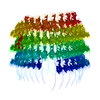
- PDB-9dlo: Crystal structure of the monomeric form of CanA -

+
Open data


ID or keywords:

Loading...

-
Basic information

Entry
Database: PDB / ID: 9dlo
TitleCrystal structure of the monomeric form of CanA
ComponentsCanA
KeywordsCELL ADHESION / Cannula-like protein
Biological speciesPyrodictium abyssi (archaea)
MethodX-RAY DIFFRACTION / SYNCHROTRON / MOLECULAR REPLACEMENT / Resolution: 1.95 Å
AuthorsRudolph, M.J. / Conticello, V.P.
Funding support United States, 1items
OrganizationGrant numberCountry
National Institutes of Health/National Institute of General Medical Sciences (NIH/NIGMS) United States
CitationJournal: Nat Commun / Year: 2025
Title: Donor strand complementation and calcium ion coordination drive the chaperone-free polymerization of archaeal cannulae.
Authors: Mike Sleutel / Ravi R Sonani / Jessalyn G Miller / Fengbin Wang / Andres Gonzalez Socorro / Yang Chen / Reece Martin / Borries Demeler / Michael J Rudolph / Vikram Alva / Han Remaut / Edward ...Authors: Mike Sleutel / Ravi R Sonani / Jessalyn G Miller / Fengbin Wang / Andres Gonzalez Socorro / Yang Chen / Reece Martin / Borries Demeler / Michael J Rudolph / Vikram Alva / Han Remaut / Edward H Egelman / Vincent P Conticello /
Abstract: Cannulae are structurally rigid tubular protein filaments that accumulate on the extracellular surface of archaea within the family Pyrodictiaceae during cell growth. These obligate anaerobes ...Cannulae are structurally rigid tubular protein filaments that accumulate on the extracellular surface of archaea within the family Pyrodictiaceae during cell growth. These obligate anaerobes propagate under hyperthermophilic conditions in which cannulae form a biomatrix that interconnects and sustains cells. The persistence of cannulae in this environment suggests that these filaments display significant thermostability, which has attracted technological interest in their development as synthetic protein-based biomaterials. Here, we report cryoEM structural analyses of ex vivo and in vitro assembled recombinant cannulae. We demonstrate that the interactions between protomers in native and recombinant cannulae is based on donor strand complementation (DSC), a form of non-covalent polymerization previously observed for bacterial chaperone-usher pili. Unexpectedly, calcium ion coordination at the subunit interfaces reinforces the network of donor strand interactions in the cannulae. This study provides insight into the mechanism of assembly of cannulae and the structural origin of their high stability and rigidity.
History
DepositionSep 11, 2024Deposition site: RCSB / Processing site: RCSB
Revision 1.0Aug 27, 2025Provider: repository / Type: Initial release
Revision 1.1Mar 11, 2026Group: Database references / Category: citation / citation_author
Item: _citation.country / _citation.journal_abbrev ..._citation.country / _citation.journal_abbrev / _citation.journal_id_CSD / _citation.journal_id_ISSN / _citation.journal_volume / _citation.page_first / _citation.page_last / _citation.pdbx_database_id_DOI / _citation.pdbx_database_id_PubMed / _citation.title / _citation.year

-
Structure visualization

Structure viewerMolecule:
MolmilJmol/JSmol

Downloads & links

-
Assembly

Deposited unit
a: CanA


Theoretical massNumber of molelcules
Total (without water)19,9891
Polymers19,9891
Non-polymers00
Water1,78399
1


  • Idetical with deposited unit
  • defined by author
  • Evidence: gel filtration
TypeNameSymmetry operationNumber
identity operation1_555x,y,z1
Unit cell
Length a, b, c (Å)30.963, 58.443, 173.563
Angle α, β, γ (deg.)90.00, 90.00, 90.00
Int Tables number20
Space group name H-MC2221

-
Components

#1: Protein CanA


Mass: 19989.492 Da / Num. of mol.: 1
Source method: isolated from a genetically manipulated source
Source: (gene. exp.) Pyrodictium abyssi (archaea) / Production host: Escherichia coli (E. coli)
#2: Water ChemComp-HOH / water


Mass: 18.015 Da / Num. of mol.: 99 / Source method: isolated from a natural source / Formula: H2O
Has protein modificationN

-
Experimental details

-
Experiment

ExperimentMethod: X-RAY DIFFRACTION / Number of used crystals: 1

-
Sample preparation

CrystalDensity Matthews: 1.96 Å3/Da / Density % sol: 37.37 %
Crystal growTemperature: 293 K / Method: vapor diffusion, sitting drop
Details: 100 mM MgCl2, 30% PEG 4K, 3% Xylitol, and 100 mM Tris pH 8.5

-
Data collection

DiffractionMean temperature: 100 K / Serial crystal experiment: N
Diffraction sourceSource: SYNCHROTRON / Site: NSLS-II / Beamline: 19-ID / Wavelength: 0.979 Å
DetectorType: DECTRIS EIGER X 9M / Detector: PIXEL / Date: Dec 12, 2023
RadiationProtocol: SINGLE WAVELENGTH / Monochromatic (M) / Laue (L): M / Scattering type: x-ray
Radiation wavelengthWavelength: 0.979 Å / Relative weight: 1
ReflectionResolution: 1.95→50 Å / Num. obs: 11043 / % possible obs: 94.9 % / Redundancy: 7.1 % / CC1/2: 0.998 / CC star: 1 / Rmerge(I) obs: 0.17 / Rpim(I) all: 0.063 / Rrim(I) all: 0.182 / Χ2: 0.99 / Net I/σ(I): 4.5
Reflection shell

Diffraction-ID: 1

Resolution (Å)Redundancy (%)Rmerge(I) obsNum. unique obsCC1/2CC starRpim(I) allRrim(I) allΧ2% possible all
1.95-1.984.80.8295180.7280.9180.3770.9160.2991.5
1.98-2.024.80.7495310.8220.950.3370.8260.31294.3
2.02-2.064.70.6475290.860.9620.2990.7170.34495.8
2.06-2.15.20.625230.7840.9380.2810.6840.35595.1
2.1-2.155.90.7095540.8130.9470.30.7730.38994.2
2.15-2.26.50.7835260.7240.9160.3190.8490.37697
2.2-2.256.80.7045360.9120.9770.270.7560.41196.4
2.25-2.318.10.725430.9230.980.2510.7650.41694.3
2.31-2.388.90.6825380.9420.9850.2240.720.4598.4
2.38-2.468.80.6265480.960.990.2060.6610.47696.3
2.46-2.5490.5495340.9480.9870.1830.580.50392.7
2.54-2.658.70.4165380.9550.9880.1420.4410.56797.1
2.65-2.778.50.3125370.9620.990.1090.3320.69892.4
2.77-2.918.10.2495390.9870.9970.0880.2660.88195.1
2.91-3.17.60.2075260.9810.9950.0760.2211.20692.1
3.1-3.336.90.1635510.9850.9960.0620.1761.90893.4
3.33-3.676.50.1225460.9890.9970.0490.1322.09694.3
3.67-4.25.90.0865490.9940.9990.0380.0942.13793.7
4.2-5.2970.0735550.9950.9990.0290.0792.393.3
5.29-509.60.0696500.9980.9990.0230.0732.46199.5

-
Processing

Software
NameVersionClassification
PHENIX1.20.1_4487refinement
HKL-2000data reduction
HKL-2000data scaling
PHASERphasing
RefinementMethod to determine structure: MOLECULAR REPLACEMENT / Resolution: 1.95→29.22 Å / SU ML: 0.18 / Cross valid method: FREE R-VALUE / σ(F): 1.36 / Phase error: 28.39 / Stereochemistry target values: ML
RfactorNum. reflection% reflection
Rfree0.2369 499 4.52 %
Rwork0.2127 --
obs0.214 11043 92.45 %
Solvent computationShrinkage radii: 0.9 Å / VDW probe radii: 1.1 Å / Solvent model: FLAT BULK SOLVENT MODEL
Refinement stepCycle: LAST / Resolution: 1.95→29.22 Å
ProteinNucleic acidLigandSolventTotal
Num. atoms1241 0 0 99 1340
Refine LS restraints
Refine-IDTypeDev idealNumber
X-RAY DIFFRACTIONf_bond_d0.0091284
X-RAY DIFFRACTIONf_angle_d1.1731755
X-RAY DIFFRACTIONf_dihedral_angle_d7.257168
X-RAY DIFFRACTIONf_chiral_restr0.069207
X-RAY DIFFRACTIONf_plane_restr0.009223
LS refinement shell
Resolution (Å)Rfactor RfreeNum. reflection RfreeRfactor RworkNum. reflection RworkRefine-ID% reflection obs (%)
1.95-2.150.2865870.24192416X-RAY DIFFRACTION87
2.15-2.460.31041240.25122689X-RAY DIFFRACTION95
2.46-3.090.31211320.25052679X-RAY DIFFRACTION93
3.09-29.220.19591560.1832760X-RAY DIFFRACTION94
Refinement TLS params.

Method: refined / Refine-ID: X-RAY DIFFRACTION

IDL112)L122)L132)L222)L232)L332)S11 (Å °)S12 (Å °)S13 (Å °)S21 (Å °)S22 (Å °)S23 (Å °)S31 (Å °)S32 (Å °)S33 (Å °)T112)T122)T132)T222)T232)T332)Origin x (Å)Origin y (Å)Origin z (Å)
14.6271-1.7526-0.20970.7858-0.84556.44420.20720.19030.0448-0.2703-0.00750.5998-0.0893-0.2895-0.32490.2173-0.0257-0.08080.2384-0.04490.204-10.5894-5.5379-22.3726
24.851-2.42042.4953.9767-2.35448.2650.22880.0979-0.60750.4113-0.04670.44490.36870.6402-0.13570.30.01970.00890.1475-0.00470.2918-5.6595-16.1071-23.4036
32.50890.6133-0.08061.751-1.3696.87490.21780.68970.22910.0443-0.21820.196-0.0740.2994-0.14620.21270.08250.03440.17740.0040.1927-5.407-0.7854-35.0303
41.6892-0.0628-0.07241.4622-0.11927.68550.1093-0.0652-0.1160.075-0.0826-0.02980.04390.3984-0.03270.16080.0383-0.01770.15720.00390.182-2.2429-6.8621-12.4245
50.65910.1764-0.37254.4744-4.04173.6906-0.14490.03170.0443-0.11480.2213-0.09530.1402-0.5441-0.08780.33080.0357-0.00380.2647-0.02180.17-4.21640.1632-27.4094
61.5925-0.53151.63217.2054-3.26174.54290.00320.41710.1362-0.0812-0.13590.1927-0.0827-0.1080.07930.14220.02850.02270.3287-0.01090.2715-10.576-3.2331-34.2872
Refinement TLS group
IDRefine-IDRefine TLS-IDSelection details
1X-RAY DIFFRACTION1chain 'a' and (resid 20 through 51 )
2X-RAY DIFFRACTION2chain 'a' and (resid 52 through 66 )
3X-RAY DIFFRACTION3chain 'a' and (resid 67 through 85 )
4X-RAY DIFFRACTION4chain 'a' and (resid 86 through 150 )
5X-RAY DIFFRACTION5chain 'a' and (resid 151 through 162 )
6X-RAY DIFFRACTION6chain 'a' and (resid 163 through 182 )

+
About Yorodumi

-
News

-
Feb 9, 2022. New format data for meta-information of EMDB entries

New format data for meta-information of EMDB entries

  • Version 3 of the EMDB header file is now the official format.
  • The previous official version 1.9 will be removed from the archive.

Related info.:EMDB header

External links:wwPDB to switch to version 3 of the EMDB data model

-
Aug 12, 2020. Covid-19 info

Covid-19 info

URL: https://pdbj.org/emnavi/covid19.php

New page: Covid-19 featured information page in EM Navigator.

Related info.:Covid-19 info / Mar 5, 2020. Novel coronavirus structure data

+
Mar 5, 2020. Novel coronavirus structure data

Novel coronavirus structure data

Related info.:Yorodumi Speices / Aug 12, 2020. Covid-19 info

External links:COVID-19 featured content - PDBj / Molecule of the Month (242):Coronavirus Proteases

+
Jan 31, 2019. EMDB accession codes are about to change! (news from PDBe EMDB page)

EMDB accession codes are about to change! (news from PDBe EMDB page)

  • The allocation of 4 digits for EMDB accession codes will soon come to an end. Whilst these codes will remain in use, new EMDB accession codes will include an additional digit and will expand incrementally as the available range of codes is exhausted. The current 4-digit format prefixed with “EMD-” (i.e. EMD-XXXX) will advance to a 5-digit format (i.e. EMD-XXXXX), and so on. It is currently estimated that the 4-digit codes will be depleted around Spring 2019, at which point the 5-digit format will come into force.
  • The EM Navigator/Yorodumi systems omit the EMD- prefix.

Related info.:Q: What is EMD? / ID/Accession-code notation in Yorodumi/EM Navigator

External links:EMDB Accession Codes are Changing Soon! / Contact to PDBj

+
Jul 12, 2017. Major update of PDB

Major update of PDB

  • wwPDB released updated PDB data conforming to the new PDBx/mmCIF dictionary.
  • This is a major update changing the version number from 4 to 5, and with Remediation, in which all the entries are updated.
  • In this update, many items about electron microscopy experimental information are reorganized (e.g. em_software).
  • Now, EM Navigator and Yorodumi are based on the updated data.

External links:wwPDB Remediation / Enriched Model Files Conforming to OneDep Data Standards Now Available in the PDB FTP Archive

-
Yorodumi

Thousand views of thousand structures

  • Yorodumi is a browser for structure data from EMDB, PDB, SASBDB, etc.
  • This page is also the successor to EM Navigator detail page, and also detail information page/front-end page for Omokage search.
  • The word "yorodu" (or yorozu) is an old Japanese word meaning "ten thousand". "mi" (miru) is to see.

Related info.:EMDB / PDB / SASBDB / Comparison of 3 databanks / Yorodumi Search / Aug 31, 2016. New EM Navigator & Yorodumi / Yorodumi Papers / Jmol/JSmol / Function and homology information / Changes in new EM Navigator and Yorodumi

Read more