 Movie
Movie Controller


+ Open data

- Basic information
| Entry | Database: PDB / ID: 9bac | |||||||||||||||||||||||||||
|---|---|---|---|---|---|---|---|---|---|---|---|---|---|---|---|---|---|---|---|---|---|---|---|---|---|---|---|---|
| Title | Cryo-EM of Hyper2 tube, ~24 nm diameter | |||||||||||||||||||||||||||
 Components Components | DUF1102 domain-containing protein | |||||||||||||||||||||||||||
 Keywords Keywords | PROTEIN FIBRIL / Hyper2 / Protein tube / Helical tube / Strand donation | |||||||||||||||||||||||||||
| Function / homology | DUF1102 domain-containing protein Function and homology information Function and homology information | |||||||||||||||||||||||||||
| Biological species |   Hyperthermus sp. (archaea) Hyperthermus sp. (archaea) | |||||||||||||||||||||||||||
| Method | ELECTRON MICROSCOPY / helical reconstruction / cryo EM / Resolution: 3.4 Å | |||||||||||||||||||||||||||
 Authors Authors | Sonani, R.R. / Miller, J.G. / Conticello, V. / Egelman, E.H. | |||||||||||||||||||||||||||
| Funding support |  United States, 1items United States, 1items
| |||||||||||||||||||||||||||
 Citation Citation | Journal: Nat Commun / Year: 2025 Title: Donor strand complementation and calcium ion coordination drive the chaperone-free polymerization of archaeal cannulae. Authors: Mike Sleutel / Ravi R Sonani / Jessalyn G Miller / Fengbin Wang / Andres Gonzalez Socorro / Yang Chen / Reece Martin / Borries Demeler / Michael J Rudolph / Vikram Alva / Han Remaut / Edward ...Authors: Mike Sleutel / Ravi R Sonani / Jessalyn G Miller / Fengbin Wang / Andres Gonzalez Socorro / Yang Chen / Reece Martin / Borries Demeler / Michael J Rudolph / Vikram Alva / Han Remaut / Edward H Egelman / Vincent P Conticello /    Abstract: Cannulae are structurally rigid tubular protein filaments that accumulate on the extracellular surface of archaea within the family Pyrodictiaceae during cell growth. These obligate anaerobes ...Cannulae are structurally rigid tubular protein filaments that accumulate on the extracellular surface of archaea within the family Pyrodictiaceae during cell growth. These obligate anaerobes propagate under hyperthermophilic conditions in which cannulae form a biomatrix that interconnects and sustains cells. The persistence of cannulae in this environment suggests that these filaments display significant thermostability, which has attracted technological interest in their development as synthetic protein-based biomaterials. Here, we report cryoEM structural analyses of ex vivo and in vitro assembled recombinant cannulae. We demonstrate that the interactions between protomers in native and recombinant cannulae is based on donor strand complementation (DSC), a form of non-covalent polymerization previously observed for bacterial chaperone-usher pili. Unexpectedly, calcium ion coordination at the subunit interfaces reinforces the network of donor strand interactions in the cannulae. This study provides insight into the mechanism of assembly of cannulae and the structural origin of their high stability and rigidity. | |||||||||||||||||||||||||||
| History |
|
- Structure visualization
| Structure viewer | Molecule: MolmilJmol/JSmol |
|---|
- Downloads & links
-Download
| PDBx/mmCIF format | 9bac.cif.gz | 41.2 KB | Display | PDBx/mmCIF format |
|---|---|---|---|---|
| PDB format | pdb9bac.ent.gz | 27 KB | Display | PDB format |
| PDBx/mmJSON format | 9bac.json.gz | Tree view | PDBx/mmJSON format | |
| Others |  Other downloads Other downloads |
-Validation report
| Arichive directory | https://data.pdbj.org/pub/pdb/validation_reports/ba/9bacftp://data.pdbj.org/pub/pdb/validation_reports/ba/9bac | HTTPS FTP |
|---|
-Related structure data
| Related structure data |  44404MC 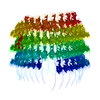 7uiiC  9babC  9dloC  9h8bC C: citing same article ( M: map data used to model this data |
|---|---|
| Similar structure data |


-Links
 PDBj
PDBj- Assembly
| Deposited unit | 
|
|---|---|
| 1 | x 66
|
| 2 |
|
| Symmetry | Helical symmetry: (Circular symmetry: 1 / Dyad axis: no / N subunits divisor: 1 / Num. of operations: 66 / Rise per n subunits: 1.424 Å / Rotation per n subunits: 46.23 °) |
-Components
| #1: Protein | Mass: 16234.279 Da / Num. of mol.: 1 Source method: isolated from a genetically manipulated source Source: (gene. exp.) Hyperthermus sp. (archaea) / Gene: DSY37_03180 / Production host:   Escherichia coli BL21 (bacteria) / References: UniProt: A0A432R7L7 Escherichia coli BL21 (bacteria) / References: UniProt: A0A432R7L7 | ||||
|---|---|---|---|---|---|
| #2: Chemical |  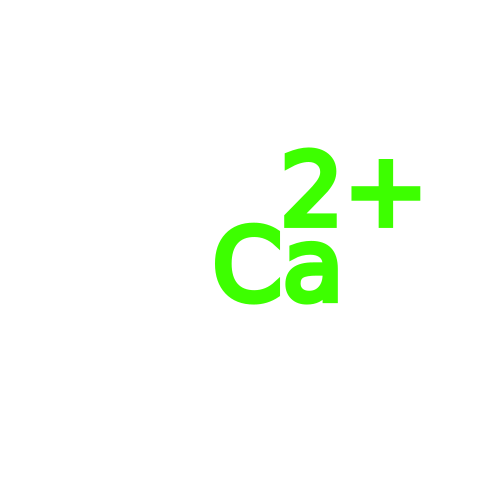 Mass: 40.078 Da / Num. of mol.: 3 / Source method: obtained synthetically / Formula: Ca / Feature type: SUBJECT OF INVESTIGATION Mass: 40.078 Da / Num. of mol.: 3 / Source method: obtained synthetically / Formula: Ca / Feature type: SUBJECT OF INVESTIGATIONHas ligand of interest | Y | Has protein modification | N | |
-Experimental details
-Experiment
| Experiment | Method: ELECTRON MICROSCOPY |
|---|---|
| EM experiment | Aggregation state: FILAMENT / 3D reconstruction method: helical reconstruction |
- Sample preparation
| Component | Name: Hyper2 tube / Type: COMPLEX / Entity ID: #1 / Source: RECOMBINANT |
|---|---|
| Source (natural) | Organism: Hyperthermus sp. (archaea) |
| Source (recombinant) | Organism: Escherichia coli BL21 (bacteria) |
| Buffer solution | pH: 8 |
| Specimen | Embedding applied: NO / Shadowing applied: NO / Staining applied: NO / Vitrification applied: YES |
| Vitrification | Cryogen name: ETHANE |
- Electron microscopy imaging
| Experimental equipment |  Model: Titan Krios / Image courtesy: FEI Company |
|---|---|
| Microscopy | Model: TFS KRIOS |
| Electron gun | Electron source:  FIELD EMISSION GUN / Accelerating voltage: 300 kV / Illumination mode: FLOOD BEAM FIELD EMISSION GUN / Accelerating voltage: 300 kV / Illumination mode: FLOOD BEAM |
| Electron lens | Mode: BRIGHT FIELD / Nominal defocus max: 2200 nm / Nominal defocus min: 1200 nm |
| Image recording | Electron dose: 50 e/Å2 / Film or detector model: GATAN K3 (6k x 4k) |
- Processing
| EM software | Name: PHENIX / Version: 1.15.2_3472: / Category: model refinement | ||||||||||||||||||||||||
|---|---|---|---|---|---|---|---|---|---|---|---|---|---|---|---|---|---|---|---|---|---|---|---|---|---|
| CTF correction | Type: PHASE FLIPPING AND AMPLITUDE CORRECTION | ||||||||||||||||||||||||
| Helical symmerty | Angular rotation/subunit: 46.23 ° / Axial rise/subunit: 1.424 Å / Axial symmetry: C1 | ||||||||||||||||||||||||
| 3D reconstruction | Resolution: 3.4 Å / Resolution method: FSC 0.143 CUT-OFF / Num. of particles: 95418 / Symmetry type: HELICAL | ||||||||||||||||||||||||
| Refine LS restraints |
|
