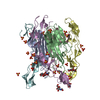
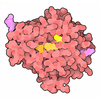
- PDB-8zui: Binary cluster of TNF-TNFR1 ectodomain complex -
+
データを開く
IDまたはキーワード:
読み込み中...
-
基本情報
登録情報
データベース: PDB / ID: 8zui
タイトル
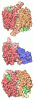
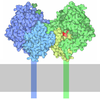
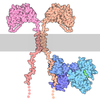
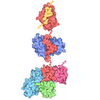
Binary cluster of TNF-TNFR1 ectodomain complex
要素
Tumor necrosis factor
Tumor necrosis factor receptor superfamily member 1A, membrane form
キーワード
IMMUNE SYSTEM / TNF receptor / Receptor / Receptor cluster
機能・相同性
機能・相同性情報
: / pulmonary valve development / tumor necrosis factor receptor superfamily complex / response to Gram-negative bacterium / negative regulation of L-glutamate import across plasma membrane / negative regulation of bile acid secretion / positive regulation of neutrophil activation / negative regulation of branching involved in lung morphogenesis / positive regulation of interleukin-33 production / positive regulation of fractalkine production ...: / pulmonary valve development / tumor necrosis factor receptor superfamily complex / response to Gram-negative bacterium / negative regulation of L-glutamate import across plasma membrane / negative regulation of bile acid secretion / positive regulation of neutrophil activation / negative regulation of branching involved in lung morphogenesis / positive regulation of interleukin-33 production / positive regulation of fractalkine production / positive regulation of blood microparticle formation / aortic valve development / positive regulation of chronic inflammatory response to antigenic stimulus / negative regulation of extracellular matrix constituent secretion / tumor necrosis factor receptor activity / response to 3,3',5-triiodo-L-thyronine / : / death receptor agonist activity / positive regulation of protein transport / positive regulation of vitamin D biosynthetic process / positive regulation of apoptotic process involved in morphogenesis / positive regulation of translational initiation by iron / regulation of endothelial cell apoptotic process / regulation of branching involved in salivary gland morphogenesis / chronic inflammatory response to antigenic stimulus / response to macrophage colony-stimulating factor / negative regulation of protein-containing complex disassembly / positive regulation of humoral immune response mediated by circulating immunoglobulin / positive regulation of leukocyte adhesion to arterial endothelial cell / response to gold nanoparticle / negative regulation of myelination / TNFs bind their physiological receptors / positive regulation of JUN kinase activity / negative regulation of vascular wound healing / tumor necrosis factor binding / negative regulation of amyloid-beta clearance / negative regulation of cytokine production involved in immune response / reactive gliosis / positive regulation of hair follicle development / positive regulation of interleukin-18 production / inflammatory response to wounding / negative regulation of cardiac muscle hypertrophy / response to resveratrol / positive regulation of action potential / epithelial cell proliferation involved in salivary gland morphogenesis / response to quercetin / TNF signaling / toll-like receptor 3 signaling pathway / vascular endothelial growth factor production / negative regulation of D-glucose import across plasma membrane / embryonic digestive tract development / positive regulation of fever generation / positive regulation of synoviocyte proliferation / positive regulation of calcineurin-NFAT signaling cascade / leukocyte tethering or rolling / necroptotic signaling pathway / positive regulation of mononuclear cell migration / negative regulation of myoblast differentiation / positive regulation of hepatocyte proliferation / response to fructose / regulation of establishment of endothelial barrier / response to hydrogen sulfide / endothelial cell apoptotic process / negative regulation of oxidative phosphorylation / positive regulation of protein-containing complex disassembly / regulation of tumor necrosis factor-mediated signaling pathway / positive regulation of protein localization to cell surface / positive regulation of osteoclast differentiation / cellular response to toxic substance / macrophage activation involved in immune response / tumor necrosis factor receptor binding / positive regulation of macrophage derived foam cell differentiation / negative regulation of mitotic cell cycle / negative regulation of systemic arterial blood pressure / positive regulation of chemokine (C-X-C motif) ligand 2 production / positive regulation of cytokine production involved in inflammatory response / positive regulation of podosome assembly / regulation of fat cell differentiation / positive regulation of heterotypic cell-cell adhesion / positive regulation of programmed cell death / positive regulation of membrane protein ectodomain proteolysis / regulation of canonical NF-kappaB signal transduction / response to L-glutamate / positive regulation of leukocyte adhesion to vascular endothelial cell / TNFR1-induced proapoptotic signaling / positive regulation of extrinsic apoptotic signaling pathway / TNFR1-mediated ceramide production / mRNA stabilization / regulation of reactive oxygen species metabolic process / prostaglandin metabolic process / negative regulation of heart rate / positive regulation of DNA biosynthetic process / positive regulation of amyloid-beta formation / positive regulation of neuroinflammatory response / negative regulation of viral genome replication / positive regulation of lipid metabolic process / positive regulation of immunoglobulin production / negative regulation of bicellular tight junction assembly / negative regulation of fat cell differentiation / response to isolation stress 類似検索 - 分子機能
Tumour necrosis factor receptor 1A / Tumor necrosis factor receptor 1A, N-terminal / Tumor necrosis factor receptor 1A, death domain / : / Tumour necrosis factor alpha / Tumour necrosis factor / Tumour necrosis factor, conserved site / Tumor necrosis factor (TNF) homology domain (THD) signature. / Tumour necrosis factor family. / TNFR/NGFR family cysteine-rich region domain profile. ...Tumour necrosis factor receptor 1A / Tumor necrosis factor receptor 1A, N-terminal / Tumor necrosis factor receptor 1A, death domain / : / Tumour necrosis factor alpha / Tumour necrosis factor / Tumour necrosis factor, conserved site / Tumor necrosis factor (TNF) homology domain (THD) signature. / Tumour necrosis factor family. / TNFR/NGFR family cysteine-rich region domain profile. / TNFR/NGFR cysteine-rich region / TNF(Tumour Necrosis Factor) family / TNFR/NGFR family cysteine-rich region signature. / Tumor necrosis factor receptor / nerve growth factor receptor repeats. / TNFR/NGFR cysteine-rich region / Tumour necrosis factor domain / Tumor necrosis factor (TNF) homology domain (THD) profile. / Tumour necrosis factor-like domain superfamily / Death domain profile. / DEATH domain, found in proteins involved in cell death (apoptosis). / Death domain / Death domain / Death-like domain superfamily 類似検索 - ドメイン・相同性
ジャーナル: Nat Commun / 年: 2025 タイトル: Highly ordered clustering of TNFα and BAFF ligand-receptor-intracellular adaptor complexes on a lipid membrane. 著者: Chan Seok Lim / Jisun Lee / Ji Won Kim / Jie-Oh Lee / 要旨: The TNF family plays a critical role in immune regulation. Here, we present high-resolution structures of clusters formed by two TNF receptor family proteins, TNFR1 and BAFFR. Using a lipid monolayer ...The TNF family plays a critical role in immune regulation. Here, we present high-resolution structures of clusters formed by two TNF receptor family proteins, TNFR1 and BAFFR. Using a lipid monolayer method to mimic their membrane-bound state, we observe that the TNFα-TNFR1 complex forms highly ordered clusters of trimers on the lipid membrane. A non-competitive TNFR1 antagonist that inhibits receptor activation disrupted these clusters without blocking ligand binding or receptor trimerization. Furthermore, we find that the BAFF-BAFFR, BAFF-TACI, and BAFF-BCMA receptor-ligand complexes predominantly form pentagonal clusters of trimers on the lipid membrane. Notably, the binding of the intracellular adaptor TRAF3 to the BAFF-BAFFR complex induces a structural transition from a pentagonal to a flat hexagonal cluster. Mutations in BAFF that impair BAFFR activation prevented cluster formation. Our findings demonstrate that ligand binding induces the formation of highly ordered clusters of TNFR1 and BAFFR receptors on the lipid membrane, which is essential for their activation.
履歴
登録
2024年6月9日
登録サイト: PDBJ / 処理サイト: PDBJ
改定 1.0
2025年6月11日
Provider: repository / タイプ: Initial release
改定 1.0
2025年6月11日
Data content type: EM metadata / Data content type: EM metadata / Provider: repository / タイプ: Initial release
改定 1.0
2025年6月11日
Data content type: FSC / Data content type: FSC / Provider: repository / タイプ: Initial release
改定 1.0
2025年6月11日
Data content type: Half map / Part number: 1 / Data content type: Half map / Provider: repository / タイプ: Initial release
改定 1.0
2025年6月11日
Data content type: Half map / Part number: 2 / Data content type: Half map / Provider: repository / タイプ: Initial release
改定 1.0
2025年6月11日
Data content type: Image / Data content type: Image / Provider: repository / タイプ: Initial release
改定 1.0
2025年6月11日
Data content type: Primary map / Data content type: Primary map / Provider: repository / タイプ: Initial release
 ムービー
ムービー コントローラー


 データを開く
 基本情報
基本情報 要素
要素 キーワード
キーワード 機能・相同性情報
 Homo sapiens (ヒト)
 データ登録者
 韓国, 1件
  引用
引用 構造の表示
構造の表示 ダウンロードとリンク
 その他のダウンロード


 PDBj
PDBj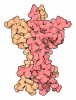
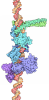

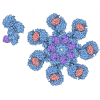
 集合体
集合体
 Trichoplusia ni (イラクサキンウワバ) / 参照: UniProt: P01375
 試料調製
試料調製 電子顕微鏡撮影
 FIELD EMISSION GUN / 加速電圧: 300 kV / 照射モード: FLOOD BEAM
 解析
解析