positive regulation of chronic inflammatory response to antigenic stimulus / positive regulation of humoral immune response mediated by circulating immunoglobulin / TNF signaling / death receptor agonist activity / positive regulation of translational initiation by iron / TNFR1-induced proapoptotic signaling / regulation of branching involved in salivary gland morphogenesis / negative regulation of protein-containing complex disassembly / TNFR1-mediated ceramide production / pulmonary valve development ...positive regulation of chronic inflammatory response to antigenic stimulus / positive regulation of humoral immune response mediated by circulating immunoglobulin / TNF signaling / death receptor agonist activity / positive regulation of translational initiation by iron / TNFR1-induced proapoptotic signaling / regulation of branching involved in salivary gland morphogenesis / negative regulation of protein-containing complex disassembly / TNFR1-mediated ceramide production / pulmonary valve development / cellular extravasation / establishment of blood-brain barrier / negative regulation of L-glutamate import across plasma membrane / negative regulation of bile acid secretion / positive regulation of interleukin-33 production / positive regulation of neutrophil activation / negative regulation of branching involved in lung morphogenesis / positive regulation of fractalkine production / positive regulation of blood microparticle formation / aortic valve development / tumor necrosis factor receptor activity / negative regulation of extracellular matrix constituent secretion / positive regulation of protein transport / positive regulation of vitamin D biosynthetic process / chronic inflammatory response to antigenic stimulus / positive regulation of apoptotic process involved in morphogenesis / regulation of endothelial cell apoptotic process / TNFR1-induced NF-kappa-B signaling pathway / epithelial cell proliferation involved in salivary gland morphogenesis / endothelial cell apoptotic process / positive regulation of JUN kinase activity / negative regulation of myelination / TNFR2 non-canonical NF-kB pathway / Regulation of TNFR1 signaling / positive regulation of leukocyte adhesion to arterial endothelial cell / regulation of immunoglobulin production / TNFs bind their physiological receptors / negative regulation of vascular wound healing / negative regulation of cytokine production involved in immune response / tumor necrosis factor binding / negative regulation of amyloid-beta clearance / tumor necrosis factor receptor superfamily complex / positive regulation of podosome assembly / positive regulation of hair follicle development / positive regulation of interleukin-18 production / inflammatory response to wounding / positive regulation of hepatocyte proliferation / negative regulation of bicellular tight junction assembly / activation of NF-kappaB-inducing kinase activity / negative regulation of myoblast differentiation / positive regulation of action potential / toll-like receptor 3 signaling pathway / TNF signaling / embryonic digestive tract development / vascular endothelial growth factor production / negative regulation of cardiac muscle hypertrophy / negative regulation of D-glucose import across plasma membrane / regulation of osteoclast differentiation / positive regulation of fever generation / positive regulation of calcineurin-NFAT signaling cascade / positive regulation of protein localization to cell surface / leukocyte tethering or rolling / negative regulation of mitotic cell cycle / necroptotic signaling pathway / positive regulation of synoviocyte proliferation / regulation of establishment of endothelial barrier / negative regulation of oxidative phosphorylation / macrophage activation involved in immune response / positive regulation of glial cell proliferation / positive regulation of protein-containing complex disassembly / positive regulation of osteoclast differentiation / positive regulation of macrophage derived foam cell differentiation / tumor necrosis factor receptor binding / positive regulation of chemokine (C-X-C motif) ligand 2 production / positive regulation of heterotypic cell-cell adhesion / positive regulation of membrane protein ectodomain proteolysis / negative regulation of systemic arterial blood pressure / response to L-glutamate / positive regulation of extrinsic apoptotic signaling pathway / positive regulation of leukocyte adhesion to vascular endothelial cell / regulation of canonical NF-kappaB signal transduction / TNFR1-induced proapoptotic signaling / regulation of reactive oxygen species metabolic process / negative regulation of fat cell differentiation / positive regulation of cytokine production involved in inflammatory response / leukocyte migration / prostaglandin metabolic process / positive regulation of programmed cell death / TNFR1-mediated ceramide production / negative regulation of viral genome replication / negative regulation of heart rate / non-canonical NF-kappaB signal transduction / positive regulation of amyloid-beta formation / positive regulation of DNA biosynthetic process / extrinsic apoptotic signaling pathway via death domain receptors / regulation of protein secretion / positive regulation of immunoglobulin production / negative regulation of endothelial cell proliferation / negative regulation of interleukin-6 production / humoral immune response Similarity search - Function
Tumour necrosis factor receptor 1A / Tumor necrosis factor receptor 1A, N-terminal / Tumor necrosis factor receptor 1A, death domain / : / Tumour necrosis factor alpha / Tumour necrosis factor / Tumour necrosis factor, conserved site / Tumor necrosis factor (TNF) homology domain (THD) signature. / Tumour necrosis factor family. / TNF(Tumour Necrosis Factor) family ...Tumour necrosis factor receptor 1A / Tumor necrosis factor receptor 1A, N-terminal / Tumor necrosis factor receptor 1A, death domain / : / Tumour necrosis factor alpha / Tumour necrosis factor / Tumour necrosis factor, conserved site / Tumor necrosis factor (TNF) homology domain (THD) signature. / Tumour necrosis factor family. / TNF(Tumour Necrosis Factor) family / TNFR/NGFR family cysteine-rich region domain profile. / TNFR/NGFR cysteine-rich region / TNFR/NGFR family cysteine-rich region signature. / Tumor necrosis factor receptor / nerve growth factor receptor repeats. / Tumour necrosis factor domain / Tumor necrosis factor (TNF) homology domain (THD) profile. / TNFR/NGFR cysteine-rich region / Tumour necrosis factor-like domain superfamily / Death domain profile. / DEATH domain, found in proteins involved in cell death (apoptosis). / Death domain / Death domain / Death-like domain superfamily Similarity search - Domain/homology
In the structure databanks used in Yorodumi, some data are registered as the other names, "COVID-19 virus" and "2019-nCoV". Here are the details of the virus and the list of structure data.
Jan 31, 2019. EMDB accession codes are about to change! (news from PDBe EMDB page)
EMDB accession codes are about to change! (news from PDBe EMDB page)
The allocation of 4 digits for EMDB accession codes will soon come to an end. Whilst these codes will remain in use, new EMDB accession codes will include an additional digit and will expand incrementally as the available range of codes is exhausted. The current 4-digit format prefixed with “EMD-” (i.e. EMD-XXXX) will advance to a 5-digit format (i.e. EMD-XXXXX), and so on. It is currently estimated that the 4-digit codes will be depleted around Spring 2019, at which point the 5-digit format will come into force.
The EM Navigator/Yorodumi systems omit the EMD- prefix.
Related info.:Q: What is EMD? / ID/Accession-code notation in Yorodumi/EM Navigator
Yorodumi is a browser for structure data from EMDB, PDB, SASBDB, etc.
This page is also the successor to EM Navigator detail page, and also detail information page/front-end page for Omokage search.
The word "yorodu" (or yorozu) is an old Japanese word meaning "ten thousand". "mi" (miru) is to see.
Related info.:EMDB / PDB / SASBDB / Comparison of 3 databanks / Yorodumi Search / Aug 31, 2016. New EM Navigator & Yorodumi / Yorodumi Papers / Jmol/JSmol / Function and homology information / Changes in new EM Navigator and Yorodumi
 Movie
Movie Controller


 Open data
 Basic information
 Components
 Keywords
 Function and homology information
 Mus musculus (house mouse)
 Homo sapiens (human)
 X-RAY DIFFRACTION /
  Authors
 Citation
 Structure visualization
 Downloads & links
 Other downloads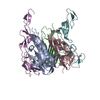


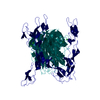
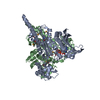
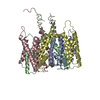
 PDBj
PDBj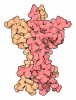
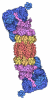


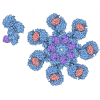
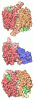
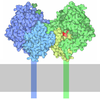
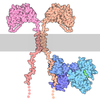
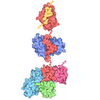
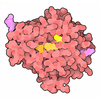
 Assembly

 Escherichia coli (E. coli) / Strain (production host): Top10 / References: UniProt: P06804
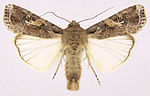 Spodoptera frugiperda (fall armyworm) / References: UniProt: P19438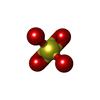
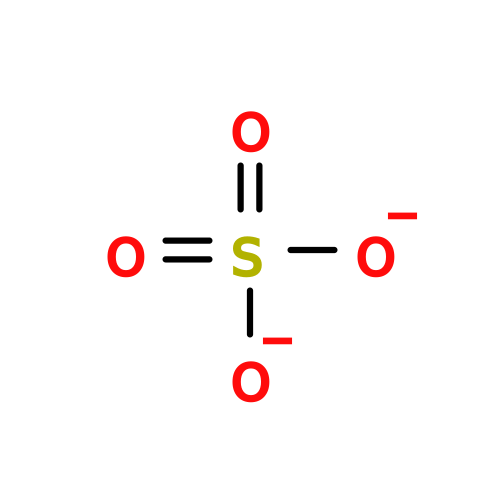 Mass: 96.063 Da / Num. of mol.: 30 / Source method: obtained synthetically / Formula: SO4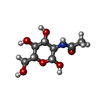
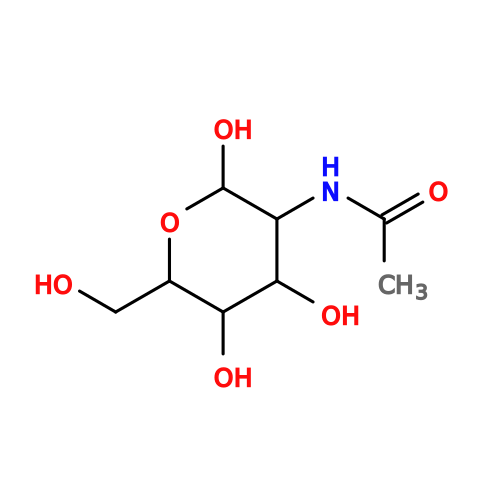 Type: D-saccharide, beta linking / Mass: 221.208 Da / Num. of mol.: 5 / Source method: isolated from a natural source / Formula: C8H15NO6
 Mass: 18.015 Da / Num. of mol.: 225 / Source method: isolated from a natural source / Formula: H2O
 Sample preparation
 / Beamline: 5.0.1 / Wavelength: 0.9774 Å
 Processing