 ムービー
ムービー コントローラー


+ データを開く

- 基本情報
基本情報
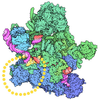
| 登録情報 | データベース: PDB / ID: 8tar | |||||||||||||||
|---|---|---|---|---|---|---|---|---|---|---|---|---|---|---|---|---|
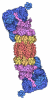
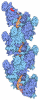
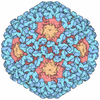
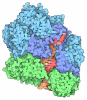
| タイトル | APC/C-CDH1-UBE2C-Ubiquitin-CyclinB-NTD | |||||||||||||||
 要素 要素 |
| |||||||||||||||
 キーワード キーワード | TRANSFERASE / E3 RING Ligase / Ubiquitin Ligase / LIGASE | |||||||||||||||
| 機能・相同性 |  機能・相同性情報 機能・相同性情報response to DDT / cyclin B1-CDK1 complex / positive regulation of mitochondrial ATP synthesis coupled electron transport / regulation of chromosome condensation / Mitotic Prophase / positive regulation of ubiquitin protein ligase activity / E2F-enabled inhibition of pre-replication complex formation / ventricular cardiac muscle cell development / Depolymerization of the Nuclear Lamina / positive regulation of anaphase-promoting complex-dependent catabolic process ...response to DDT / cyclin B1-CDK1 complex / positive regulation of mitochondrial ATP synthesis coupled electron transport / regulation of chromosome condensation / Mitotic Prophase / positive regulation of ubiquitin protein ligase activity / E2F-enabled inhibition of pre-replication complex formation / ventricular cardiac muscle cell development / Depolymerization of the Nuclear Lamina / positive regulation of anaphase-promoting complex-dependent catabolic process / positive regulation of synapse maturation / free ubiquitin chain polymerization / positive regulation of exit from mitosis / regulation of meiotic nuclear division / Conversion from APC/C:Cdc20 to APC/C:Cdh1 in late anaphase / regulation of mitotic cell cycle spindle assembly checkpoint / positive regulation of mRNA 3'-end processing / positive regulation of attachment of spindle microtubules to kinetochore / MASTL Facilitates Mitotic Progression / Inactivation of APC/C via direct inhibition of the APC/C complex / APC/C:Cdc20 mediated degradation of mitotic proteins / Activation of NIMA Kinases NEK9, NEK6, NEK7 / anaphase-promoting complex / patched binding / Phosphorylation of Emi1 / Aberrant regulation of mitotic exit in cancer due to RB1 defects / anaphase-promoting complex-dependent catabolic process / regulation of meiotic cell cycle / protein branched polyubiquitination / lens fiber cell differentiation / metaphase/anaphase transition of mitotic cell cycle / Transcriptional regulation by RUNX2 / Nuclear Pore Complex (NPC) Disassembly / Phosphorylation of the APC/C / anaphase-promoting complex binding / tissue regeneration / G2/M DNA replication checkpoint / regulation of exit from mitosis / outer kinetochore / (E3-independent) E2 ubiquitin-conjugating enzyme / positive regulation of synaptic plasticity / positive regulation of dendrite morphogenesis / Polo-like kinase mediated events / exit from mitosis / Initiation of Nuclear Envelope (NE) Reformation / cellular response to fatty acid / positive regulation of mitotic metaphase/anaphase transition / cyclin-dependent protein serine/threonine kinase activator activity / Golgi Cisternae Pericentriolar Stack Reorganization / protein K11-linked ubiquitination / oocyte maturation / digestive tract development / ubiquitin ligase activator activity / Condensation of Prometaphase Chromosomes / regulation of mitotic metaphase/anaphase transition / cyclin-dependent protein serine/threonine kinase regulator activity / ubiquitin-ubiquitin ligase activity / E2 ubiquitin-conjugating enzyme / mitotic metaphase chromosome alignment / mitotic G2 DNA damage checkpoint signaling / Regulation of APC/C activators between G1/S and early anaphase / ubiquitin conjugating enzyme activity / Transcriptional Regulation by VENTX / negative regulation of cellular senescence / microtubule organizing center / ubiquitin-like protein ligase binding / cullin family protein binding / positive regulation of G2/M transition of mitotic cell cycle / enzyme-substrate adaptor activity / ubiquitin ligase complex / response to mechanical stimulus / Regulation of MITF-M-dependent genes involved in cell cycle and proliferation / positive regulation of axon extension / Cyclin A:Cdk2-associated events at S phase entry / positive regulation of cardiac muscle cell proliferation / intercellular bridge / Cyclin A/B1/B2 associated events during G2/M transition / ubiquitin-like ligase-substrate adaptor activity / Chk1/Chk2(Cds1) mediated inactivation of Cyclin B:Cdk1 complex / Nuclear events stimulated by ALK signaling in cancer / heterochromatin / protein K48-linked ubiquitination / positive regulation of mitotic cell cycle / nuclear periphery / APC/C:Cdc20 mediated degradation of Cyclin B / regulation of mitotic cell cycle / APC-Cdc20 mediated degradation of Nek2A / TP53 Regulates Transcription of Genes Involved in G2 Cell Cycle Arrest / Synthesis of active ubiquitin: roles of E1 and E2 enzymes / Resolution of Sister Chromatid Cohesion / Condensation of Prophase Chromosomes / mitotic spindle organization / Autodegradation of Cdh1 by Cdh1:APC/C / APC/C:Cdc20 mediated degradation of Securin / SCF-beta-TrCP mediated degradation of Emi1 / cellular response to iron(III) ion / Assembly of the pre-replicative complex / Cdc20:Phospho-APC/C mediated degradation of Cyclin A / G1/S transition of mitotic cell cycle / APC/C:Cdh1 mediated degradation of Cdc20 and other APC/C:Cdh1 targeted proteins in late mitosis/early G1 類似検索 - 分子機能 | |||||||||||||||
| 生物種 |  Homo sapiens (ヒト) Homo sapiens (ヒト) | |||||||||||||||
| 手法 | 電子顕微鏡法 / 単粒子再構成法 / クライオ電子顕微鏡法 / 解像度: 4 Å | |||||||||||||||
 データ登録者 データ登録者 | Bodrug, T. / Welsh, K.A. / Bolhuis, D.L. / Paulakonis, E. / Martinez-Chacin, R.C. / Liu, B. / Pinkin, N. / Bonacci, T. / Cui, L. / Xu, P. ...Bodrug, T. / Welsh, K.A. / Bolhuis, D.L. / Paulakonis, E. / Martinez-Chacin, R.C. / Liu, B. / Pinkin, N. / Bonacci, T. / Cui, L. / Xu, P. / Roscow, O. / Amann, S.J. / Grishkovskaya, I. / Emanuele, M.J. / Harrison, J.S. / Steimel, J.P. / Hahn, K.M. / Zhang, W. / Zhong, E. / Haselbach, D. / Brown, N.G. | |||||||||||||||
| 資金援助 |  米国, 米国,  オーストリア, 4件 オーストリア, 4件
| |||||||||||||||
 引用 引用 | ジャーナル: Nat Struct Mol Biol / 年: 2023 タイトル: Time-resolved cryo-EM (TR-EM) analysis of substrate polyubiquitination by the RING E3 anaphase-promoting complex/cyclosome (APC/C). 著者: Tatyana Bodrug / Kaeli A Welsh / Derek L Bolhuis / Ethan Paulаkonis / Raquel C Martinez-Chacin / Bei Liu / Nicholas Pinkin / Thomas Bonacci / Liying Cui / Pengning Xu / Olivia Roscow / ...著者: Tatyana Bodrug / Kaeli A Welsh / Derek L Bolhuis / Ethan Paulаkonis / Raquel C Martinez-Chacin / Bei Liu / Nicholas Pinkin / Thomas Bonacci / Liying Cui / Pengning Xu / Olivia Roscow / Sascha Josef Amann / Irina Grishkovskaya / Michael J Emanuele / Joseph S Harrison / Joshua P Steimel / Klaus M Hahn / Wei Zhang / Ellen D Zhong / David Haselbach / Nicholas G Brown /   要旨: Substrate polyubiquitination drives a myriad of cellular processes, including the cell cycle, apoptosis and immune responses. Polyubiquitination is highly dynamic, and obtaining mechanistic insight ...Substrate polyubiquitination drives a myriad of cellular processes, including the cell cycle, apoptosis and immune responses. Polyubiquitination is highly dynamic, and obtaining mechanistic insight has thus far required artificially trapped structures to stabilize specific steps along the enzymatic process. So far, how any ubiquitin ligase builds a proteasomal degradation signal, which is canonically regarded as four or more ubiquitins, remains unclear. Here we present time-resolved cryogenic electron microscopy studies of the 1.2 MDa E3 ubiquitin ligase, known as the anaphase-promoting complex/cyclosome (APC/C), and its E2 co-enzymes (UBE2C/UBCH10 and UBE2S) during substrate polyubiquitination. Using cryoDRGN (Deep Reconstructing Generative Networks), a neural network-based approach, we reconstruct the conformational changes undergone by the human APC/C during polyubiquitination, directly visualize an active E3-E2 pair modifying its substrate, and identify unexpected interactions between multiple ubiquitins with parts of the APC/C machinery, including its coactivator CDH1. Together, we demonstrate how modification of substrates with nascent ubiquitin chains helps to potentiate processive substrate polyubiquitination, allowing us to model how a ubiquitin ligase builds a proteasomal degradation signal. | |||||||||||||||
| 履歴 |
|
- 構造の表示
構造の表示
| 構造ビューア | 分子: MolmilJmol/JSmol |
|---|
- ダウンロードとリンク
-ダウンロード
| PDBx/mmCIF形式 | 8tar.cif.gz | 1.5 MB | 表示 | PDBx/mmCIF形式 |
|---|---|---|---|---|
| PDB形式 | pdb8tar.ent.gz | 1 MB | 表示 | PDB形式 |
| PDBx/mmJSON形式 | 8tar.json.gz | ツリー表示 | PDBx/mmJSON形式 | |
| その他 |  その他のダウンロード その他のダウンロード |
-検証レポート
| アーカイブディレクトリ | https://data.pdbj.org/pub/pdb/validation_reports/ta/8tarftp://data.pdbj.org/pub/pdb/validation_reports/ta/8tar | HTTPS FTP |
|---|
-関連構造データ
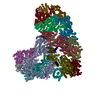
-リンク
 PDBj
PDBj

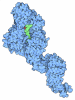
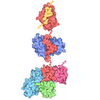
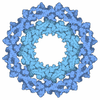
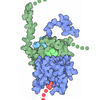
- 集合体
集合体
| 登録構造単位 | 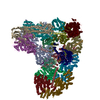
|
|---|---|
| 1 |
|
-要素
-Anaphase-promoting complex subunit ... , 11種, 13分子 ACDGWHILMNOYZ
| #1: タンパク質 | 分子量: 217566.141 Da / 分子数: 1 変異: S202E, S286E, T291E, S313E, T316E, S317E, S334E, S341E, S343E, S355E, S362E, S372E, S377E, T537E, S547E, S555E, S569E, S688E, S699E, S916E, S1347E 由来タイプ: 組換発現 / 由来: (組換発現) Homo sapiens (ヒト) / 遺伝子: ANAPC1発現宿主:   Spodoptera frugiperda (ツマジロクサヨトウ) Spodoptera frugiperda (ツマジロクサヨトウ)参照: UniProt: Q9H1A4 | ||||||||||||||
|---|---|---|---|---|---|---|---|---|---|---|---|---|---|---|---|
| #3: タンパク質 | 分子量: 9854.647 Da / 分子数: 1 / 由来タイプ: 組換発現 / 由来: (組換発現) Homo sapiens (ヒト) / 遺伝子: ANAPC11, HSPC214発現宿主: Spodoptera frugiperda (ツマジロクサヨトウ)参照: UniProt: Q9NYG5 | ||||||||||||||
| #4: タンパク質 | 分子量: 6556.302 Da / 分子数: 1 / 由来タイプ: 組換発現 / 由来: (組換発現) Homo sapiens (ヒト) / 遺伝子: ANAPC15発現宿主: Spodoptera frugiperda (ツマジロクサヨトウ)参照: UniProt: P60006 | ||||||||||||||
| #5: タンパク質 | 分子量: 9920.108 Da / 分子数: 2 / 変異: S51E, S52E, S82E / 由来タイプ: 組換発現 / 由来: (組換発現) Homo sapiens (ヒト) / 遺伝子: CDC26, ANAPC12, C9orf17発現宿主: Spodoptera frugiperda (ツマジロクサヨトウ)参照: UniProt: Q8NHZ8 #6: タンパク質 | | 分子量: 6764.688 Da / 分子数: 1 / 由来タイプ: 組換発現 / 由来: (組換発現) Homo sapiens (ヒト) / 遺伝子: ANAPC16, C10orf104, CENP-27発現宿主: Spodoptera frugiperda (ツマジロクサヨトウ)参照: UniProt: Q96DE5 #7: タンパク質 | | 分子量: 92303.305 Da / 分子数: 1 / 由来タイプ: 組換発現 / 由来: (組換発現) Homo sapiens (ヒト) / 遺伝子: ANAPC4, APC4発現宿主: Spodoptera frugiperda (ツマジロクサヨトウ)参照: UniProt: Q9UJX5 #10: タンパク質 | | 分子量: 21310.152 Da / 分子数: 1 / 由来タイプ: 組換発現 / 由来: (組換発現) Homo sapiens (ヒト) / 遺伝子: ANAPC10, APC10発現宿主: Spodoptera frugiperda (ツマジロクサヨトウ)参照: UniProt: Q9UM13 #11: タンパク質 | | 分子量: 8528.309 Da / 分子数: 1 / 由来タイプ: 組換発現 / 由来: (組換発現) Homo sapiens (ヒト) / 遺伝子: ANAPC13発現宿主: Spodoptera frugiperda (ツマジロクサヨトウ)参照: UniProt: Q9BS18 #12: タンパク質 | | 分子量: 94149.156 Da / 分子数: 1 / 由来タイプ: 組換発現 / 由来: (組換発現) Homo sapiens (ヒト) / 遺伝子: ANAPC2, APC2, KIAA1406発現宿主: Spodoptera frugiperda (ツマジロクサヨトウ)参照: UniProt: Q9UJX6 #13: タンパク質 | | 分子量: 85445.961 Da / 分子数: 1 / 由来タイプ: 組換発現 / 由来: (組換発現) Homo sapiens (ヒト) / 遺伝子: ANAPC5, APC5発現宿主: Spodoptera frugiperda (ツマジロクサヨトウ)参照: UniProt: Q9UJX4 #17: タンパク質 | 分子量: 63204.020 Da / 分子数: 2 / 由来タイプ: 組換発現 / 由来: (組換発現) Homo sapiens (ヒト) / 遺伝子: ANAPC7, APC7発現宿主: Spodoptera frugiperda (ツマジロクサヨトウ)参照: UniProt: Q9UJX3 |
-Cell division cycle protein ... , 3種, 6分子 JPKSUV
| #8: タンパク質 | 分子量: 92519.547 Da / 分子数: 2 / 由来タイプ: 組換発現 / 由来: (組換発現) Homo sapiens (ヒト) / 遺伝子: CDC27, ANAPC3, D0S1430E, D17S978E発現宿主: Spodoptera frugiperda (ツマジロクサヨトウ)参照: UniProt: P30260 #9: タンパク質 | 分子量: 71929.656 Da / 分子数: 2 / 由来タイプ: 組換発現 / 由来: (組換発現) Homo sapiens (ヒト) / 遺伝子: CDC16, ANAPC6発現宿主: Spodoptera frugiperda (ツマジロクサヨトウ)参照: UniProt: Q13042 #16: タンパク質 | 分子量: 69075.133 Da / 分子数: 2 / 由来タイプ: 組換発現 / 由来: (組換発現) Homo sapiens (ヒト) / 遺伝子: CDC23, ANAPC8発現宿主: Spodoptera frugiperda (ツマジロクサヨトウ)参照: UniProt: Q9UJX2 |
|---|
-タンパク質 , 2種, 2分子 QR
| #14: タンパク質 | 分子量: 16346.630 Da / 分子数: 1 / 由来タイプ: 組換発現 / 由来: (組換発現) Homo sapiens (ヒト) / 遺伝子: UBE2C / 発現宿主:   Escherichia coli (大腸菌) / 参照: UniProt: O00762 Escherichia coli (大腸菌) / 参照: UniProt: O00762 |
|---|---|
| #15: タンパク質 | 分子量: 55253.207 Da / 分子数: 1 / 由来タイプ: 組換発現 / 由来: (組換発現) Homo sapiens (ヒト) / 遺伝子: FZR1発現宿主: Spodoptera frugiperda (ツマジロクサヨトウ)参照: UniProt: Q9UM11 |
-タンパク質・ペプチド / 非ポリマー , 2種, 5分子 B
| #18: 化合物 | ChemComp-ZN /  分子量: 65.409 Da / 分子数: 4 / 由来タイプ: 合成 / 式: Zn 分子量: 65.409 Da / 分子数: 4 / 由来タイプ: 合成 / 式: Zn#2: タンパク質・ペプチド | | 分子量: 1284.467 Da / 分子数: 1 / Fragment: NTD (residues 39-50) / 由来タイプ: 組換発現 / 由来: (組換発現) Homo sapiens (ヒト) / 遺伝子: CCNB1, CCNB発現宿主: Spodoptera frugiperda (ツマジロクサヨトウ)参照: UniProt: P14635 |
|---|
-詳細
| 研究の焦点であるリガンドがあるか | N |
|---|
-実験情報
-実験
| 実験 | 手法: 電子顕微鏡法 |
|---|---|
| EM実験 | 試料の集合状態: PARTICLE / 3次元再構成法: 単粒子再構成法 |
- 試料調製
試料調製
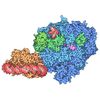
| 構成要素 | 名称: Anaphase-promoting complex/cyclosome in complex with CHD1, UBE2C, and Cyclin-B タイプ: COMPLEX / Entity ID: #1-#17 / 由来: RECOMBINANT |
|---|---|
| 由来(天然) | 生物種: Homo sapiens (ヒト) |
| 由来(組換発現) | 生物種: Spodoptera frugiperda (ツマジロクサヨトウ) |
| 緩衝液 | pH: 8 |
| 試料 | 包埋: NO / シャドウイング: NO / 染色: NO / 凍結: YES |
| 急速凍結 | 凍結剤: ETHANE |
- 電子顕微鏡撮影
| 実験機器 |  モデル: Titan Krios / 画像提供: FEI Company |
|---|---|
| 顕微鏡 | モデル: FEI TITAN KRIOS |
| 電子銃 | 電子線源:  FIELD EMISSION GUN / 加速電圧: 300 kV / 照射モード: SPOT SCAN FIELD EMISSION GUN / 加速電圧: 300 kV / 照射モード: SPOT SCAN |
| 電子レンズ | モード: BRIGHT FIELD / 最大 デフォーカス(公称値): 1500 nm / 最小 デフォーカス(公称値): 200 nm |
| 撮影 | 電子線照射量: 42 e/Å2 フィルム・検出器のモデル: GATAN K2 BASE (4k x 4k) |
- 解析
解析
| CTF補正 | タイプ: PHASE FLIPPING AND AMPLITUDE CORRECTION |
|---|---|
| 3次元再構成 | 解像度: 4 Å / 解像度の算出法: FSC 0.143 CUT-OFF / 粒子像の数: 661289 / 対称性のタイプ: POINT |
