 Movie
Movie Controller


+ Open data

- Basic information
| Entry | Database: PDB / ID: 8jvj | |||||||||||||||||||||||||||||||||||||||||||||
|---|---|---|---|---|---|---|---|---|---|---|---|---|---|---|---|---|---|---|---|---|---|---|---|---|---|---|---|---|---|---|---|---|---|---|---|---|---|---|---|---|---|---|---|---|---|---|
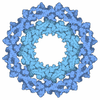
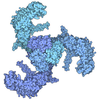
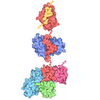
| Title | Structure of human TRPV4 with antagonist A2 and RhoA | |||||||||||||||||||||||||||||||||||||||||||||
 Components Components |
| |||||||||||||||||||||||||||||||||||||||||||||
 Keywords Keywords | MEMBRANE PROTEIN / Channel | |||||||||||||||||||||||||||||||||||||||||||||
| Function / homology |  Function and homology information Function and homology informationstretch-activated, monoatomic cation-selective, calcium channel activity / blood vessel endothelial cell delamination / osmosensor activity / calcium ion import into cytosol / cartilage development involved in endochondral bone morphogenesis / positive regulation of microtubule depolymerization / positive regulation of macrophage inflammatory protein 1 alpha production / positive regulation of striated muscle contraction / positive regulation of chemokine (C-C motif) ligand 5 production / positive regulation of chemokine (C-X-C motif) ligand 1 production ...stretch-activated, monoatomic cation-selective, calcium channel activity / blood vessel endothelial cell delamination / osmosensor activity / calcium ion import into cytosol / cartilage development involved in endochondral bone morphogenesis / positive regulation of microtubule depolymerization / positive regulation of macrophage inflammatory protein 1 alpha production / positive regulation of striated muscle contraction / positive regulation of chemokine (C-C motif) ligand 5 production / positive regulation of chemokine (C-X-C motif) ligand 1 production / alpha-beta T cell lineage commitment / aortic valve formation / beta selection / positive regulation of lipase activity / endothelial tube lumen extension / skeletal muscle satellite cell migration / bone trabecula morphogenesis / SLIT2:ROBO1 increases RHOA activity / RHO GTPases Activate Rhotekin and Rhophilins / Roundabout signaling pathway / cellular hypotonic salinity response / Axonal growth inhibition (RHOA activation) / Axonal growth stimulation / cleavage furrow formation / cellular hypotonic response / negative regulation of cell size / cortical microtubule organization / multicellular organismal-level water homeostasis / regulation of osteoblast proliferation / regulation of modification of postsynaptic actin cytoskeleton / diet induced thermogenesis / mitotic cleavage furrow formation / apical junction assembly / negative regulation of cell migration involved in sprouting angiogenesis / calcium ion import / establishment of epithelial cell apical/basal polarity / positive regulation of alpha-beta T cell differentiation / cell junction assembly / cellular response to chemokine / positive regulation of vascular permeability / negative regulation of oxidative phosphorylation / positive regulation of monocyte chemotactic protein-1 production / regulation of modification of postsynaptic structure / RHO GTPases Activate ROCKs / negative regulation of brown fat cell differentiation / RHO GTPases activate CIT / cell volume homeostasis / odontogenesis / PCP/CE pathway / cell-cell junction assembly / Sema4D induced cell migration and growth-cone collapse / RHO GTPases activate KTN1 / osmosensory signaling pathway / apolipoprotein A-I-mediated signaling pathway / cellular response to osmotic stress / wound healing, spreading of cells / Sema4D mediated inhibition of cell attachment and migration / positive regulation of leukocyte adhesion to vascular endothelial cell / Wnt signaling pathway, planar cell polarity pathway / PI3K/AKT activation / ossification involved in bone maturation / regulation of focal adhesion assembly / negative chemotaxis / regulation of aerobic respiration / EPHA-mediated growth cone collapse / cortical actin cytoskeleton / apical junction complex / stress fiber assembly / myosin binding / positive regulation of cytokinesis / RHOC GTPase cycle / positive regulation of macrophage chemotaxis / cellular response to cytokine stimulus / positive regulation of protein serine/threonine kinase activity / TRP channels / ERBB2 Regulates Cell Motility / cleavage furrow / microtubule polymerization / semaphorin-plexin signaling pathway / negative regulation of cell-substrate adhesion / calcium ion import across plasma membrane / mitotic spindle assembly / ficolin-1-rich granule membrane / RHOA GTPase cycle / response to mechanical stimulus / endothelial cell migration / positive regulation of T cell migration / alpha-tubulin binding / Rho protein signal transduction / beta-tubulin binding / positive regulation of stress fiber assembly / RHO GTPases activate PKNs / GPVI-mediated activation cascade / substrate adhesion-dependent cell spreading / cytoplasmic microtubule / PTK6 Regulates RHO GTPases, RAS GTPase and MAP kinases / monoatomic cation channel activity / negative regulation of reactive oxygen species biosynthetic process / cytoplasmic microtubule organization / positive regulation of neuron differentiation Similarity search - Function | |||||||||||||||||||||||||||||||||||||||||||||
| Biological species |  Homo sapiens (human) Homo sapiens (human)synthetic construct (others) | |||||||||||||||||||||||||||||||||||||||||||||
| Method | ELECTRON MICROSCOPY / single particle reconstruction / cryo EM / Resolution: 3.44 Å | |||||||||||||||||||||||||||||||||||||||||||||
 Authors Authors | Fan, J. / Lei, X. | |||||||||||||||||||||||||||||||||||||||||||||
| Funding support |  China, 1items China, 1items
| |||||||||||||||||||||||||||||||||||||||||||||
 Citation Citation | Journal: Adv Sci (Weinh) / Year: 2024 Title: Structural Pharmacology of TRPV4 Antagonists. Authors: Junping Fan / Chang Guo / Daohong Liao / Han Ke / Jing Lei / Wenjun Xie / Yuliang Tang / Makoto Tominaga / Zhuo Huang / Xiaoguang Lei /  Abstract: The nonselective calcium-permeable Transient Receptor Potential Cation Channel Subfamily V Member4 (TRPV4) channel regulates various physiological activities. Dysfunction of TRPV4 is linked to many ...The nonselective calcium-permeable Transient Receptor Potential Cation Channel Subfamily V Member4 (TRPV4) channel regulates various physiological activities. Dysfunction of TRPV4 is linked to many severe diseases, including edema, pain, gastrointestinal disorders, lung diseases, and inherited neurodegeneration. Emerging TRPV4 antagonists show potential clinical benefits. However, the molecular mechanisms of TRPV4 antagonism remain poorly understood. Here, cryo-electron microscopy (cryo-EM) structures of human TRPV4 are presented in-complex with two potent antagonists, revealing the detailed binding pockets and regulatory mechanisms of TRPV4 gating. Both antagonists bind to the voltage-sensing-like domain (VSLD) and stabilize the channel in closed states. These two antagonists induce TRPV4 to undergo an apparent fourfold to twofold symmetry transition. Moreover, it is demonstrated that one of the antagonists binds to the VSLD extended pocket, which differs from the canonical VSLD pocket. Complemented with functional and molecular dynamics simulation results, this study provides crucial mechanistic insights into TRPV4 regulation by small-molecule antagonists, which may facilitate future drug discovery targeting TRPV4. | |||||||||||||||||||||||||||||||||||||||||||||
| History |
|
- Structure visualization
| Structure viewer | Molecule: MolmilJmol/JSmol |
|---|
- Downloads & links
-Download
| PDBx/mmCIF format | 8jvj.cif.gz | 627.5 KB | Display | PDBx/mmCIF format |
|---|---|---|---|---|
| PDB format | pdb8jvj.ent.gz | 491.4 KB | Display | PDB format |
| PDBx/mmJSON format | 8jvj.json.gz | Tree view | PDBx/mmJSON format | |
| Others |  Other downloads Other downloads |
-Validation report
| Arichive directory | https://data.pdbj.org/pub/pdb/validation_reports/jv/8jvjftp://data.pdbj.org/pub/pdb/validation_reports/jv/8jvj | HTTPS FTP |
|---|
-Related structure data
| Related structure data |  36676MC  8ju5C  8ju6C  8jviC M: map data used to model this data C: citing same article ( |
|---|---|
| Similar structure data |
-Links
 PDBj
PDBj
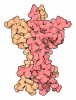
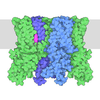

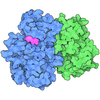

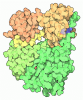
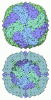
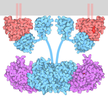
- Assembly
| Deposited unit | 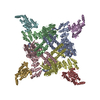
|
|---|---|
| 1 |
|
-Components
| #1: Protein | Mass: 128628.547 Da / Num. of mol.: 4 Source method: isolated from a genetically manipulated source Details: Author stated: The section (872-874) is the cloning site. The domain (875-882) is PreScission Site. The domain (883-1116) is corresponding to this sfGFP (462-695 amino acids, GenBank: ...Details: Author stated: The section (872-874) is the cloning site. The domain (875-882) is PreScission Site. The domain (883-1116) is corresponding to this sfGFP (462-695 amino acids, GenBank: ALP48449.1). The domain (1117-1144) is the expression Tag. Source: (gene. exp.) Homo sapiens (human), (gene. exp.) synthetic construct (others)Gene: TRPV4, VRL2, VROAC / Production host: Homo sapiens (human) / References: UniProt: Q9HBA0#2: Protein | Mass: 21799.158 Da / Num. of mol.: 4 Source method: isolated from a genetically manipulated source Source: (gene. exp.) Homo sapiens (human) / Gene: RHOA, ARH12, ARHA, RHO12 / Production host: Homo sapiens (human) / References: UniProt: P61586, small monomeric GTPase#3: Chemical | ChemComp-F9M / [ Mass: 572.628 Da / Num. of mol.: 4 / Source method: obtained synthetically / Formula: C25H23F3N8OS2 / Feature type: SUBJECT OF INVESTIGATION Has ligand of interest | Y | Has protein modification | N | |
|---|
-Experimental details
-Experiment
| Experiment | Method: ELECTRON MICROSCOPY |
|---|---|
| EM experiment | Aggregation state: PARTICLE / 3D reconstruction method: single particle reconstruction |
- Sample preparation
| Component | Name: Complex of TRPV4 and RhoA / Type: COMPLEX / Entity ID: #2, #1 / Source: RECOMBINANT |
|---|---|
| Molecular weight | Value: 0.4 MDa / Experimental value: NO |
| Source (natural) | Organism: Homo sapiens (human) |
| Source (recombinant) | Organism: Homo sapiens (human) |
| Buffer solution | pH: 8 |
| Specimen | Embedding applied: NO / Shadowing applied: NO / Staining applied: NO / Vitrification applied: YES |
| Vitrification | Cryogen name: ETHANE |
- Electron microscopy imaging
| Experimental equipment |  Model: Titan Krios / Image courtesy: FEI Company |
|---|---|
| Microscopy | Model: FEI TITAN KRIOS |
| Electron gun | Electron source:  FIELD EMISSION GUN / Accelerating voltage: 300 kV / Illumination mode: FLOOD BEAM FIELD EMISSION GUN / Accelerating voltage: 300 kV / Illumination mode: FLOOD BEAM |
| Electron lens | Mode: BRIGHT FIELD / Nominal defocus max: 2000 nm / Nominal defocus min: 1000 nm |
| Image recording | Electron dose: 60 e/Å2 / Film or detector model: GATAN K2 SUMMIT (4k x 4k) |
- Processing
| EM software | Name: PHENIX / Category: model refinement | ||||||||||||||||||||||||
|---|---|---|---|---|---|---|---|---|---|---|---|---|---|---|---|---|---|---|---|---|---|---|---|---|---|
| CTF correction | Type: PHASE FLIPPING AND AMPLITUDE CORRECTION | ||||||||||||||||||||||||
| 3D reconstruction | Resolution: 3.44 Å / Resolution method: FSC 0.143 CUT-OFF / Num. of particles: 47803 / Symmetry type: POINT | ||||||||||||||||||||||||
| Refine LS restraints |
|
