 ムービー
ムービー コントローラー


+ データを開く

- 基本情報
基本情報
| 登録情報 | データベース: PDB / ID: 8eza | |||||||||
|---|---|---|---|---|---|---|---|---|---|---|
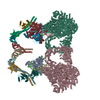
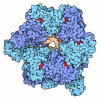
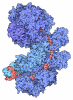
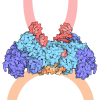
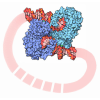
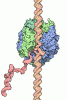
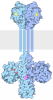
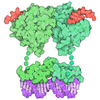
| タイトル | NHEJ Long-range complex with PAXX | |||||||||
 要素 要素 |
| |||||||||
 キーワード キーワード | DNA BINDING PROTEIN/DNA / Complex / Kinase / NHEJ / DNA BINDING PROTEIN / DNA BINDING PROTEIN-DNA complex | |||||||||
| 機能・相同性 |  機能・相同性情報 機能・相同性情報FHA domain binding / positive regulation of chromosome organization / DN2 thymocyte differentiation / positive regulation of ligase activity / DNA ligase IV complex / positive regulation of platelet formation / DNA ligase activity / DNA double-strand break attachment to nuclear envelope / Ku70:Ku80 complex / T cell receptor V(D)J recombination ...FHA domain binding / positive regulation of chromosome organization / DN2 thymocyte differentiation / positive regulation of ligase activity / DNA ligase IV complex / positive regulation of platelet formation / DNA ligase activity / DNA double-strand break attachment to nuclear envelope / Ku70:Ku80 complex / T cell receptor V(D)J recombination / DNA ligase (ATP) / negative regulation of t-circle formation / pro-B cell differentiation / DNA end binding / DNA-dependent protein kinase activity / small-subunit processome assembly / DNA ligase (ATP) activity / positive regulation of lymphocyte differentiation / histone H2AXS139 kinase activity / DNA-dependent protein kinase complex / DNA-dependent protein kinase-DNA ligase 4 complex / immunoglobulin V(D)J recombination / nonhomologous end joining complex / nucleotide-excision repair, DNA gap filling / single strand break repair / immature B cell differentiation / V(D)J recombination / regulation of smooth muscle cell proliferation / cellular response to X-ray / regulation of epithelial cell proliferation / double-strand break repair via alternative nonhomologous end joining / double-strand break repair via classical nonhomologous end joining / isotype switching / nuclear telomere cap complex / Cytosolic sensors of pathogen-associated DNA / protein localization to site of double-strand break / telomere capping / IRF3-mediated induction of type I IFN / regulation of hematopoietic stem cell differentiation / regulation of telomere maintenance / recombinational repair / protein localization to chromosome, telomeric region / U3 snoRNA binding / peptidyl-threonine phosphorylation / positive regulation of neurogenesis / maturation of 5.8S rRNA / T cell lineage commitment / cellular response to lithium ion / cellular hyperosmotic salinity response / DNA biosynthetic process / positive regulation of double-strand break repair via nonhomologous end joining / 2-LTR circle formation / negative regulation of cGAS/STING signaling pathway / B cell lineage commitment / hematopoietic stem cell proliferation / AMP binding / response to ionizing radiation / telomeric repeat DNA binding / ligase activity / negative regulation of protein phosphorylation / DNA 3'-5' helicase / T cell differentiation / somatic stem cell population maintenance / 5'-deoxyribose-5-phosphate lyase activity / chromosome organization / hematopoietic stem cell differentiation / response to X-ray / ectopic germ cell programmed cell death / ATP-dependent activity, acting on DNA / somitogenesis / telomere maintenance via telomerase / SUMOylation of DNA damage response and repair proteins / site of DNA damage / condensed chromosome / mitotic G1 DNA damage checkpoint signaling / DNA polymerase binding / activation of innate immune response / neurogenesis / positive regulation of erythrocyte differentiation / B cell differentiation / telomere maintenance / cyclin binding / stem cell proliferation / DNA-(apurinic or apyrimidinic site) lyase / protein modification process / DNA helicase activity / peptidyl-serine phosphorylation / cellular response to leukemia inhibitory factor / central nervous system development / cellular response to ionizing radiation / response to gamma radiation / positive regulation of translation / Nonhomologous End-Joining (NHEJ) / small-subunit processome / cellular response to gamma radiation / protein-DNA complex / regulation of circadian rhythm / brain development / base-excision repair / establishment of integrated proviral latency 類似検索 - 分子機能 | |||||||||
| 生物種 |  Homo sapiens (ヒト) Homo sapiens (ヒト) | |||||||||
| 手法 | 電子顕微鏡法 / 単粒子再構成法 / クライオ電子顕微鏡法 / 解像度: 4.39 Å | |||||||||
 データ登録者 データ登録者 | Chen, S. / He, Y. | |||||||||
| 資金援助 |  米国, 2件 米国, 2件
| |||||||||
 引用 引用 | ジャーナル: Sci Adv / 年: 2023 タイトル: Cryo-EM visualization of DNA-PKcs structural intermediates in NHEJ. 著者: Siyu Chen / Alex Vogt / Linda Lee / Tasmin Naila / Ryan McKeown / Alan E Tomkinson / Susan P Lees-Miller / Yuan He /  要旨: DNA double-strand breaks (DSBs), one of the most cytotoxic forms of DNA damage, can be repaired by the tightly regulated nonhomologous end joining (NHEJ) machinery (Stinson and Loparo and Zhao ). ...DNA double-strand breaks (DSBs), one of the most cytotoxic forms of DNA damage, can be repaired by the tightly regulated nonhomologous end joining (NHEJ) machinery (Stinson and Loparo and Zhao ). Core NHEJ factors form an initial long-range (LR) synaptic complex that transitions into a DNA-PKcs (DNA-dependent protein kinase, catalytic subunit)-free, short-range state to align the DSB ends (Chen ). Using single-particle cryo-electron microscopy, we have visualized three additional key NHEJ complexes representing different transition states, with DNA-PKcs adopting distinct dimeric conformations within each of them. Upon DNA-PKcs autophosphorylation, the LR complex undergoes a substantial conformational change, with both Ku and DNA-PKcs rotating outward to promote DNA break exposure and DNA-PKcs dissociation. We also captured a dimeric state of catalytically inactive DNA-PKcs, which resembles structures of other PIKK (Phosphatidylinositol 3-kinase-related kinase) family kinases, revealing a model of the full regulatory cycle of DNA-PKcs during NHEJ. | |||||||||
| 履歴 |
|
- 構造の表示
構造の表示
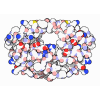
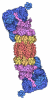
| 構造ビューア | 分子: MolmilJmol/JSmol |
|---|
- ダウンロードとリンク
-ダウンロード
| PDBx/mmCIF形式 | 8eza.cif.gz | 2.1 MB | 表示 | PDBx/mmCIF形式 |
|---|---|---|---|---|
| PDB形式 | pdb8eza.ent.gz | 1.7 MB | 表示 | PDB形式 |
| PDBx/mmJSON形式 | 8eza.json.gz | ツリー表示 | PDBx/mmJSON形式 | |
| その他 |  その他のダウンロード その他のダウンロード |
-検証レポート
| アーカイブディレクトリ | https://data.pdbj.org/pub/pdb/validation_reports/ez/8ezaftp://data.pdbj.org/pub/pdb/validation_reports/ez/8eza | HTTPS FTP |
|---|
-関連構造データ




-リンク
 PDBj
PDBj

- 集合体
集合体
| 登録構造単位 | 
|
|---|---|
| 1 |
|
-要素
-タンパク質 , 5種, 12分子 STLCHIFGOPXY
| #1: タンパク質 | 分子量: 21663.498 Da / 分子数: 2 / 由来タイプ: 組換発現 / 由来: (組換発現) Homo sapiens (ヒト) / 遺伝子: PAXX, C9orf142, XLS / 発現宿主:   Escherichia coli (大腸菌) / 参照: UniProt: Q9BUH6 Escherichia coli (大腸菌) / 参照: UniProt: Q9BUH6#4: タンパク質 | 分子量: 469673.219 Da / 分子数: 2 / 由来タイプ: 天然 / 由来: (天然) Homo sapiens (ヒト) / 細胞株: HELA / 参照: UniProt: P78527#8: タンパク質 | 分子量: 33372.234 Da / 分子数: 2 / 由来タイプ: 組換発現 / 由来: (組換発現) Homo sapiens (ヒト) / 遺伝子: NHEJ1, XLF / 発現宿主: Escherichia coli (大腸菌) / 参照: UniProt: Q9H9Q4#9: タンパク質 | 分子量: 38337.703 Da / 分子数: 4 / 由来タイプ: 組換発現 / 由来: (組換発現) Homo sapiens (ヒト) / 遺伝子: XRCC4 / 発現宿主: Escherichia coli (大腸菌) / 参照: UniProt: Q13426#10: タンパク質 | 分子量: 104124.953 Da / 分子数: 2 / 由来タイプ: 組換発現 / 由来: (組換発現) Homo sapiens (ヒト) / 遺伝子: LIG4 / 発現宿主: Escherichia coli (大腸菌) / 参照: UniProt: P49917, DNA ligase (ATP) |
|---|
-X-ray repair cross-complementing protein ... , 2種, 4分子 JAKB
| #2: タンパク質 | 分子量: 69945.039 Da / 分子数: 2 / 由来タイプ: 組換発現 / 由来: (組換発現) Homo sapiens (ヒト) / 発現宿主:  unidentified baculovirus (ウイルス) / 参照: UniProt: P12956 unidentified baculovirus (ウイルス) / 参照: UniProt: P12956#3: タンパク質 | 分子量: 82812.438 Da / 分子数: 2 / 由来タイプ: 組換発現 / 由来: (組換発現) Homo sapiens (ヒト) / 発現宿主: unidentified baculovirus (ウイルス) / 参照: UniProt: P13010 |
|---|
-DNA鎖 , 2種, 4分子 MDNE
| #6: DNA鎖 | 分子量: 9510.159 Da / 分子数: 2 / 由来タイプ: 合成 / 由来: (合成) Homo sapiens (ヒト)#7: DNA鎖 | 分子量: 9236.976 Da / 分子数: 2 / 由来タイプ: 合成 / 由来: (合成) Homo sapiens (ヒト) |
|---|
-タンパク質・ペプチド / 非ポリマー , 2種, 4分子 RQ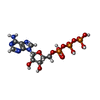
| #11: 化合物 | 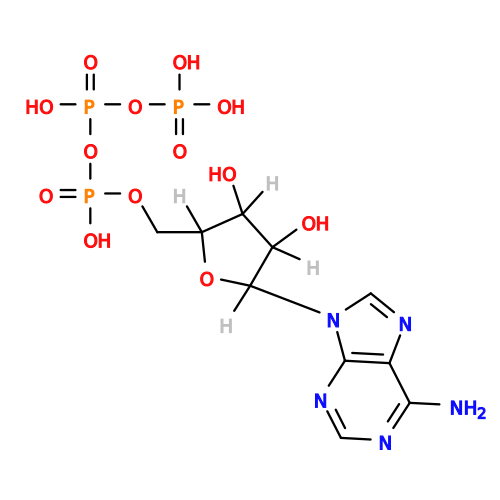 分子量: 507.181 Da / 分子数: 2 / 由来タイプ: 合成 / 式: C10H16N5O13P3 / タイプ: SUBJECT OF INVESTIGATION / コメント: ATP, エネルギー貯蔵分子*YM 分子量: 507.181 Da / 分子数: 2 / 由来タイプ: 合成 / 式: C10H16N5O13P3 / タイプ: SUBJECT OF INVESTIGATION / コメント: ATP, エネルギー貯蔵分子*YM#5: タンパク質・ペプチド | 分子量: 1720.111 Da / 分子数: 2 / 由来タイプ: 天然 / 由来: (天然) Homo sapiens (ヒト) / 細胞株: HELA / 参照: non-specific serine/threonine protein kinase |
|---|
-詳細
| 研究の焦点であるリガンドがあるか | Y |
|---|
-実験情報
-実験
| 実験 | 手法: 電子顕微鏡法 |
|---|---|
| EM実験 | 試料の集合状態: PARTICLE / 3次元再構成法: 単粒子再構成法 |
- 試料調製
試料調製
| 構成要素 | 名称: NHEJ Long-range complex with PAXX / タイプ: COMPLEX / Entity ID: #1-#7, #9-#10, #8 / 由来: MULTIPLE SOURCES |
|---|---|
| 分子量 | 値: 1.75 MDa / 実験値: NO |
| 緩衝液 | pH: 7.9 |
| 試料 | 濃度: 2 mg/ml / 包埋: NO / シャドウイング: NO / 染色: NO / 凍結: YES |
| 試料支持 | グリッドの材料: COPPER / グリッドのサイズ: 200 divisions/in. / グリッドのタイプ: Quantifoil R2/1 |
| 急速凍結 | 装置: FEI VITROBOT MARK IV / 凍結剤: ETHANE / 湿度: 100 % / 凍結前の試料温度: 302 K |
- 電子顕微鏡撮影
| 実験機器 |  モデル: Titan Krios / 画像提供: FEI Company |
|---|---|
| 顕微鏡 | モデル: FEI TITAN KRIOS |
| 電子銃 | 電子線源:  FIELD EMISSION GUN / 加速電圧: 300 kV / 照射モード: FLOOD BEAM FIELD EMISSION GUN / 加速電圧: 300 kV / 照射モード: FLOOD BEAM |
| 電子レンズ | モード: BRIGHT FIELD / 倍率(公称値): 60000 X / 倍率(補正後): 60000 X / 最大 デフォーカス(公称値): 4000 nm / 最小 デフォーカス(公称値): 2000 nm / Calibrated defocus min: 2000 nm / 最大 デフォーカス(補正後): 4000 nm / Cs: 2 mm / C2レンズ絞り径: 100 µm / アライメント法: BASIC |
| 試料ホルダ | 凍結剤: NITROGEN 試料ホルダーモデル: FEI TITAN KRIOS AUTOGRID HOLDER 最高温度: 70 K / 最低温度: 70 K |
| 撮影 | 平均露光時間: 4 sec. / 電子線照射量: 65 e/Å2 / フィルム・検出器のモデル: GATAN K3 (6k x 4k) / 撮影したグリッド数: 1 / 実像数: 11006 |
| 画像スキャン | 横: 5760 / 縦: 4092 |
- 解析
解析
| EMソフトウェア |
| ||||||||||||||||||||||||||||||||||||
|---|---|---|---|---|---|---|---|---|---|---|---|---|---|---|---|---|---|---|---|---|---|---|---|---|---|---|---|---|---|---|---|---|---|---|---|---|---|
| CTF補正 | タイプ: PHASE FLIPPING AND AMPLITUDE CORRECTION | ||||||||||||||||||||||||||||||||||||
| 粒子像の選択 | 選択した粒子像数: 1101255 | ||||||||||||||||||||||||||||||||||||
| 対称性 | 点対称性: C2 (2回回転対称) | ||||||||||||||||||||||||||||||||||||
| 3次元再構成 | 解像度: 4.39 Å / 解像度の算出法: FSC 0.143 CUT-OFF / 粒子像の数: 138252 / アルゴリズム: FOURIER SPACE / クラス平均像の数: 1 / 対称性のタイプ: POINT | ||||||||||||||||||||||||||||||||||||
| 原子モデル構築 | プロトコル: FLEXIBLE FIT / 空間: REAL / Target criteria: Cross-correlation coefficient |
