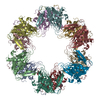
Journal: mBio / Year: 2023 Title: A Fijivirus Major Viroplasm Protein Shows RNA-Stimulated ATPase Activity by Adopting Pentameric and Hexameric Assemblies of Dimers. Authors: Gabriela Llauger / Roberto Melero / Demián Monti / Gabriela Sycz / Cristián Huck-Iriart / María L Cerutti / Sebastián Klinke / Evelyn Mikkelsen / Ariel Tijman / Rocío Arranz / Victoria ...Authors: Gabriela Llauger / Roberto Melero / Demián Monti / Gabriela Sycz / Cristián Huck-Iriart / María L Cerutti / Sebastián Klinke / Evelyn Mikkelsen / Ariel Tijman / Rocío Arranz / Victoria Alfonso / Sofía M Arellano / Fernando A Goldbaum / Yann G J Sterckx / José-María Carazo / Sergio B Kaufman / Pablo D Dans / Mariana Del Vas / Lisandro H Otero / Abstract: Fijiviruses replicate and package their genomes within viroplasms in a process involving RNA-RNA and RNA-protein interactions. Here, we demonstrate that the 24 C-terminal residues (C-arm) of the P9-1 ...Fijiviruses replicate and package their genomes within viroplasms in a process involving RNA-RNA and RNA-protein interactions. Here, we demonstrate that the 24 C-terminal residues (C-arm) of the P9-1 major viroplasm protein of the mal de Río Cuarto virus (MRCV) are required for its multimerization and the formation of viroplasm-like structures. Using an integrative structural approach, the C-arm was found to be dispensable for P9-1 dimer assembly but essential for the formation of pentamers and hexamers of dimers (decamers and dodecamers), which favored RNA binding. Although both P9-1 and P9-1ΔC-arm catalyzed ATP with similar activities, an RNA-stimulated ATPase activity was only detected in the full-length protein, indicating a C-arm-mediated interaction between the ATP catalytic site and the allosteric RNA binding sites in the (do)decameric assemblies. A stronger preference to bind phosphate moieties in the decamer was predicted, suggesting that the allosteric modulation of ATPase activity by RNA is favored in this structural conformation. Our work reveals the structural versatility of a fijivirus major viroplasm protein and provides clues to its mechanism of action. The mal de Río Cuarto virus (MRCV) causes an important maize disease in Argentina. MRCV replicates in several species of plants and planthopper vectors. The viral factories, also called viroplasms, have been studied in detail in animal reovirids. This work reveals that a major viroplasm protein of MRCV forms previously unidentified structural arrangements and provides evidence that it may simultaneously adopt two distinct quaternary assemblies. Furthermore, our work uncovers an allosteric communication between the ATP and RNA binding sites that is favored in the multimeric arrangements. Our results contribute to the understanding of plant reovirids viroplasm structure and function and pave the way for the design of antiviral strategies for disease control.
In the structure databanks used in Yorodumi, some data are registered as the other names, "COVID-19 virus" and "2019-nCoV". Here are the details of the virus and the list of structure data.
Jan 31, 2019. EMDB accession codes are about to change! (news from PDBe EMDB page)
EMDB accession codes are about to change! (news from PDBe EMDB page)
The allocation of 4 digits for EMDB accession codes will soon come to an end. Whilst these codes will remain in use, new EMDB accession codes will include an additional digit and will expand incrementally as the available range of codes is exhausted. The current 4-digit format prefixed with “EMD-” (i.e. EMD-XXXX) will advance to a 5-digit format (i.e. EMD-XXXXX), and so on. It is currently estimated that the 4-digit codes will be depleted around Spring 2019, at which point the 5-digit format will come into force.
The EM Navigator/Yorodumi systems omit the EMD- prefix.
Related info.:Q: What is EMD? / ID/Accession-code notation in Yorodumi/EM Navigator
Yorodumi is a browser for structure data from EMDB, PDB, SASBDB, etc.
This page is also the successor to EM Navigator detail page, and also detail information page/front-end page for Omokage search.
The word "yorodu" (or yorozu) is an old Japanese word meaning "ten thousand". "mi" (miru) is to see.
Related info.:EMDB / PDB / SASBDB / Comparison of 3 databanks / Yorodumi Search / Aug 31, 2016. New EM Navigator & Yorodumi / Yorodumi Papers / Jmol/JSmol / Function and homology information / Changes in new EM Navigator and Yorodumi
 Movie
Movie Controller

 Yorodumi
 Open data
 Basic information
 Components
 Keywords
 Function and homology information
 Mal de Rio Cuarto virus
 X-RAY DIFFRACTION /
  Authors
 Argentina, 4items
  Citation

 Structure visualization
 Downloads & links
 Other downloads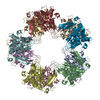






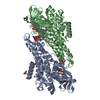
 PDBj
PDBj Assembly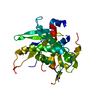
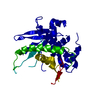

 Escherichia coli BL21 (bacteria) / Strain (production host): BL21 / References: UniProt: D9U542
 Sample preparation
 / Beamline: PROXIMA 2 / Wavelength: 0.98 Å
 Processing