 Movie
Movie Controller


+ Open data

- Basic information
| Entry | Database: PDB / ID: 6pwv | |||||||||
|---|---|---|---|---|---|---|---|---|---|---|
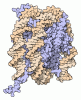
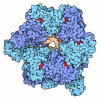
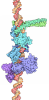
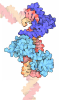
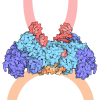
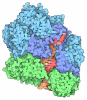
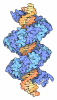
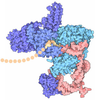
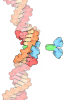
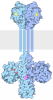
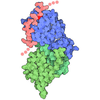
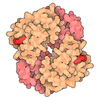
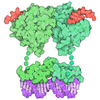
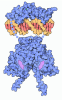
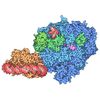
| Title | Cryo-EM structure of MLL1 core complex bound to the nucleosome | |||||||||
 Components Components |
| |||||||||
 Keywords Keywords | HISTONE BINDING/DNA BINDING/DNA / Mixed-Lineage Leukemia / MLL1 / nucleosome / histone H3 Lys4 methyltransferase / RbBP5 / WDR5 / HISTONE BINDING-DNA BINDING-DNA complex | |||||||||
| Function / homology |  Function and homology information Function and homology informationnegative regulation of DNA methylation-dependent heterochromatin formation / MLL1/2 complex / [histone H3]-lysine4 N-methyltransferase / histone H3K4 monomethyltransferase activity / protein-cysteine methyltransferase activity / response to potassium ion / histone H3K4 trimethyltransferase activity / T-helper 2 cell differentiation / unmethylated CpG binding / Phosphorylation of CLOCK, acetylation of BMAL1 (ARNTL) at target gene promoters ...negative regulation of DNA methylation-dependent heterochromatin formation / MLL1/2 complex / [histone H3]-lysine4 N-methyltransferase / histone H3K4 monomethyltransferase activity / protein-cysteine methyltransferase activity / response to potassium ion / histone H3K4 trimethyltransferase activity / T-helper 2 cell differentiation / unmethylated CpG binding / Phosphorylation of CLOCK, acetylation of BMAL1 (ARNTL) at target gene promoters / histone H3Q5ser reader activity / definitive hemopoiesis / histone H3K4me1 reader activity / Loss of Function of KMT2D in MLL4 Complex Formation in Kabuki Syndrome / Epigenetic regulation of gene expression by MLL3 and MLL4 complexes / The CRY:PER:kinase complex represses transactivation by the BMAL:CLOCK (ARNTL:CLOCK) complex / MLL3/4 complex / embryonic hemopoiesis / Set1C/COMPASS complex / ATAC complex / histone H3K4 methyltransferase activity / Cardiogenesis / Phosphorylated BMAL1:CLOCK (ARNTL:CLOCK) activates expression of core clock genes / regulation of tubulin deacetylation / endosomal transport / Formation of WDR5-containing histone-modifying complexes / hemopoiesis / minor groove of adenine-thymine-rich DNA binding / histone methyltransferase complex / Differentiation of naive CD4+ T cells to T helper 2 cells (Th2 cells) / MLL1 complex / histone acetyltransferase complex / regulation of cell division / cellular response to transforming growth factor beta stimulus / membrane depolarization / regulation of embryonic development / Transferases; Transferring one-carbon groups; Methyltransferases / transcription initiation-coupled chromatin remodeling / circadian regulation of gene expression / trans-Golgi network / RUNX1 regulates genes involved in megakaryocyte differentiation and platelet function / Deactivation of the beta-catenin transactivating complex / response to estrogen / beta-catenin binding / PKMTs methylate histone lysines / mitotic spindle / Formation of the beta-catenin:TCF transactivating complex / Activation of anterior HOX genes in hindbrain development during early embryogenesis / Transcriptional regulation of granulopoiesis / nucleosomal DNA binding / RMTs methylate histone arginines / innate immune response in mucosa / structural constituent of chromatin / nucleosome / Regulation of PD-L1(CD274) transcription / nucleosome assembly / HATs acetylate histones / MLL4 and MLL3 complexes regulate expression of PPARG target genes in adipogenesis and hepatic steatosis / RUNX1 regulates transcription of genes involved in differentiation of HSCs / chromatin organization / Neddylation / protein-containing complex assembly / antimicrobial humoral immune response mediated by antimicrobial peptide / heterochromatin formation / histone binding / antibacterial humoral response / regulation of cell cycle / transcription cis-regulatory region binding / protein heterodimerization activity / chromatin binding / positive regulation of cell population proliferation / regulation of transcription by RNA polymerase II / DNA damage response / nucleolus / regulation of DNA-templated transcription / positive regulation of DNA-templated transcription / negative regulation of transcription by RNA polymerase II / Golgi apparatus / : / positive regulation of transcription by RNA polymerase II / protein homodimerization activity / DNA binding / zinc ion binding / nucleoplasm / identical protein binding / nucleus / plasma membrane / cytosol Similarity search - Function | |||||||||
| Biological species |  Homo sapiens (human) Homo sapiens (human) Xenopus laevis (African clawed frog) Xenopus laevis (African clawed frog)synthetic construct (others) | |||||||||
| Method | ELECTRON MICROSCOPY / single particle reconstruction / cryo EM / Resolution: 6.2 Å | |||||||||
 Authors Authors | Park, S.H. / Ayoub, A. / Lee, Y.T. / Xu, J. / Zhang, W. / Zhang, B. / Zhang, Y. / Cianfrocco, M.A. / Su, M. / Dou, Y. / Cho, U. | |||||||||
| Funding support |  United States, United States,  Korea, Republic Of, 2items Korea, Republic Of, 2items
| |||||||||
 Citation Citation | Journal: Nat Commun / Year: 2019 Title: Cryo-EM structure of the human MLL1 core complex bound to the nucleosome. Authors: Sang Ho Park / Alex Ayoub / Young-Tae Lee / Jing Xu / Hanseong Kim / Wei Zheng / Biao Zhang / Liang Sha / Sojin An / Yang Zhang / Michael A Cianfrocco / Min Su / Yali Dou / Uhn-Soo Cho / Abstract: Mixed lineage leukemia (MLL) family histone methyltransferases are enzymes that deposit histone H3 Lys4 (K4) mono-/di-/tri-methylation and regulate gene expression in mammals. Despite extensive ...Mixed lineage leukemia (MLL) family histone methyltransferases are enzymes that deposit histone H3 Lys4 (K4) mono-/di-/tri-methylation and regulate gene expression in mammals. Despite extensive structural and biochemical studies, the molecular mechanisms whereby the MLL complexes recognize histone H3K4 within nucleosome core particles (NCPs) remain unclear. Here we report the single-particle cryo-electron microscopy (cryo-EM) structure of the NCP-bound human MLL1 core complex. We show that the MLL1 core complex anchors to the NCP via the conserved RbBP5 and ASH2L, which interact extensively with nucleosomal DNA and the surface close to the N-terminal tail of histone H4. Concurrent interactions of RbBP5 and ASH2L with the NCP uniquely align the catalytic MLL1 domain at the nucleosome dyad, thereby facilitating symmetrical access to both H3K4 substrates within the NCP. Our study sheds light on how the MLL1 complex engages chromatin and how chromatin binding promotes MLL1 tri-methylation activity. | |||||||||
| History |
|
- Structure visualization
| Movie |
Movie viewer |
|---|---|
| Structure viewer | Molecule: MolmilJmol/JSmol |
- Downloads & links
-Download
| PDBx/mmCIF format | 6pwv.cif.gz | 649 KB | Display | PDBx/mmCIF format |
|---|---|---|---|---|
| PDB format | pdb6pwv.ent.gz | Display | PDB format | |
| PDBx/mmJSON format | 6pwv.json.gz | Tree view | PDBx/mmJSON format | |
| Others |  Other downloads Other downloads |
-Validation report
| Arichive directory | https://data.pdbj.org/pub/pdb/validation_reports/pw/6pwvftp://data.pdbj.org/pub/pdb/validation_reports/pw/6pwv | HTTPS FTP |
|---|
-Related structure data
| Related structure data | 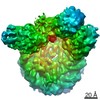 20512MC  6pwwC 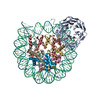 6pwxC M: map data used to model this data C: citing same article ( |
|---|---|
| Similar structure data |

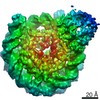
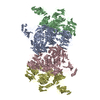


-Links
 PDBj
PDBj

- Assembly
| Deposited unit | 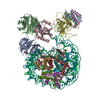
|
|---|---|
| 1 |
|
-Components
-Protein , 9 types, 14 molecules ABCGKHLIMJNEFD
| #1: Protein | Mass: 59179.359 Da / Num. of mol.: 1 Source method: isolated from a genetically manipulated source Source: (gene. exp.) Homo sapiens (human) / Gene: RBBP5, RBQ3 / Production host:   Escherichia coli (E. coli) / References: UniProt: Q15291 Escherichia coli (E. coli) / References: UniProt: Q15291 | ||||||||||
|---|---|---|---|---|---|---|---|---|---|---|---|
| #2: Protein | Mass: 34390.992 Da / Num. of mol.: 1 Source method: isolated from a genetically manipulated source Source: (gene. exp.) Homo sapiens (human) / Gene: WDR5, BIG3 / Production host: Escherichia coli (E. coli) / References: UniProt: P61964 | ||||||||||
| #3: Protein | Mass: 24141.732 Da / Num. of mol.: 1 Source method: isolated from a genetically manipulated source Source: (gene. exp.) Homo sapiens (human) / Gene: KMT2A, ALL1, CXXC7, HRX, HTRX, MLL, MLL1, TRX1 / Production host: Escherichia coli (E. coli)References: UniProt: Q03164, histone-lysine N-methyltransferase | ||||||||||
| #4: Protein | Mass: 15435.126 Da / Num. of mol.: 2 Source method: isolated from a genetically manipulated source Source: (gene. exp.) Xenopus laevis (African clawed frog) / Production host: Escherichia coli (E. coli) / References: UniProt: P84233#5: Protein | Mass: 11394.426 Da / Num. of mol.: 2 Source method: isolated from a genetically manipulated source Source: (gene. exp.) Xenopus laevis (African clawed frog) / Production host: Escherichia coli (E. coli) / References: UniProt: P62799#6: Protein | Mass: 13978.241 Da / Num. of mol.: 2 Source method: isolated from a genetically manipulated source Source: (gene. exp.) Xenopus laevis (African clawed frog) / Production host: Escherichia coli (E. coli) / References: UniProt: P06897#7: Protein | Mass: 13524.752 Da / Num. of mol.: 2 Source method: isolated from a genetically manipulated source Source: (gene. exp.) Xenopus laevis (African clawed frog) / Production host: Escherichia coli (E. coli) / References: UniProt: P02281#10: Protein | Mass: 11492.876 Da / Num. of mol.: 2 Source method: isolated from a genetically manipulated source Source: (gene. exp.) Homo sapiens (human) / Gene: DPY30 / Production host: Escherichia coli (E. coli) / References: UniProt: Q9C005#11: Protein | | Mass: 60244.641 Da / Num. of mol.: 1 Source method: isolated from a genetically manipulated source Source: (gene. exp.) Homo sapiens (human) / Gene: ASH2L, ASH2L1 / Production host: Escherichia coli (E. coli) / References: UniProt: Q9UBL3 |
-DNA chain , 2 types, 2 molecules OP
| #8: DNA chain | Mass: 45138.770 Da / Num. of mol.: 1 / Source method: obtained synthetically / Source: (synth.) synthetic construct (others) |
|---|---|
| #9: DNA chain | Mass: 45610.043 Da / Num. of mol.: 1 / Source method: obtained synthetically / Source: (synth.) synthetic construct (others) |
-Non-polymers , 2 types, 4 molecules 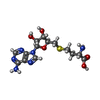

| #12: Chemical | 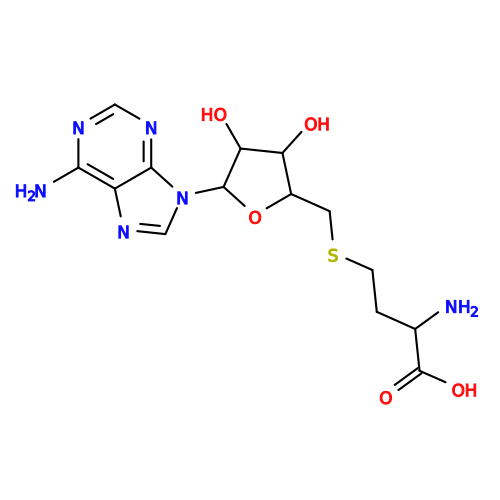 Type: L-peptide linking / Mass: 384.411 Da / Num. of mol.: 2 / Source method: obtained synthetically / Formula: C14H20N6O5S / Feature type: SUBJECT OF INVESTIGATION Type: L-peptide linking / Mass: 384.411 Da / Num. of mol.: 2 / Source method: obtained synthetically / Formula: C14H20N6O5S / Feature type: SUBJECT OF INVESTIGATION#13: Chemical |  Mass: 65.409 Da / Num. of mol.: 2 / Source method: obtained synthetically / Formula: Zn / Feature type: SUBJECT OF INVESTIGATION Mass: 65.409 Da / Num. of mol.: 2 / Source method: obtained synthetically / Formula: Zn / Feature type: SUBJECT OF INVESTIGATION |
|---|
-Details
| Has ligand of interest | Y |
|---|
-Experimental details
-Experiment
| Experiment | Method: ELECTRON MICROSCOPY |
|---|---|
| EM experiment | Aggregation state: PARTICLE / 3D reconstruction method: single particle reconstruction |
- Sample preparation
| Component | Name: Human MLL1 complex bound to the nucleosome / Type: COMPLEX / Entity ID: #1-#11 / Source: MULTIPLE SOURCES |
|---|---|
| Source (natural) | Organism: Xenopus laevis (African clawed frog) |
| Source (recombinant) | Organism: Escherichia coli (E. coli) |
| Buffer solution | pH: 7.5 |
| Specimen | Embedding applied: NO / Shadowing applied: NO / Staining applied: NO / Vitrification applied: YES |
| Specimen support | Details: unspecified |
| Vitrification | Cryogen name: ETHANE / Humidity: 100 % / Chamber temperature: 277.15 K |
- Electron microscopy imaging
| Experimental equipment |  Model: Titan Krios / Image courtesy: FEI Company |
|---|---|
| Microscopy | Model: FEI TITAN KRIOS |
| Electron gun | Electron source:  FIELD EMISSION GUN / Accelerating voltage: 300 kV / Illumination mode: OTHER FIELD EMISSION GUN / Accelerating voltage: 300 kV / Illumination mode: OTHER |
| Electron lens | Mode: BRIGHT FIELD |
| Image recording | Electron dose: 64 e/Å2 / Film or detector model: GATAN K2 SUMMIT (4k x 4k) |
- Processing
| CTF correction | Type: PHASE FLIPPING ONLY |
|---|---|
| Symmetry | Point symmetry: C1 (asymmetric) |
| 3D reconstruction | Resolution: 6.2 Å / Resolution method: FSC 0.143 CUT-OFF / Num. of particles: 8433 / Symmetry type: POINT |
