Protein VP3, rotavirus / Rotavirus VP3 protein / Viral protein 3 containing mRNA (guanine-N(7)-)-methyltransferase family profile. Similarity search - Domain/homology
Data content type: EM metadata / Data content type: EM metadata / Group: Experimental summary / Data content type: EM metadata / Category: em_admin / Data content type: EM metadata / Item: _em_admin.last_update
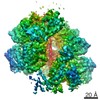
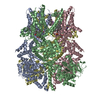
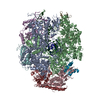
Evidence: gel filtration, Gel filtration profile indicates a tetrameric assembly in solution, equilibrium centrifugation, Analytical Ultracentrifugation confirms tetrameric state is preferred ...Evidence: gel filtration, Gel filtration profile indicates a tetrameric assembly in solution, equilibrium centrifugation, Analytical Ultracentrifugation confirms tetrameric state is preferred oligomeric assembly in solution
Type
Name
Symmetry operation
Number
identity operation
1_555
1
Buried area
19750 Å2
ΔGint
-95 kcal/mol
Surface area
134020 Å2
-
Components
#1: Protein
ProteinVP3
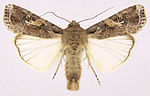
Mass: 97703.820 Da / Num. of mol.: 4 Source method: isolated from a genetically manipulated source Source: (gene. exp.) Rotavirus A / Gene: VP3 / Production host: Spodoptera frugiperda (fall armyworm) References: UniProt: Q1WK45, Hydrolases; Acting on ester bonds; Phosphoric-diester hydrolases, mRNA guanylyltransferase, mRNA (guanine-N7)-methyltransferase
Instrument: FEI VITROBOT MARK IV / Cryogen name: ETHANE / Humidity: 95 % / Chamber temperature: 295 K
-
Electron microscopy imaging
Microscopy
Model: JEOL 3200FSC
Electron gun
Electron source: FIELD EMISSION GUN / Accelerating voltage: 300 kV / Illumination mode: FLOOD BEAM
Electron lens
Mode: BRIGHT FIELD / Nominal magnification: 40000 X / Nominal defocus max: 2000 nm / Nominal defocus min: 1000 nm / Cs: 4.7 mm / C2 aperture diameter: 100 µm
Image recording
Average exposure time: 10 sec. / Electron dose: 50 e/Å2 / Detector mode: SUPER-RESOLUTION / Film or detector model: GATAN K2 SUMMIT (4k x 4k) / Num. of grids imaged: 1
Image scans
Width: 7420 / Height: 7676 / Movie frames/image: 50
In the structure databanks used in Yorodumi, some data are registered as the other names, "COVID-19 virus" and "2019-nCoV". Here are the details of the virus and the list of structure data.
Jan 31, 2019. EMDB accession codes are about to change! (news from PDBe EMDB page)
EMDB accession codes are about to change! (news from PDBe EMDB page)
The allocation of 4 digits for EMDB accession codes will soon come to an end. Whilst these codes will remain in use, new EMDB accession codes will include an additional digit and will expand incrementally as the available range of codes is exhausted. The current 4-digit format prefixed with “EMD-” (i.e. EMD-XXXX) will advance to a 5-digit format (i.e. EMD-XXXXX), and so on. It is currently estimated that the 4-digit codes will be depleted around Spring 2019, at which point the 5-digit format will come into force.
The EM Navigator/Yorodumi systems omit the EMD- prefix.
Related info.:Q: What is EMD? / ID/Accession-code notation in Yorodumi/EM Navigator
Yorodumi is a browser for structure data from EMDB, PDB, SASBDB, etc.
This page is also the successor to EM Navigator detail page, and also detail information page/front-end page for Omokage search.
The word "yorodu" (or yorozu) is an old Japanese word meaning "ten thousand". "mi" (miru) is to see.
Related info.:EMDB / PDB / SASBDB / Comparison of 3 databanks / Yorodumi Search / Aug 31, 2016. New EM Navigator & Yorodumi / Yorodumi Papers / Jmol/JSmol / Function and homology information / Changes in new EM Navigator and Yorodumi
 Movie
Movie Controller


 Open data
 Basic information
 Components
 Keywords
 Function and homology information
 Rotavirus A
 Authors
 United States, 3items
  Citation
 Structure visualization
 Downloads & links
 Other downloads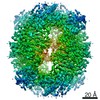
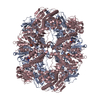
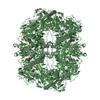

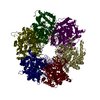

 PDBj
PDBj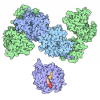
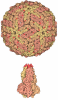
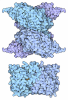
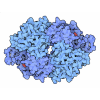
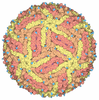
 Assembly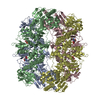

 Spodoptera frugiperda (fall armyworm)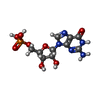
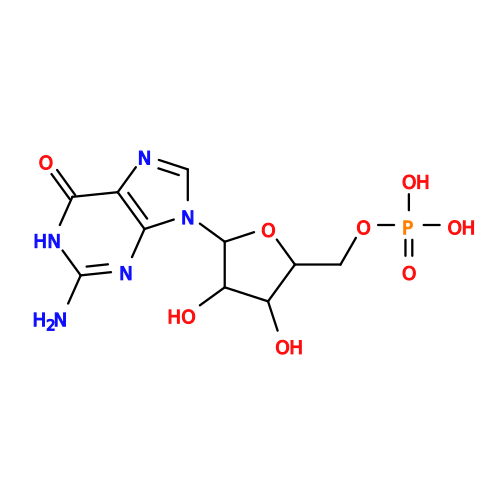 Mass: 363.221 Da / Num. of mol.: 4 / Source method: obtained synthetically / Formula: C10H14N5O8P
 Sample preparation
 Electron microscopy imaging
 FIELD EMISSION GUN / Accelerating voltage: 300 kV / Illumination mode: FLOOD BEAM
 Processing