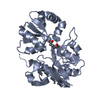
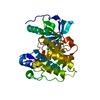
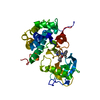
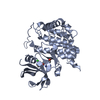
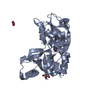
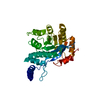
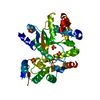
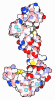
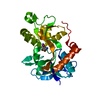
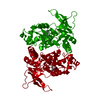
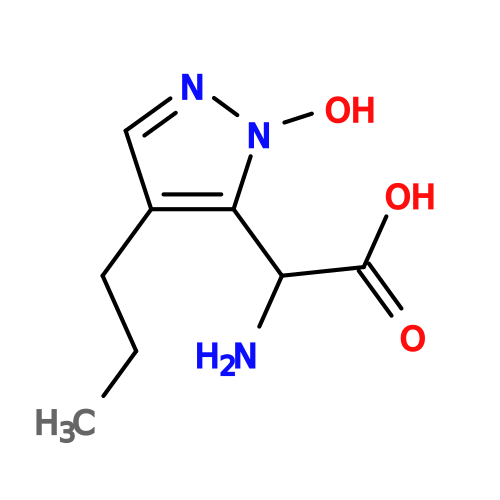
- PDB-4jwx: GluN2A ligand-binding core in complex with propyl-NHP5G -
+
Open data
ID or keywords:
Loading...
-
Basic information
Entry
Database: PDB / ID: 4jwx
Title
GluN2A ligand-binding core in complex with propyl-NHP5G
Components
GluN2A
Keywords
UNKNOWN FUNCTION / bilobed structure
Function / homology
Function and homology information
regulation of response to alcohol / response to ammonium ion / neurotransmitter receptor transport, plasma membrane to endosome / receptor recycling / response to environmental enrichment / directional locomotion / Assembly and cell surface presentation of NMDA receptors / response to hydrogen sulfide / auditory behavior / response to other organism ...regulation of response to alcohol / response to ammonium ion / neurotransmitter receptor transport, plasma membrane to endosome / receptor recycling / response to environmental enrichment / directional locomotion / Assembly and cell surface presentation of NMDA receptors / response to hydrogen sulfide / auditory behavior / response to other organism / cellular response to magnesium ion / response to methylmercury / protein localization to postsynaptic membrane / serotonin metabolic process / regulation of ARF protein signal transduction / response to manganese ion / response to carbohydrate / positive regulation of inhibitory postsynaptic potential / sleep / cellular response to dsRNA / regulation of NMDA receptor activity / cellular response to lipid / locomotion / dendritic spine organization / response to amine / Synaptic adhesion-like molecules / regulation of monoatomic cation transmembrane transport / NMDA glutamate receptor activity / response to glycoside / NMDA selective glutamate receptor complex / voltage-gated monoatomic cation channel activity / glutamate binding / glutamate receptor signaling pathway / calcium ion transmembrane import into cytosol / spinal cord development / startle response / cellular response to zinc ion / dopamine metabolic process / parallel fiber to Purkinje cell synapse / response to lithium ion / monoatomic cation transmembrane transport / cellular response to glycine / regulation of postsynaptic membrane potential / response to light stimulus / action potential / modulation of excitatory postsynaptic potential / conditioned place preference / regulation of neuronal synaptic plasticity / positive regulation of protein targeting to membrane / Unblocking of NMDA receptors, glutamate binding and activation / glutamate receptor binding / neuron development / multicellular organismal response to stress / positive regulation of synaptic transmission, glutamatergic / postsynaptic density, intracellular component / response to fungicide / monoatomic cation channel activity / glutamate-gated receptor activity / cellular response to manganese ion / glutamate-gated calcium ion channel activity / neurogenesis / cell adhesion molecule binding / dendrite membrane / sensory perception of pain / ionotropic glutamate receptor signaling pathway / ligand-gated monoatomic ion channel activity involved in regulation of presynaptic membrane potential / protein tyrosine kinase binding / cytoplasmic vesicle membrane / synaptic membrane / sodium ion transmembrane transport / positive regulation of excitatory postsynaptic potential / response to amphetamine / learning / response to nicotine / response to cocaine / hippocampus development / protein catabolic process / synaptic transmission, glutamatergic / excitatory postsynaptic potential / regulation of membrane potential / cellular response to amino acid stimulus / transmitter-gated monoatomic ion channel activity involved in regulation of postsynaptic membrane potential / response to calcium ion / negative regulation of protein catabolic process / regulation of long-term neuronal synaptic plasticity / regulation of synaptic plasticity / cerebral cortex development / visual learning / postsynaptic density membrane / modulation of chemical synaptic transmission / response to wounding / response to lead ion / cellular response to growth factor stimulus / calcium ion transmembrane transport / memory / calcium channel activity / terminal bouton / calcium-dependent protein binding / synaptic vesicle / calcium ion transport Similarity search - Function
Glutamate [NMDA] receptor, epsilon subunit, C-terminal / N-methyl D-aspartate receptor 2B3 C-terminus / Ionotropic glutamate receptor, metazoa / Ligated ion channel L-glutamate- and glycine-binding site / Ionotropic glutamate receptor, L-glutamate and glycine-binding domain / Ligated ion channel L-glutamate- and glycine-binding site / Ligand-gated ion channel / : / Ionotropic glutamate receptor / Eukaryotic homologues of bacterial periplasmic substrate binding proteins. ...Glutamate [NMDA] receptor, epsilon subunit, C-terminal / N-methyl D-aspartate receptor 2B3 C-terminus / Ionotropic glutamate receptor, metazoa / Ligated ion channel L-glutamate- and glycine-binding site / Ionotropic glutamate receptor, L-glutamate and glycine-binding domain / Ligated ion channel L-glutamate- and glycine-binding site / Ligand-gated ion channel / : / Ionotropic glutamate receptor / Eukaryotic homologues of bacterial periplasmic substrate binding proteins. / Periplasmic binding protein-like II / Receptor, ligand binding region / Receptor family ligand binding region / D-Maltodextrin-Binding Protein; domain 2 / Periplasmic binding protein-like I / 3-Layer(aba) Sandwich / Alpha Beta Similarity search - Domain/homology
In the structure databanks used in Yorodumi, some data are registered as the other names, "COVID-19 virus" and "2019-nCoV". Here are the details of the virus and the list of structure data.
Jan 31, 2019. EMDB accession codes are about to change! (news from PDBe EMDB page)
EMDB accession codes are about to change! (news from PDBe EMDB page)
The allocation of 4 digits for EMDB accession codes will soon come to an end. Whilst these codes will remain in use, new EMDB accession codes will include an additional digit and will expand incrementally as the available range of codes is exhausted. The current 4-digit format prefixed with “EMD-” (i.e. EMD-XXXX) will advance to a 5-digit format (i.e. EMD-XXXXX), and so on. It is currently estimated that the 4-digit codes will be depleted around Spring 2019, at which point the 5-digit format will come into force.
The EM Navigator/Yorodumi systems omit the EMD- prefix.
Related info.:Q: What is EMD? / ID/Accession-code notation in Yorodumi/EM Navigator
Yorodumi is a browser for structure data from EMDB, PDB, SASBDB, etc.
This page is also the successor to EM Navigator detail page, and also detail information page/front-end page for Omokage search.
The word "yorodu" (or yorozu) is an old Japanese word meaning "ten thousand". "mi" (miru) is to see.
Related info.:EMDB / PDB / SASBDB / Comparison of 3 databanks / Yorodumi Search / Aug 31, 2016. New EM Navigator & Yorodumi / Yorodumi Papers / Jmol/JSmol / Function and homology information / Changes in new EM Navigator and Yorodumi