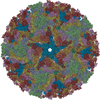
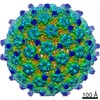
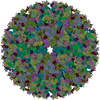
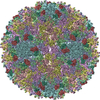
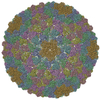
- PDB-3j6r: Electron cryo-microscopy of Human Papillomavirus Type 16 capsid -
+
データを開く
IDまたはキーワード:
読み込み中...
-
基本情報
登録情報
データベース: PDB / ID: 3j6r
タイトル
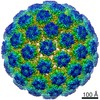
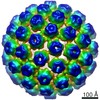
Electron cryo-microscopy of Human Papillomavirus Type 16 capsid
要素
Major capsid protein L1
キーワード
VIRUS / capsid protein
機能・相同性
機能・相同性情報
T=7 icosahedral viral capsid / endocytosis involved in viral entry into host cell / virion attachment to host cell / host cell nucleus / structural molecule activity 類似検索 - 分子機能
Major capsid L1 (late) protein, Papillomavirus / Major capsid L1 (late) superfamily, Papillomavirus / L1 (late) protein / Double-stranded DNA virus, group I, capsid 類似検索 - ドメイン・相同性
Major capsid protein L1 / Major capsid protein L1 類似検索 - 構成要素
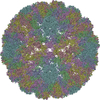
ジャーナル: mBio / 年: 2014 タイトル: Maturation of the human papillomavirus 16 capsid. 著者: Giovanni Cardone / Adam L Moyer / Naiqian Cheng / Cynthia D Thompson / Israel Dvoretzky / Douglas R Lowy / John T Schiller / Alasdair C Steven / Christopher B Buck / Benes L Trus / 要旨: Papillomaviruses are a family of nonenveloped DNA viruses that infect the skin or mucosa of their vertebrate hosts. The viral life cycle is closely tied to the differentiation of infected ...Papillomaviruses are a family of nonenveloped DNA viruses that infect the skin or mucosa of their vertebrate hosts. The viral life cycle is closely tied to the differentiation of infected keratinocytes. Papillomavirus virions are released into the environment through a process known as desquamation, in which keratinocytes lose structural integrity prior to being shed from the surface of the skin. During this process, virions are exposed to an increasingly oxidative environment, leading to their stabilization through the formation of disulfide cross-links between neighboring molecules of the major capsid protein, L1. We used time-lapse cryo-electron microscopy and image analysis to study the maturation of HPV16 capsids assembled in mammalian cells and exposed to an oxidizing environment after cell lysis. Initially, the virion is a loosely connected procapsid that, under in vitro conditions, condenses over several hours into the more familiar 60-nm-diameter papillomavirus capsid. In this process, the procapsid shrinks by ~5% in diameter, its pentameric capsomers change in structure (most markedly in the axial region), and the interaction surfaces between adjacent capsomers are consolidated. A C175S mutant that cannot achieve normal inter-L1 disulfide cross-links shows maturation-related shrinkage but does not achieve the fully condensed 60-nm form. Pseudoatomic modeling based on a 9-Å resolution reconstruction of fully mature capsids revealed C-terminal disulfide-stabilized "suspended bridges" that form intercapsomeric cross-links. The data suggest a model in which procapsids exist in a range of dynamic intermediates that can be locked into increasingly mature configurations by disulfide cross-linking, possibly through a Brownian ratchet mechanism. Importance: Human papillomaviruses (HPVs) cause nearly all cases of cervical cancer, a major fraction of cancers of the penis, vagina/vulva, anus, and tonsils, and genital and nongenital warts. HPV types associated with a high risk of cancer, such as HPV16, are generally transmitted via sexual contact. The nonenveloped virion of HPVs shows a high degree of stability, allowing the virus to persist in an infectious form in environmental fomites. In this study, we used cryo-electron microscopy to elucidate the structure of the HPV16 capsid at different stages of maturation. The fully mature capsid adopts a rigid, highly regular structure stabilized by intermolecular disulfide bonds. The availability of a pseudoatomic model of the fully mature HPV16 virion should help guide understanding of antibody responses elicited by HPV capsid-based vaccines.
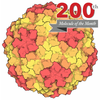
#200 - 2016年8月 正二十面体型ウイルスの準対称性 (Quasisymmetry in Icosahedral Viruses) 類似性 (2)
-
集合体
登録構造単位
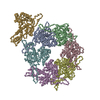
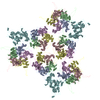
B: Major capsid protein L1 A: Major capsid protein L1 E: Major capsid protein L1 D: Major capsid protein L1 C: Major capsid protein L1 F: Major capsid protein L1
B: Major capsid protein L1 A: Major capsid protein L1 E: Major capsid protein L1 D: Major capsid protein L1 C: Major capsid protein L1 F: Major capsid protein L1
B: Major capsid protein L1 A: Major capsid protein L1 E: Major capsid protein L1 D: Major capsid protein L1 C: Major capsid protein L1 F: Major capsid protein L1
x 5
icosahedral pentamer
1.6 MDa, 30 ポリマー
分子量 (理論値)
分子数
合計 (水以外)
1,603,369
30
ポリマ-
1,603,369
30
非ポリマー
0
0
水
0
タイプ
名称
対称操作
数
identity operation
1_555
x,y,z
1
point symmetry operation
4
4
B: Major capsid protein L1 A: Major capsid protein L1 E: Major capsid protein L1 D: Major capsid protein L1 C: Major capsid protein L1 F: Major capsid protein L1
x 6
icosahedral 23 hexamer
1.92 MDa, 36 ポリマー
分子量 (理論値)
分子数
合計 (水以外)
1,924,042
36
ポリマ-
1,924,042
36
非ポリマー
0
0
水
0
タイプ
名称
対称操作
数
identity operation
1_555
x,y,z
1
point symmetry operation
5
5
登録構造と同一(異なる座標系)
icosahedral asymmetric unit, std point frame
タイプ
名称
対称操作
数
transform to point frame
1
対称性
点対称性: (シェーンフリース記号: I (正20面体型対称))
-
要素
#1: タンパク質
MajorcapsidproteinL1 / L1 protein
分子量: 53445.617 Da / 分子数: 6 / 断片: UNP residues 35-512 / 由来タイプ: 天然 由来: (天然) Human papillomavirus type 16 (パピローマウイルス) 参照: UniProt: Q4VRM0, UniProt: P03101*PLUS
-
実験情報
-
実験
実験
手法: 電子顕微鏡法
EM実験
試料の集合状態: PARTICLE / 3次元再構成法: 単粒子再構成法
-
試料調製
構成要素
名称: Human Papilloma Virus type 16 capsid / タイプ: VIRUS
ウイルスについての詳細
中空か: NO / エンベロープを持つか: NO / ホストのカテゴリ: VERTEBRATES / 単離: SEROTYPE / タイプ: VIRION
プロトコル: SINGLE WAVELENGTH / 単色(M)・ラウエ(L): M / 散乱光タイプ: x-ray
放射波長
相対比: 1
-
解析
EMソフトウェア
ID
名称
カテゴリ
1
MDFF
モデルフィッティング
2
NAMD
モデルフィッティング
3
PyMOL
モデルフィッティング
4
UCSF Chimera
モデルフィッティング
5
VMD
モデルフィッティング
6
Auto3DEM
3次元再構成
7
Bsoft
3次元再構成
CTF補正
詳細: each micrograph
対称性
点対称性: I (正20面体型対称)
3次元再構成
手法: projection-matching, direct Fourier inversion / 解像度: 9.1 Å / 解像度の算出法: FSC 0.33 CUT-OFF / 粒子像の数: 5952 / ピクセルサイズ(公称値): 1.41 Å / ピクセルサイズ(実測値): 1.41 Å / 詳細: (Single particle--Applied symmetry: I) / 対称性のタイプ: POINT
原子モデル構築
プロトコル: FLEXIBLE FIT / 空間: REAL 詳細: REFINEMENT PROTOCOL--flexible DETAILS--Rigid fitting of domain copies in asymmetric unit, followed by molecular dynamics-based flexible fitting, adding symmetry as constraint
 ムービー
ムービー コントローラー


 データを開く
 基本情報
基本情報 要素
要素 キーワード
キーワード 機能・相同性情報
 Human papillomavirus type 16 (パピローマウイルス)
 データ登録者
 引用
引用
 構造の表示
構造の表示 ダウンロードとリンク
 その他のダウンロード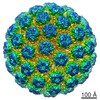
 PDBj
PDBj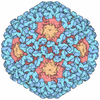
 集合体
集合体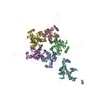


 試料調製
試料調製 電子顕微鏡撮影
 FIELD EMISSION GUN / 加速電圧: 120 kV / 照射モード: FLOOD BEAM
 解析
解析
